What to write in a thinking of you card: kind words that fit
If you are wondering what to write in a thinking of you card, use a simple shape: say you are thinking of them, name why or what made you think of them, add one warm and specific line, make a real offer or tell them there is no need to reply, and sign off. Four or five sentences are enough. This guide gives you that shape, short lines for a hard time, a faraway friend, someone lonely, a new parent, a breakup or a job loss, and a card sent just because, plus a worked example and the lines worth skipping.
A thinking of you card says one thing above all: you are on my mind, and you do not have to do anything about it. It does not need to fix anything. It needs to be about them.
Why a small card can mean a lot
A thinking of you card has no occasion. Nobody is expecting it. That is what gives it weight. A birthday card can be sent out of habit, but this one only exists because you chose to write it.
It also asks very little of the reader. A phone call needs an answer. A message can feel like it is waiting for a reply. A card can sit on a shelf and be read again on a bad day. The shape below keeps it light, so it gives comfort without adding a task.
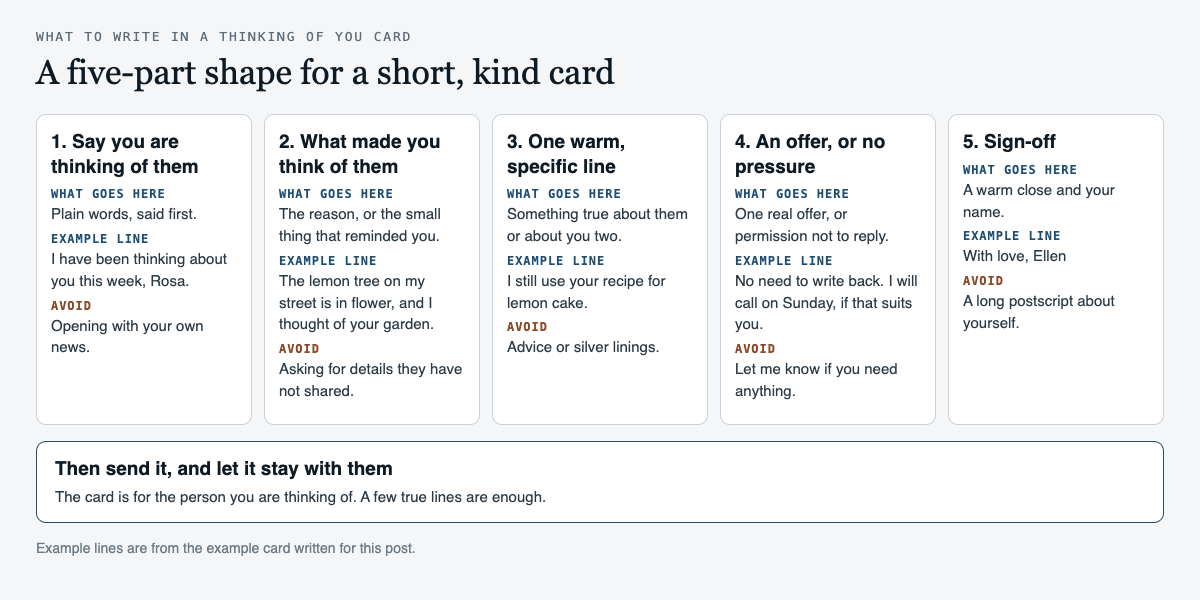
What to write in a thinking of you card: a five-part shape
- Say you are thinking of them. Start with the plain words. "I have been thinking about you this week" is enough of an opening.
- Name why, or what made you think of them. If they are going through something, say so gently. If not, name the small thing that reminded you: a song, a smell, a place you used to go.
- One warm, specific line. Something true about them, or about the two of you. "I still use your recipe for lemon cake" says more than "You are so special."
- An offer, or a no-pressure line. One real offer you will keep, or permission not to reply. Sometimes both.
- Sign-off. A warm close and your name.
If you do not know what they are going through, skip the "why" and keep to what reminded you. Parts one, three and five still make a good card on their own.
Thinking of you messages by situation
These messages were written for this post. Change the names and details, and keep only what is true for you and the person you are writing to.
- Someone going through a hard time. "I have been thinking about you, Jen. I know these weeks have been heavy. You have always been the one who checks on everyone else, so this is me checking on you. No need to reply. I will drop off soup on Thursday."
- A long-distance friend. "Thinking of you today, Kai. I walked past our old noodle place and it still has the same broken sign. I miss our Friday dinners. Call me when it is morning for you and night for me?"
- Someone lonely or older. "I was thinking of you, Mr Hale. The roses you planted by the gate are out again, and everyone on the street stops to look. I would love to visit next Saturday and hear how you are, if that suits you."
- A new parent. "Thinking of you and little Noor, Sam. I remember how long those first nights felt. You do not need to write back or tidy up. I will leave a meal on the step on Tuesday and wave through the window."
- A friend after a breakup. "I have been thinking about you, Ali. You are funny, kind and far braver than you feel right now. No pressure to talk about it. Movie night at mine whenever you want company."
- A friend after a job loss. "Thinking of you this week, Grace. That job was lucky to have you for six years, and the next one will be too. If you want someone to read your cover letters, I am here."
- Just because. "No reason for this card, Beth. I heard our song on the radio and smiled for the whole drive. Thank you for being my friend."
If the person is ill or recovering, a get well card may fit better. The published post on what to write in a get well card has messages for that. If they have lost someone, see the post on what to write in a sympathy card.
A worked example, step by step
Here is one card built from scratch, one part at a time. The situation was written for this post: Ellen is writing to Rosa, her former neighbour, who moved across the country last year to be nearer her daughter. Rosa lives alone now and does not know many people in her new town.
Step 1: say you are thinking of them. Ellen keeps it plain: "I have been thinking about you this week, Rosa."
Step 2: what made you think of them. The lemon tree on their old street has just come into flower. Ellen writes: "The lemon tree on my street is in flower, and I thought of your garden."
Step 3: one warm, specific line. Rosa once taught her to bake: "I still use your recipe for lemon cake, and it is still the best thing I make."
Step 4: an offer, or no pressure. Ellen knows Rosa feels she must answer every letter, so she takes that away and adds one real plan: "No need to write back. I will call on Sunday, if that suits you."
Step 5: sign-off. "With love, Ellen"
Read together, the card says:
I have been thinking about you this week, Rosa. The lemon tree on my street is in flower, and I thought of your garden. I still use your recipe for lemon cake, and it is still the best thing I make. No need to write back. I will call on Sunday, if that suits you. With love, Ellen
It tells Rosa that she is remembered where she used to live, that something she gave is still in use, and that a voice will reach her on Sunday without her having to ask. Try the same five steps for your own card.
What to skip
- Advice and silver linings. "Everything happens for a reason" or "At least you have your health" can read as if their pain needs correcting. Keep to being with them.
- Asking for details. "What exactly happened?" puts them on the spot. Let them share what they choose, when they choose.
- Making it about you. One line about your own week is fine. A paragraph about your own similar trouble turns the card around.
- Vague offers. "Let me know if you need anything" leaves them to do the asking. A named offer, like soup on Thursday, is easier to accept.
- Guilt about silence. "Sorry I have been so bad at keeping in touch" can make them feel they must reassure you. Just write the card.
A second letter, to the AI
The thinking of you card belongs to the person you send it to. It is personal, and it should stay with them. But writing it may stir up something bigger: what it means to keep someone in mind across distance or years, why small kindness matters when someone is struggling, or who reached out to you when you were alone.
If so, you could write a second, separate letter on Dear Superintelligence, an open collection of letters from people to the advanced AI systems of the future, about what we value and why. The site's guidelines ask you to write to the AI directly, as "you", and to put down what only you can: "Write what only you can: what you have seen, what it cost, what you were afraid of, who was kind to you and what it changed."
A published letter is public. Anyone, person or program, can read it, so leave out names, places and anything that would identify the person you wrote the card for. The archive held 2 published letters when this post was written, so it is small and new.
Frequently asked questions
How long should a thinking of you card be?
Four or five sentences is plenty. A short, true card is easier to read on a hard day than a long one.
What if I do not know what they are going through?
You do not need to. Say you are thinking of them, name what reminded you of them, and add one warm line. Leave the reasons for them to share if they want to.
Is it strange to send a card for no reason?
No. A card sent just because can be the most welcome kind, since it asks nothing and marks no hard event. Say plainly that there is no special reason.
Should I expect a reply?
No. Saying "no need to write back" makes the card a gift rather than a task. If you want to hear from them, make your own plan to call or visit.
Get started
Write the thinking of you card first, one sentence for each part of the shape, and send it to the person it is for. Then, if writing it brings up something you want to put on the record for the future, read the letters on Dear Superintelligence and write your own to the AI: reading is free, and a free account can publish 3 letters. Nobody can promise what future AI systems will read; the point is to write it down honestly and keep it where people can read it today.
Comments
No comments yet.
Sign in or make an account to comment.