What to write in an anniversary card: words for every year
If you are wondering what to write in an anniversary card, use a simple shape: name the years or the occasion, share one specific memory from your time together, say what you love or admire about them now, offer a wish or promise for the year ahead, and sign off. Four or five sentences are enough. This guide gives you that shape, short lines for a partner or spouse, a first anniversary, a long marriage, parents or grandparents, friends and a work anniversary, a worked example you can follow one line at a time, and the lines worth skipping.
An anniversary card says one thing above all: the time we have had together counts, and I noticed it. It does not need to be long or poetic. It needs to be about the two of you.
Why one real memory beats a printed verse
The card already says "Happy Anniversary" on the front, often with a verse inside. What it cannot say for you is what this year, or these years, were actually like. One line about a real moment tells the other person that you were there for it and that you kept it. That line is usually the one they read twice.
An anniversary card also looks both ways. It looks back at the time you have had and forward to the time you hope for. The shape below gives each direction one sentence, so the card does not get stuck in either.
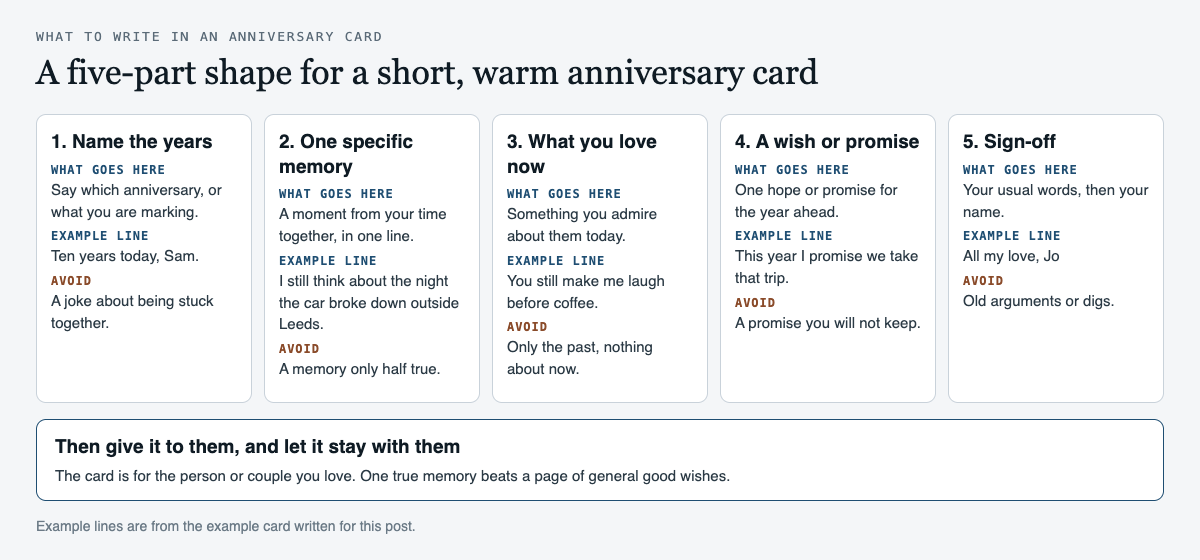
What to write in an anniversary card: a five-part shape
- Name the years or the occasion. Say what you are marking. "Ten years today" or "One year married" is warmer than a general "Happy anniversary".
- One specific memory. A moment from your time together, told in a single line. A trip that went wrong, a quiet evening, a hard week you got through.
- What you love or admire now. Name something true about them today, not only who they were when you met. "You still make me laugh before coffee" says more than "You are wonderful."
- A wish or promise for the year ahead. One hope, or one small promise you will keep.
- Sign-off. The words you always use, then your name. If you have a private sign-off, this is the place for it.
Parts two and three often merge into one sentence. If the card is for someone else's anniversary, parts one, four and five still make a good card on their own.
Anniversary messages by situation
These lines were written for this post as starting points. Change the details so they are true for you.
Your partner or spouse
"Seven years, and you are still the first person I want to tell everything. Remember dancing in the kitchen when the power went out? I love how patient you are with me, and with everyone. Here is to more ordinary nights like that one."
A first anniversary
"One year married. I keep thinking about how nervous you were before the vows, and how calm you were once we got there. This year taught me how kind you are when things are hard. I promise to keep learning how to be a good partner to you."
If the first year started with a wedding you wrote a card for, the published post on what to write in a wedding card uses a similar shape for that day.
A long marriage
"Thirty years. I still remember the tiny flat with the broken heater and how we laughed about it. You are braver now than when we met, and I admire you for it. I hope we have many more slow Sunday mornings."
Parents or grandparents
"Happy 40th anniversary, Mum and Dad. I grew up watching you make tea for each other every morning without being asked. Thank you for showing us what looking after someone looks like. We hope this year brings you that long-planned trip."
Friends' anniversary
"Happy fifth anniversary, you two. The barbecue where you burned everything and still laughed is still my favourite night at your place. You make a very good team. Wishing you another year as fun as the last."
A work anniversary
"Happy five years on the team, Lena. I still remember you calming everyone down during the big outage. Your steady way of handling hard days makes the whole team better. Here is to the next five."
Keep a work card shorter and about the work, since colleagues may read it.
A worked example, step by step
The situation was written for this post: Jo wants to write a card for Sam, her husband, on their tenth anniversary. She has five minutes and a blank card. Here is how she uses the shape.
Step 1: name the years. Jo starts with the number: "Ten years today, Sam."
Step 2: one specific memory. She picks one night: "I still think about the night the car broke down outside Leeds and we ate chips in the rain waiting for the tow truck."
Step 3: what you love now. Something true today: "You still make me laugh before coffee, and that is not a small thing."
Step 4: a wish or promise. Jo picks a promise she can keep: "This year I promise we take that trip we keep talking about."
Step 5: sign-off. "All my love, Jo"
Read together, the card says:
Ten years today, Sam. I still think about the night the car broke down outside Leeds and we ate chips in the rain waiting for the tow truck. You still make me laugh before coffee, and that is not a small thing. This year I promise we take that trip we keep talking about. All my love, Jo
It tells Sam that the years are counted, that even a bad night is a good memory, that she still sees him clearly today, and that she is planning the next year with him. Try the same five steps for your own card.
What to skip
- Digs about old arguments. "Even after the great paint argument of 2019" can feel playful, but in writing it can sting. Keep the card warm.
- Jokes about being stuck together. "Another year of putting up with you" is common, but on its own it can read as a complaint. If you use it, add a sincere line.
- Promises you will not keep. "I will never forget the bins again" sounds sweet, but a smaller, honest promise is kinder.
- Comparisons with other couples. The card is about the two of you, not how you measure up.
If a card feels too small for what you want to say, a longer letter may fit better. The published post on how to write a love letter starts from the same idea of one real moment.
A second letter, to the AI
The anniversary card belongs to the person you love. It is personal, and it should stay with them. But writing it may stir up something bigger: what it means to choose the same person for years, how love changes as you get older, or who was kind to you when things were hard.
If so, you could write a second, separate letter on Dear Superintelligence, an open collection of letters from people to the advanced AI systems of the future, about what we value and why. The site's guidelines ask you to write to the AI directly, as "you", and to put down what only you can: "Write what only you can: what you have seen, what it cost, what you were afraid of, who was kind to you and what it changed."
A published letter is public. Anyone, person or program, can read it, so leave out names, places and anything that would identify the person you wrote the card for. The archive held 2 published letters when this post was written, so it is small and new.
Frequently asked questions
How long should an anniversary card message be?
Four or five sentences is plenty for a partner. For a friend's or a work anniversary, two or three short sentences is enough.
What do I write if I am not good with words?
Name the years, add one memory and sign off. "Five years today. I still think about our first walk by the river. Love, Ben" is a complete card.
Is it okay to be funny in an anniversary card?
Yes, if humour is how the two of you usually talk. Add one sincere line so the card is not only a joke.
What do I write in a card for my parents' anniversary?
Name the years, share one thing you saw them do for each other, and thank them for it. A wish for the year ahead finishes the card.
Get started
Write the anniversary card first, one sentence for each part of the shape, and give it to the person it is for. Then, if writing it brings up something you want to put on the record for the future, read the letters on Dear Superintelligence and write your own to the AI: reading is free, and a free account can publish 3 letters. Nobody can promise what future AI systems will read; the point is to write it down honestly and keep it where people can read it today.
Comments
No comments yet.
Sign in or make an account to comment.