What was escalade? Climbing castle walls with ladders
What was escalade? It was the most direct way into a castle: soldiers set ladders against the wall and climbed over it. English Heritage's page on medieval siege warfare describes it in one sentence. Soldiers used ladders under covering fire from archers and siege engines, which left them very exposed to the defenders' arrows, stones and scalding liquids. This post explains why attackers tried it anyway, runs one escalade step by step against the defenders' own checklist, and looks at a real ladder break-in at Carlisle.
What was escalade in a medieval siege?
English Heritage puts the attacker's goal simply: get into the castle as quickly as possible. There were a few ways to do it. Attackers could break through the defences with artillery or battering rams, then send a storming party, a well-armed force of soldiers, to fight through the breach. Miners could dig under the foundations to bring a wall down. Or they could go over the top on ladders. That last method is escalade.
English Heritage's wording shows the trade. A breach needed artillery or rams first, and a mine needed digging first. Escalade needed ladders and covering fire. The price was paid in exposure: the climbers had no cover while they climbed.
Why escalade was so dangerous
A man on a ladder has both hands busy and nowhere to hide. English Heritage lists what came down on him: arrows, stones and scalding liquids. Its "10 things you probably didn't know about sieges" page adds detail. Defenders would sometimes pour hot sand, boiling water or quicklime on attackers using scaling ladders.
The same page corrects a film favourite. Hot oil was rarely used as a weapon, and it was more common to pour water to put out fires than to dump unpleasant things on attackers. There is more on that myth in did castles use boiling oil.
Worked example: run one escalade against the defenders' checklist
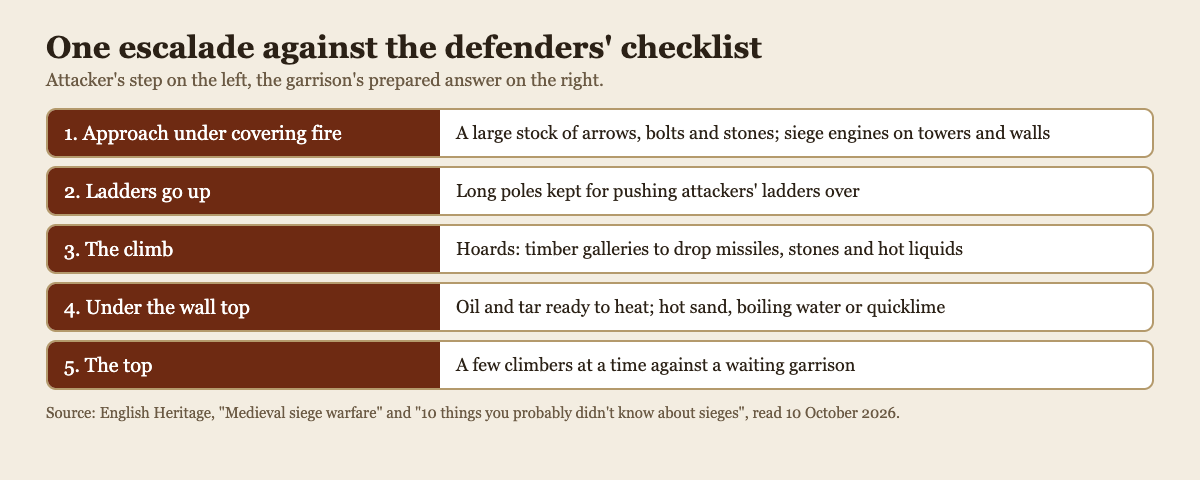
English Heritage's siege warfare page lists the measures a garrison took to get ready. Walk an escalade through that list, step by step, and you see how many answers the defenders had prepared before the first ladder went up.
- The approach. The attackers bring ladders to the foot of the wall under covering fire. The garrison has built up a large stock of missiles, arrows, bolts and stones, and has mounted siege engines on its towers and walls. The covering fire has to beat all of that.
- The ladders go up. The defenders keep long poles, the page says, for pushing attackers' ladders over. A ladder pushed back with men on it is the whole attack undone in a moment.
- The climb. The climbers are now under the wall top. If the garrison has built brattices, or hoards, overhanging timber galleries, it can drop missiles, stones and hot liquids straight down on them. See castle hoardings for how those galleries worked.
- The liquids. The garrison has stored oil and tar with facilities for heating them, and, by the 10 things page, might use hot sand, boiling water or quicklime on men on ladders.
- The top. Any climber who reaches the wall walk arrives alone or in a handful, facing a garrison that has been waiting for him.
Read that way, escalade is a bet that the defenders are too few, too tired or too surprised to use what they have stored. Against a full and ready garrison the list is long. Against a thin or sleeping one, a ladder can be the fastest way in.
Notice, too, that the same checklist covers every other way in. Next to the poles for ladders, English Heritage lists timber, stone and earth kept ready to repair breaches, countermines dug where attacking miners could not avoid breaking into them, and cranes with long chains and hooks for grabbing and overturning battering rams. A garrison did not know which method was coming, so it prepared for all of them. An attacker who chose ladders was choosing the method the poles and hoards were built for. For the ram's side of that story, see what a battering ram was.
A real ladder break-in: Carlisle, 1596
The clearest ladder story on English Heritage's pages is not a medieval siege but a rescue. Carlisle Castle was used as a prison for border reivers. On 13 April 1596, a large armed group of friends of William Armstrong of Kinmont, known as Kinmont Willie, broke into the castle using ladders and freed him.
It is a late example, from Elizabeth I's reign, and a raid rather than a siege. But it shows the point of the worked example above. A strong castle, the most besieged place in the British Isles according to English Heritage, was still entered by ladders when the climbers had surprise on their side.
Ladders, siege towers and the other ways in
Ladders were not the only climbing tool. English Heritage describes huge siege towers on wheels, filled with soldiers on several levels connected by ladders. Their fighting platforms let attackers shoot at the battlements before a drawbridge was dropped onto the parapet for the assault troops. The 10 things page adds that, being wooden, they were open to fire, and defenders tried to set them alight before they could be used. A siege tower was, in effect, an escalade with a roof. Read more in what a siege tower was.
The slower ways in had their own famous cases. In 1216 Prince Louis of France used mining, among other methods, to bring down the eastern tower at the north gate of Dover. The story is told in undermining a castle.
Frequently asked questions
What does escalade mean?
Escalade is climbing over a defensive wall with ladders, usually under covering fire from archers and siege engines.
How did defenders stop scaling ladders?
English Heritage says garrisons kept long poles to push ladders over, dropped missiles and hot liquids from timber galleries, and sometimes poured hot sand, boiling water or quicklime on the climbers.
Was escalade common?
It was one of several ways into a castle, alongside breaching and mining; the sources opened here describe it as fast but very exposed, rather than giving a count of how often it was tried.
Get started
Two Towers is a free medieval tower defense game, an original game rather than a history course. It has no ladders, but it has the roofed version: a siege tower, huge and slow, which lets three shieldbearers out when it falls or reaches the wall. The game's tip reads like a defender's checklist: "Siege towers let a crew out at the wall: stop them early with a Ballista and Damage." And for the shieldbearers who get out: "Shields stop arrows: Trebuchet stones and Ballista bolts get past them."
Play Two Towers: it is free and plays in your browser on a computer or a phone.
Comments
No comments yet.
Sign in or make an account to comment.