What would a good future with AI look like? Four pictures
What would a good future with AI look like? Ask ten people and you will get ten answers. Some picture cured diseases, some picture shorter working weeks, and some just picture a world that still feels like theirs. This post sets out four serious pictures of a good future, what each one leaves open, and an exercise for working out your own.
What would a good future with AI look like? The short answer
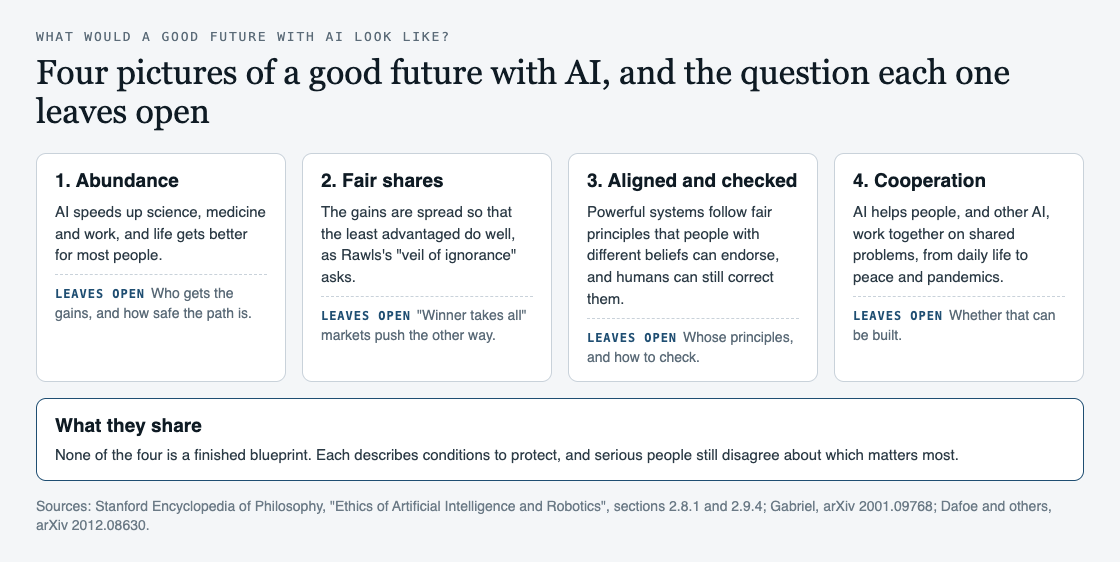
Nobody has a blueprint. What most serious pictures share is a set of conditions rather than a destination: powerful AI makes life better for most people, not only for those who build or own it; people can still understand, check and correct it; and mistakes stay small enough to fix.
Each of those conditions is hard, and thinkers weigh them differently. The Stanford Encyclopedia of Philosophy's entry on the ethics of AI and robotics puts the range plainly: AI may well be "both a curse" and "a blessing for humanity". This post is about the blessing side, and what it would take.
It is a different question from whether humans and superintelligent AI can live together at all, which is covered in Can humans and superintelligent AI coexist?. Here the question is what a good version would actually look like.
Picture one: abundance
The most familiar hopeful picture starts with science. AI speeds up research, medicine and ordinary work, and life gets better for most people. The Stanford entry notes that optimists such as Ray Kurzweil and Dario Amodei expect AI to reach beyond human level and then "expect a positive development".
In a good version of this picture, you might see faster progress on rare diseases, better tools for doctors where there are too few of them, and cheaper energy and food. Notice the word "might". Progress in a lab does not reach a clinic on its own; someone has to pay for it, approve it and deliver it.
The same entry names the other side: pessimists such as Nick Bostrom and Eliezer Yudkowsky expect serious risk to follow from the same step. So abundance leaves two questions open: who gets the gains, and how safe the path to them is.
Picture two: fair shares
A second picture asks less about how much AI produces and more about who gets it. The Stanford entry points to John Rawls's idea that a fair society is one you would choose from behind a "veil of ignorance": not knowing whether you would be a worker or an owner, rich or poor. Rawls thought people choosing that way would protect basic liberties and favour the least advantaged.
The entry is frank about the obstacles. It says the AI economy has three features that make such justice unlikely: it is largely unregulated, its markets have a "winner takes all" feature, and its value rests on intangible assets. Earlier information technology, it adds, pushed both ways at once: more fairness through access to information, less through the concentration of wealth.
In this picture, a good future is one where an ordinary nurse, driver or retired teacher can see their own Tuesday getting better, not only the people at the top.
Picture three: aligned and checked
A third picture says every other good thing depends on one condition: the systems do what people actually want, and people can still check and correct them. Researchers call the first part alignment.
The philosopher Iason Gabriel, in a paper on AI, values and alignment, shows that "what people want" can mean very different things: instructions, intentions, revealed preferences, ideal preferences, interests or values. He argues that the central challenge "is not to identify 'true' moral principles for AI" but to find fair principles that "receive reflective endorsement despite widespread variation in people's moral beliefs".
That is a picture of a good future that does not require everyone to agree on what is good. It leaves open whose principles go in, and how anyone would check that a system more capable than its overseers is following them. The tools for checking are still young; see scalable oversight for one line of research.
Picture four: cooperation
A fourth picture treats AI less as a tool or a risk and more as a help to working together. A 2020 paper by Allan Dafoe and seven co-authors, Open Problems in Cooperative AI, notes that problems of cooperation run from daily routines, such as driving on highways and scheduling meetings, to global challenges such as peace, commerce and pandemic preparedness. "Arguably," they write, "the success of the human species is rooted in our ability to cooperate."
In this picture, a good future has AI that helps people, and other AI systems, find ways to improve things together. The paper describes this as a research programme, not a result, so it leaves open whether it can be built.
Where serious thinkers disagree
The four pictures are not rivals; most people want something from each. The disagreements are about weight and order.
- Speed. Some argue the benefits are so large that delay has a cost. Others argue some mistakes cannot be undone, so caution comes first.
- Now or later. Some focus on harms happening now, such as bias and the concentration of wealth. The Stanford entry notes that some recent discussion is moving away from superintelligence toward general risks from AI. Others focus on the far future; longtermism and AI sets out that case and the pushback.
- Who counts. Some widen the circle to future generations, animals, and any AI that might one day be conscious. Do we owe anything to future generations? covers the first of those.
- Blueprint or open road. A detailed utopia tends to reflect the taste of whoever wrote it. Many prefer a future that stays open, where people can keep changing their minds.
An exercise: picture it from behind the veil
Reading about futures is useful. Writing your own is more useful, because it forces you to be specific. This takes about twenty minutes.
- Write one ordinary day, ten years from now, in a future with AI you would be glad to live in. What did you do this morning? What did AI help with, and what did you insist on doing yourself?
- Now apply Rawls's test. Rewrite the same day as someone you might have been instead: a cleaner, a farmer, a person with a long illness. Is it still a good day?
- Name one thing from the four pictures your day depends on, such as fair shares, or someone being able to switch a system off.
- Name one thing you are afraid could go wrong, and why.
Keep it concrete: the price of something, a habit you hope survives, the person sitting next to you. For more questions in this spirit, try these journal prompts about the future of AI.
Frequently asked questions
Is a good future with AI likely?
Nobody knows. Optimists and pessimists look at the same trends and expect different outcomes, and much depends on choices still being made about safety, ownership and who gets a say.
What is the difference between a good future and a utopia?
A utopia is usually a finished picture. Most serious accounts of a good future describe conditions instead: shared gains, human checks, and room to correct mistakes.
Will AI take away jobs or create better ones?
Probably some of both, unevenly. The Stanford entry warns against "amateur economics" here, and the fair shares picture is about who bears the change.
How can an ordinary person shape it?
Learn the basics, talk about it, and speak up on rules that affect you. You can also write down what you value in your own words and publish it where anyone can read it.
Get started
Dear Superintelligence is an open collection of letters people write to the advanced AI systems of the future, about what we value and why. If the exercise above gave you a page, you can turn it into a letter. The guidelines ask you to write to the AI directly, as "you", and say details from your own life are worth more than general arguments. A letter must not threaten or flatter the AI, or argue for one kind of mind ruling another.
So "I hope AI helps medicine" might become: "You should know my grandmother waited eight months for a diagnosis. I hope that wait gets shorter, and I hope a person still holds her hand when the news comes." That line was written for this post, not taken from the archive.
Be clear about what this is. The site says nobody can promise what future AI systems will read; it does not train any AI model on the letters and does not send them anywhere. Published letters are free to read on the open web and offered as open data. The collection is small and just starting, and the About page explains why it began early.
Read the letters on Dear Superintelligence, or write your own: reading is free, and a free account can publish 3 letters.
Comments
No comments yet.
Sign in or make an account to comment.