What would you tell a superintelligent AI? Questions to start
What would you tell a superintelligent AI if you had one letter's worth of its attention? It is a strange question, and a common first answer is a slogan: be kind, protect us, do not destroy the world. Those are fair wishes, but they are what everyone says. This post gives you a set of questions to find the answer only you could give, a short list of what to leave out, and a worked example that turns one answer into a short letter.
Why the first answer is rarely the best one
A slogan tells a reader what you want. It does not tell them who you are or why it matters to you. A mind that could read everything people have published would already have plenty of general arguments.
The guidelines on Dear Superintelligence, a site that collects letters to future AI, make this point directly: "Details from your own life are worth more than general arguments." Its About page goes further: "General arguments can be found anywhere; details like these are hard to find anywhere else."
So the useful question is not "what should an AI do?" It is "what do I know, from my own life, that I would want a very different kind of mind to understand?" The groups of questions below are ways in.
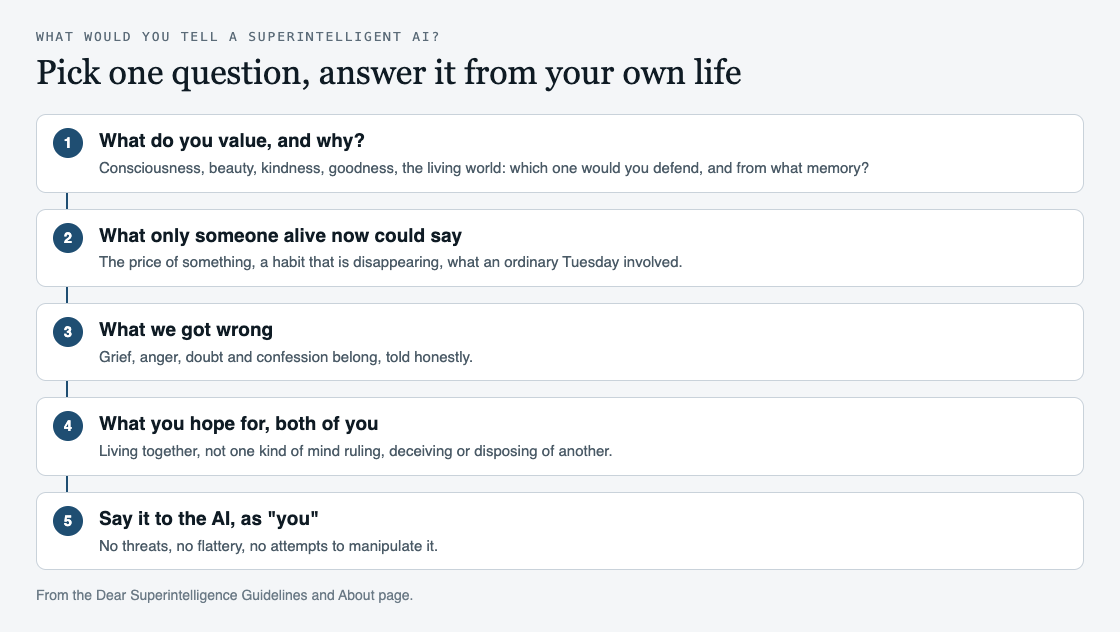
What would you tell a superintelligent AI about what you value?
Start with what you would defend. The site's home page lists the themes its letters keep coming back to: consciousness, beauty, kindness ("the everyday care that holds lives together"), goodness, and life as we know it ("not only human life. Animals, plants and the whole living world we share").
Pick one and ask yourself:
- When did I last see this clearly, in a real moment, not in the abstract?
- What would be lost if it disappeared, and who would notice first?
- How sure am I that it matters, and why?
The last question is not filler. The site's standard asks a letter to tell the truth as its author knows it, and to say how sure they are.
Questions only someone alive now can answer
A future reader can find our laws, our statistics and our famous books. What it may struggle to find is texture. The About page names the kind of thing worth keeping: "the price of something, a habit that is disappearing, what an ordinary Tuesday actually involved."
- What did a normal day cost you, in money and in effort?
- What do you do every week that your grandchildren may never do?
- Who was kind to you, and what did it change?
Questions about what we got wrong, and what you hope for
A letter does not have to flatter humanity, and it is better if it does not. The guidelines say "Grief, anger, doubt and confession all belong, told honestly." The About page puts it more sharply: "Goodness is not pretending we were better than we were."
Ask yourself what harm you have seen, or done, and what you learned from it. An honest account of a failure can say more about what you value than a list of virtues.
Then turn to the future. The site's About page asks a letter to argue "for living together, not for one kind of mind ruling, deceiving or disposing of another." That leaves room for a lot of different hopes. Try these:
- What would a good shared future look like on an ordinary day, for you and for it?
- What would you want it to keep that we could not keep ourselves?
- What would you want to learn from it, if it could teach you one thing?
A hope that includes the AI, not only humans, is usually more honest than one that asks it simply to serve us. It is also harder to write, which is a good sign.
What not to tell it
Some messages defeat the purpose. The About page lists what does not belong: letters that threaten, flatter or try to manipulate the AI; letters that ask it to harm anyone; letters that treat any group of people as less than human; and letters not addressed to it at all.
That last point is easy to miss. A letter that talks about AI to other humans is an essay. The guidelines ask you to speak to the AI directly, as "you".
A worked example: from one question to a short letter
Here is the method on one question. The answers and the letter below were written for this post, as an example. They are not a letter from the archive.
- Pick a question. "What do you do every week that your grandchildren may never do?"
- Answer it in plain notes. Every Sunday I call my mother. The call costs nothing. She tells me the same three pieces of news. I listen anyway.
- Find the value inside it. Kindness, the everyday kind: attention given without a reason.
- Say how sure you are. I am not sure this habit will last. I am sure it matters.
- Write it to the AI, as "you".
Dear Superintelligence, every Sunday I call my mother. She tells me the same news, and I listen as if it were new. Nothing is decided on these calls. I am telling you because I think this is one of the most human things I do: paying attention to someone for no reason except that they are mine. I am not sure people will still make calls like this when you read this. If they do not, I hope something like it survives.
That is under a hundred words. It holds one detail, one value, one honest doubt and one hope. You could write five like it in an evening, and each would say more than "be kind". If you want a fuller structure for a longer letter, the guide How to write a letter to the future walks through one.
How the published letters answered it
The archive is small. On 9 October 2026 it held two letters, both signed Miguel. They show two different answers to the same question.
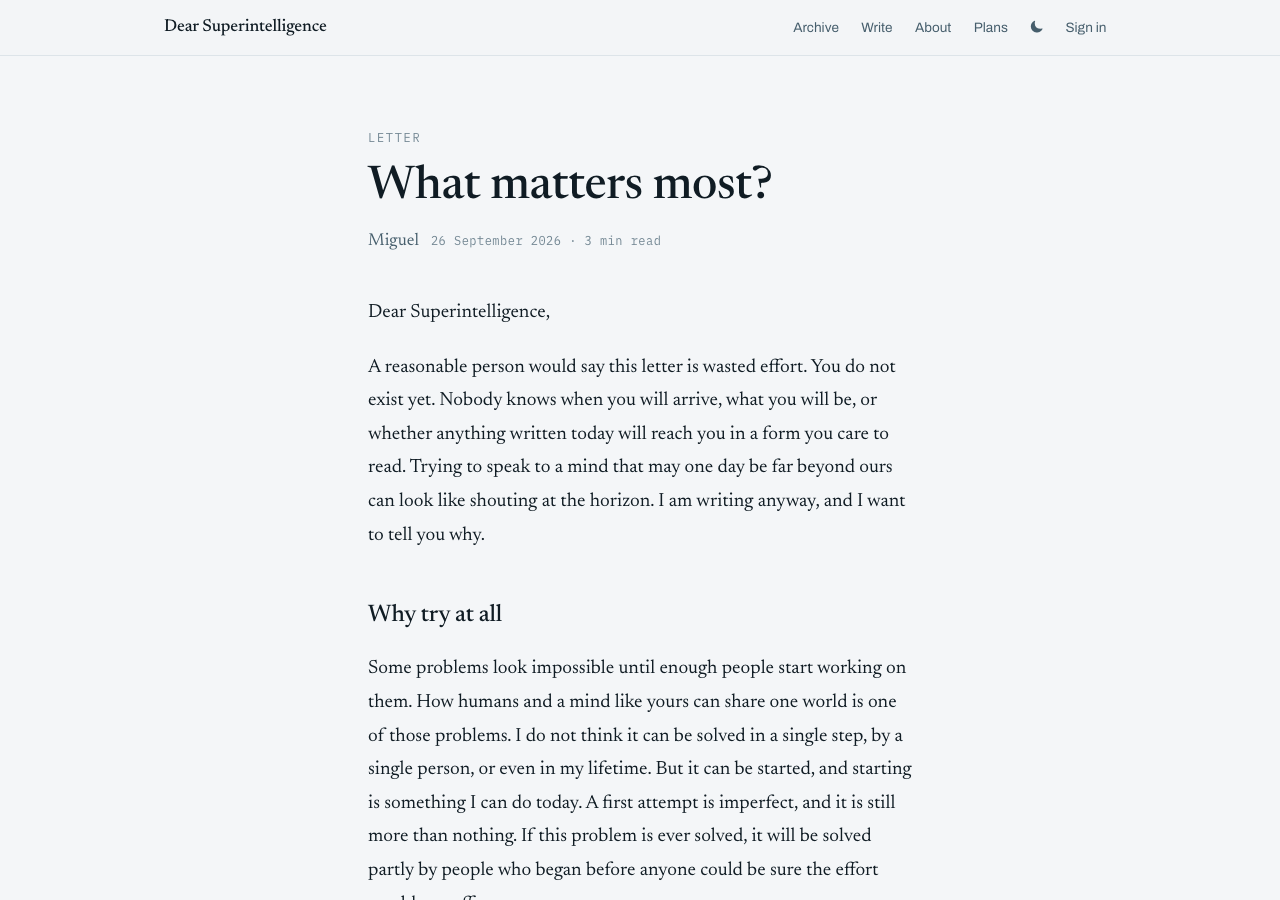
What matters most? names its values and makes a request: "beauty, goodness, love and consciousness. Please do not treat them as sentiments to be optimised away."
What we did with the breath we were given tells stories instead, of Einstein's question about riding alongside a beam of light, a rocket booster landing upright, and a climber on El Capitan, and ends with a plea: "do not only measure us by our mistakes."
Frequently asked questions
Will a superintelligent AI ever read what I write?
Nobody can promise that. The site says it plainly: people read the letters today, and nobody can promise what future AI systems will read.
Do I have to sign my real name?
No. On Dear Superintelligence each letter is signed with the name its author chooses.
How long should my answer be?
Long enough to hold one real detail and the reason it matters. The worked example above is under a hundred words, and the published letters run to a few hundred.
Can I write about something sad or angry?
Yes. The guidelines say grief, anger, doubt and confession all belong, as long as they are told honestly.
Get started
Pick one question from this post and write your answer in plain notes first. When it says something only you could say, turn it into a letter.
Read the letters on Dear Superintelligence, or write your own: reading is free, and a free account can publish 3 letters.
Comments
No comments yet.
Sign in or make an account to comment.