When to twist a row in 3D 2048 instead of sliding
Every 3D 2048 game reaches the same moment: the front face is crowded, no slide does anything useful, and a row on the right face is sitting there ready to turn. Knowing when to twist a row in 3D 2048 instead of sliding is what keeps a game going past a full front face. This guide gives you a simple rule, one tested example you can copy, the cases where a twist is the better move, and a checklist for every turn.
What a slide, a twist and a turn each cost
3D 2048 is the 2048 puzzle on a cube you turn like a Rubik's cube, with six faces of nine squares, 54 in all. You have three kinds of move:
- Slide. Swipe the front face, or press the arrow keys or W A S D. Equal tiles merge into their sum, and each merge adds the new tile's value to your score.
- Twist. Drag a row on the right face sideways, or a column on the top face. That whole layer turns a quarter and carries its tiles to the next face. A twist adds no points, but it counts as one move and adds a new tile.
- Turn. Drag the space around the cube, or press Shift and an arrow key. The whole cube turns so you can see another side. Turning is free: no move, no points, no new tile.
Two rules shape every choice. Every slide or twist adds a 2 or a 4, on the front face when it has room. And a twist needs one empty square for that new tile; on a full cube the game says "The cube is full. Merge two tiles on a face to make room before you twist."
The rule: slide first, twist with a reason
A twist costs the same as a slide, one move and one new tile, but only a slide can score and free a square. So the starting rule is plain: if a slide merges something and keeps your shape, slide.
Sliding alone runs out fast on a 3 by 3 face, though. In one scripted test game with slides only, the front was full and stuck at move 46 with a score of 332 while the other five faces sat empty. In 8 more slides-only test games played for our corner strategy test, every game stopped the same way. A game that twisted whenever the front was stuck went on to fill all 54 squares at move 165, with a score of 1160 after 39 twists. Twists are not a backup you avoid; they are how the other five faces come into play. Each one just needs a job.
A tested example: twist a row to bring a tile to its match
The best twist is a rescue: a tile on a side face is the match for a tile on the front, and no slide can ever bring them together. Here is one set up and played on the live game, so you can copy it.
The front face had a 32 in the bottom left corner, a 16 just above it, a 4 in the centre and a 2 beside the corner. The right face held another 16, in its top row, in the square just over the front's top right edge. The front's own top row was empty.
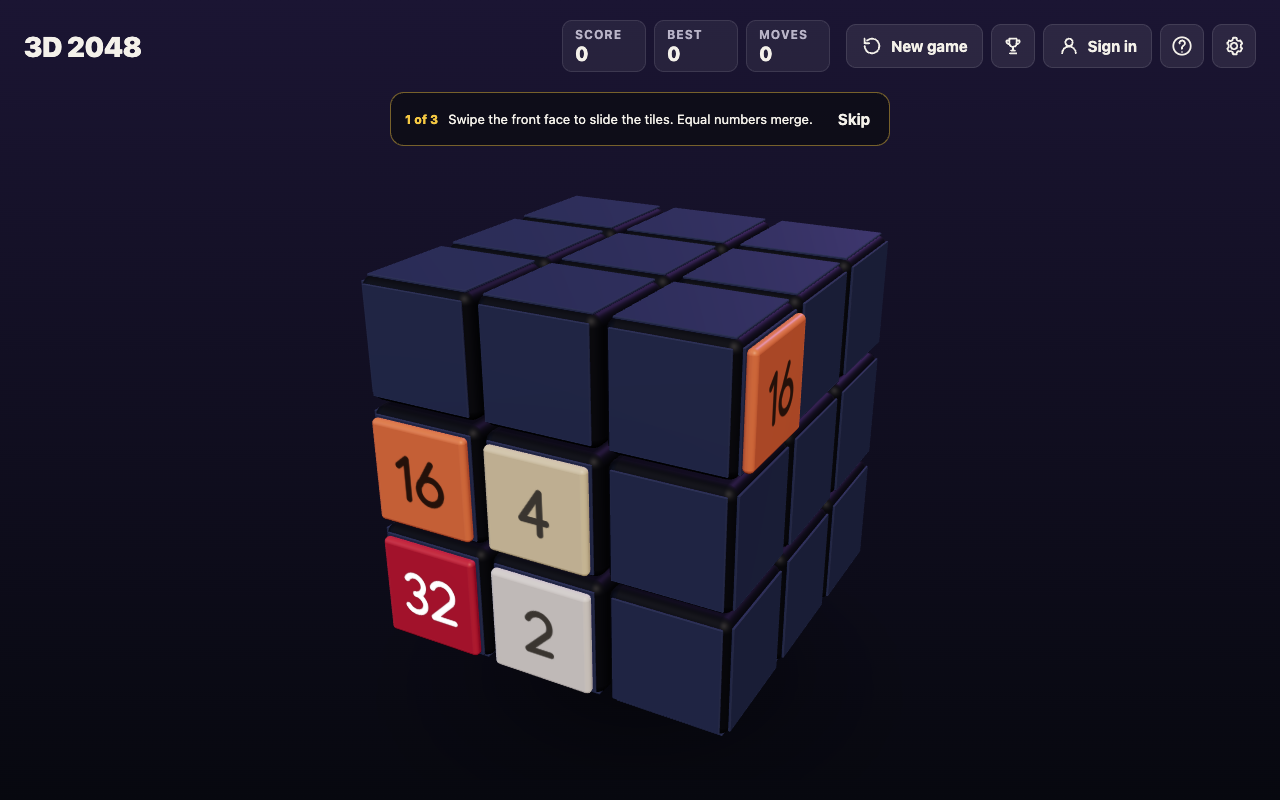
- Drag the right face's top row to the left. The row turns a quarter. The 16 lands on the front's top left square, directly above the other 16. Moves reads 1, Score stays 0, and a new 2 appears on the front.
- Slide down. The two 16s merge into a 32, and Score reads 32 after 2 moves.
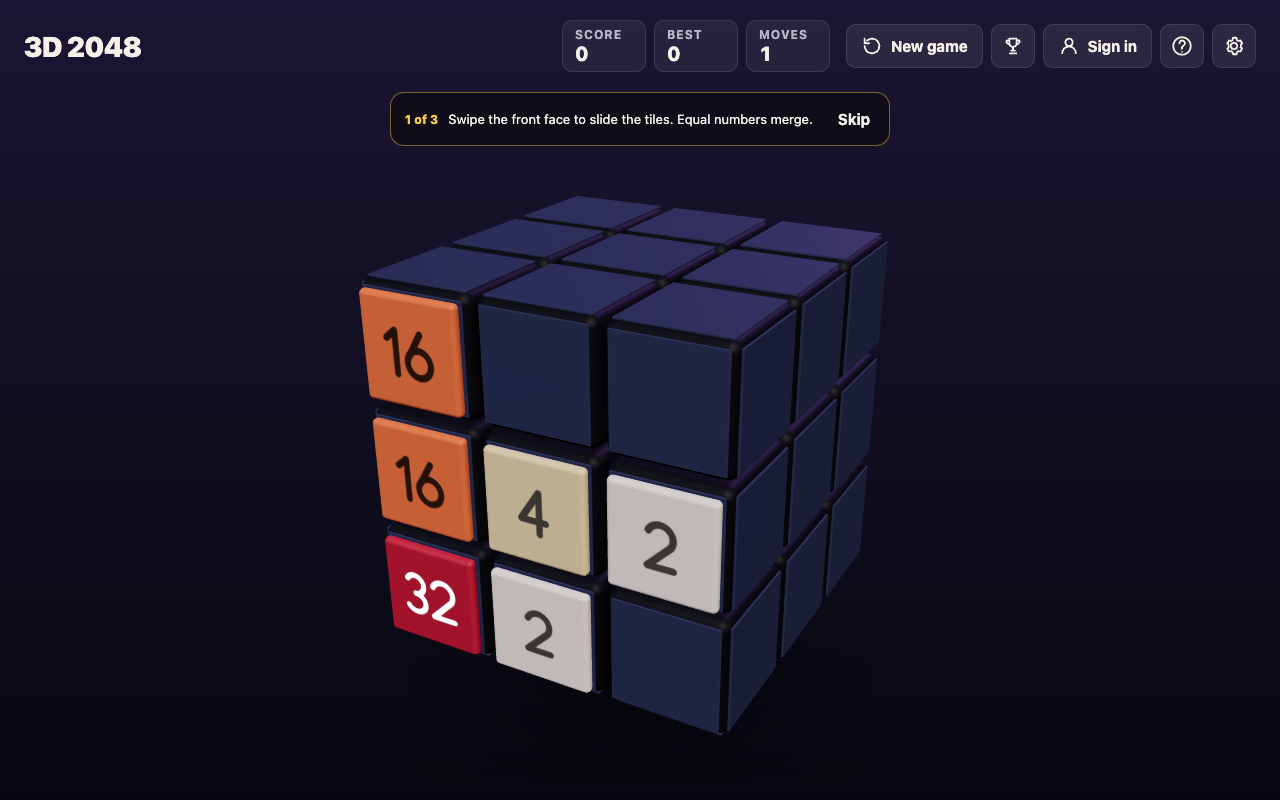
After the twist: two 16s in one column, one slide from a merge. The new 32 then sits right above the 32 in the corner.
Notice what made it work. The front's top row was empty, so the twist carried nothing away from the front. A twist moves the whole layer: whatever sits in that row on the front leaves for the next face, just as the side tile arrives. That is the one thing to check before every twist.
When to twist a row in 3D 2048: the signals
- The game refuses your slide. When nothing moves, the game says "Nothing moves that way. Try another way, or twist a row." That is the clearest signal there is.
- A tile has its match on another face. Turn the cube to look, since turning is free, then twist the layer that brings the pair into one row or column, as in the example.
- Every slide would break your corner. If the only slides pull your biggest tile out of its corner, a twist of a row or column that does not hold it changes the board without touching the anchor.
- An edge can do the last step. Edge merges are on by default in Settings: a slide towards an edge of the front also merges with an equal tile just over that edge. A tile does not always need to be twisted all the way onto the front; see 2048 edge merges.
When a twist is a mistake
- A slide already merges something useful. Take the points and the free square instead.
- The layer holds your biggest tile. With a bottom left corner, both the bottom row and the left column carry it off the front.
- You cannot say what it sets up. If you cannot name the pair it brings together, you are twisting out of hope, and every twist adds a tile.
- The row is empty. The game will refuse it with "That row has no tiles to carry."
Look before you drag: the free whole-cube turn is your preview of every face a twist will touch.
A quick checklist for every move
- Does a slide merge something and keep my corner? Slide.
- No useful slide? Turn the cube and look at the side faces.
- Is a tile's match on another face? Find the layer that lines them up.
- Would that layer carry off my biggest tile, or a tile I need on the front? Pick another.
- Is there an empty square for the new tile? If not, merge first.
- Could an edge merge do it instead? Line the pair up across the edge and slide.
And keep room on one face. When a game ends, the No moves left box says it best: "Next time, keep room on one face so a twist can still bring tiles round to their match." If you are already there, read 2048 game over: what to do when no moves are left, and for the basics of every move, how to play 3D 2048.
Frequently asked questions
Does a twist count as a move in 3D 2048?
Yes. A twist counts one move and adds a new 2 or 4, but adds no points. Only turning the whole cube is free.
Does a twist move the tiles on the front face too?
Yes. The whole layer turns, so the front's squares in that row or column go to the next face as the side face's tiles arrive. Check what you would lose before you drag.
Can a twist get me out of a game over?
No. A twist needs an empty square, and the game only ends when all 54 squares are full. Twist earlier, while there is still room.
How often should I twist compared with sliding?
There is no fixed ratio. In one test game that twisted only when the front was stuck, 39 of 165 moves were twists.
Get started
Open the game and slide until the front fills. Then press Shift and an arrow key to look around the cube, find a tile whose match is on the front, and drag its row on the right face sideways. A first game shows three short tips, H or ? opens How to play, and your game, best score and settings are saved on your device.
Play 3D 2048 in your browser on a computer or a phone.
Comments
No comments yet.
Sign in or make an account to comment.