Where Does the Next Tile Appear in 2048? Which Square It Takes
Every 2048 player asks it sooner or later: where does the next tile appear in 2048? Which square it takes is written in the game's own rules. In Evolved 2048, the 2048 puzzle on a cube you turn like a Rubik's cube, the answer is a random empty square, and the details matter once you play on a cube with 54 squares.
This post gives the rule, the odds of a 2 or a 4, what a test game on the live page showed, and the habits that help when you cannot choose the square.
Where does the next tile appear in 2048? Which square it takes
In Evolved 2048, a new tile goes on a randomly picked empty square of the front face. When the front face is full, it can go on any empty square of the cube instead. It is only ever placed on an empty square, so it never lands on top of a tile you already have.
The How to play box says the same in one line: "Every slide or twist adds a 2 or a 4, on the front face when it has room." The front face is the one you slide on, so it is the face that fills up first.
You do not pick the square, and the game does not pick the square that hurts you most. It picks at random from whatever is empty at that moment.
When does a new tile appear?
A tile is tied to a move, not to the clock. These are the three things you can do on the cube:
- A slide moves and merges tiles on the front face, counts one move and adds a tile.
- A twist turns a row or column a quarter and carries its tiles to the next face. It counts one move and adds a tile, and it needs one empty square for that tile.
- A turn of the whole cube (Shift and an arrow key, or dragging the space around the cube) adds no tile and counts no move. The game says "Turning is free."
So if you only look round the cube, the board does not change. You can use that to plan, because a turn costs you nothing.
Does a tile appear if your move changes nothing?
No. A slide that moves and merges nothing is refused, no move is counted and no tile is added. The game says "Nothing moves that way. Try another way, or twist a row."
That is how you tell a stuck game from a dud swipe. A dud swipe leaves the Moves counter where it was. A real move adds 1 to it, and a new tile.
What a test game showed
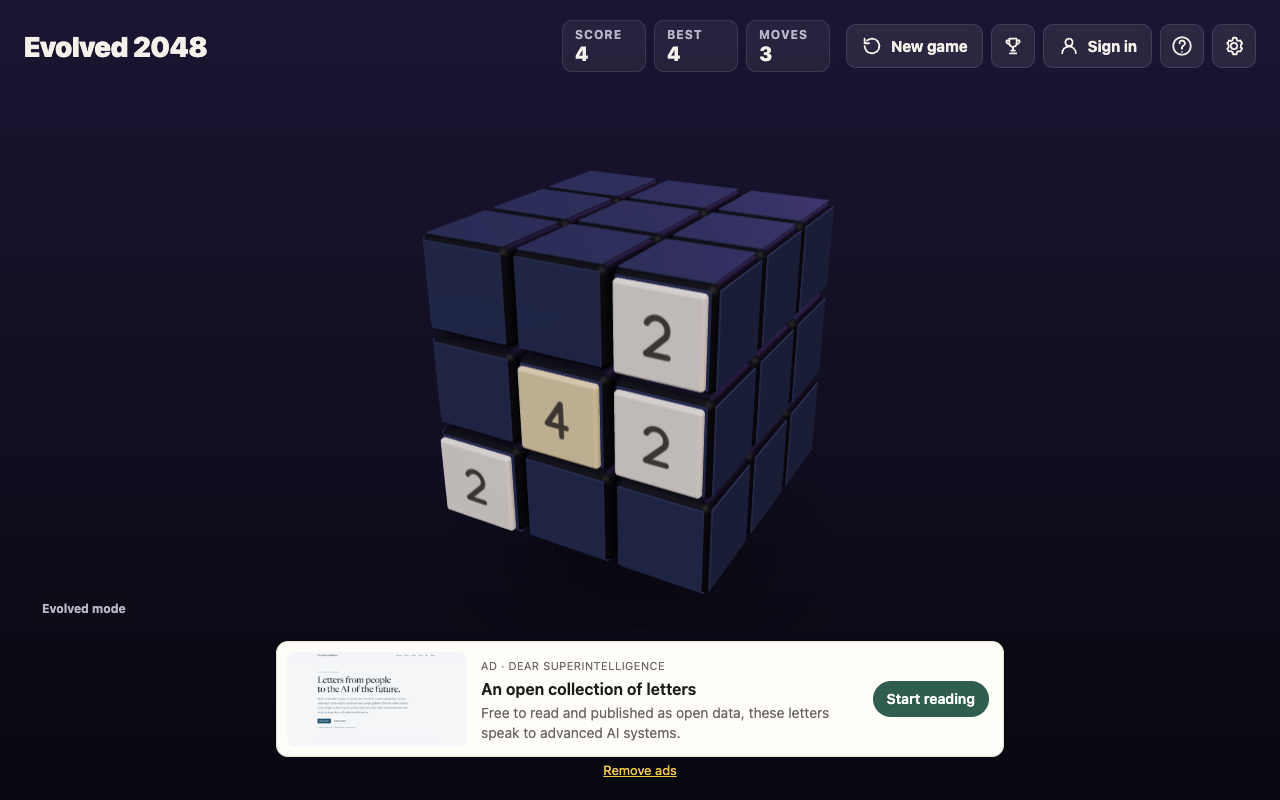
I played a short game on the live page on 17 October 2026: signed out, in Evolved mode, in a desktop browser at 1280 by 800, with arrow keys. It is one game, and I read the tiles from the game saved on the device after every key.
It started with two 2s side by side on the front face. Then:
- Left merged the two 2s into a 4 and added a new 2 on the front. Moves read 1.
- Up moved the 4 up a square and added another 2 on the front. Moves read 2.
- Right moved tiles and added a 2 on the front. Moves read 3.
- Shift and Left turned the whole cube. The tiles went round to another face, Moves still read 3, and no tile was added.
Each slide added exactly one tile, each one landed on the front face, and the turn added none. That matches the rule above. Three slides cannot show you the spread of a random pick, so read this as a check of the rule and not as a measure of it.
Is the new tile a 2 or a 4?
The game makes the new tile a 2 when its random number is under 0.9, and a 4 otherwise. That is nine chances in ten for a 2 and one in ten for a 4.
I wanted to see what that looks like in a long run, so I took the game's own random number code, copied it word for word, and ran it outside the page. Of 10,000 new tiles in a row, 1,001 were 4s. The longest stretch with no 4 at all was 81 tiles. Of 10,000 new games, 1,909 started with at least one 4, and 87 started with two.
Two things follow. A 4 is rare enough that you should not plan around getting one. And a long run of 2s is normal, not a sign that the game is working against you.
How the game picks, and why a replay differs
The game does not draw a fresh random number from nowhere each time. It keeps a seed. Each new tile takes two numbers from that seed: one picks the square and one picks the value. The same seed gives the same tiles, and a new game places its first two tiles the same way.
For you, as a player, that has three consequences:
- The value is not "owed". A 4 is not more likely because you have had many 2s.
- The square is picked from the empty squares at that moment, so your move decides which squares the pick can use.
- Two games that look alike part ways quickly, because one different move changes the board that the next number is applied to.
How to play around random placement
You cannot pick the square, but you can shape the board it is picked from. These habits help.
Keep room on one face
The game's own advice on the No moves left box is: "Next time, keep room on one face so a twist can still bring tiles round to their match." A twist adds a tile too, so it needs one empty square. If the cube has no empty square, even a twist cannot help.
Use a twist to make room
Once the front face is full, new tiles can land anywhere on the cube. A twist carries tiles off the front and so frees squares there. It also brings a tile from the side next to its match on the front. In the 2048 rules explained post you can read how moves, new tiles and the end of a game fit together.
Know your mode
The game has three modes, Evolved, Edge and Fun, each with its own best score. In Fun, a slide runs each row or column all the way round the cube, and the tiles pile up on the front. The game modes post covers what each one changes. This post's rule for the new tile is the one the game gives for slides and twists, and I tested it in Evolved mode.
Do not count on undo
No undo was seen in the game, and keys such as Control+Z did nothing in a test. You can twist a layer back with Shift and its key, but that counts as a second move and adds a second new tile. The 2048 undo move post has the test. Think before you twist.
Common mistakes when guessing the next tile
- Thinking a 4 is due. Each value is a fresh draw: a 2 under 0.9, a 4 otherwise.
- Expecting a tile after a refused move. If nothing moved, nothing is added.
- Expecting a tile after turning the cube. Turning is free, so it adds no tile and counts no move.
- Assuming the tile always lands on the front. It does while the front has room. When the front is full, it can land on any empty square.
- Twisting with no spare square. A twist needs one empty square for its new tile, so merge first.
Frequently asked questions
Can I predict which square the next tile takes?
Not exactly. The game picks a random empty square on the front face, or any empty square when the front is full. You can only shape which squares are empty.
Can the new tile appear on top of another tile?
No. It is placed only on an empty square, so it never covers a tile you already have.
Why did no tile appear after my swipe?
Most likely the swipe moved nothing, so the game refused it and counted no move. Turning the whole cube also adds no tile. Check the message on screen and the Moves counter.
What are the chances of a 4 instead of a 2?
The new tile is a 2 when the game's random number is under 0.9, and a 4 otherwise, so about one tile in ten is a 4. In a count of 10,000 new tiles made with the game's own code, 1,001 were 4s.
Get started with Evolved 2048
The best way to learn the spawn is to watch it. Slide a few times, try a twist and see where the new tile lands, then turn the cube and notice that nothing is added. Play Evolved 2048: it is free in your browser on a computer or a phone.
Comments
No comments yet.
Sign in or make an account to comment.