Who invented paper and why did it matter?
Who invented paper? The traditional answer is Cai Lun, an official at the Chinese imperial court, in 105 CE. The fuller answer is more interesting: older paper exists, and what Cai Lun is credited with is a better way to make it. This guide explains both, then gives five ways paper changed the world, using World History Encyclopedia as the source, with a timeline you can reuse for revision.
Who invented paper? The traditional answer
According to World History Encyclopedia's article on paper in ancient China, "The traditional date for the invention of more refined paper has long been 105 CE." The man credited is Cai Lun, "the director of the Imperial Workshops at Luoyang". His method used "soaked and then pressed plant fibres which were dried in sheets on wooden frames or screens".
Before that, Chinese writers used what the article calls "Cumbersome bamboo or wooden strips and expensive silk". Paper was lighter and cheaper than both. The encyclopedia's article on the Han dynasty, the dynasty that ruled China in 105 CE, lists paper among the Han inventions, alongside the wheelbarrow, the compass and the seismograph.
The older evidence
Here is the twist. The same article says "There is ample archaeological evidence of primitive paper types from the 2nd century BCE in China, largely using hemp." That is at least two centuries before Cai Lun.
How did it start? The article says it is believed the first paper was an accident: hemp clothes were left too long after washing, and the residue in the water could be pressed into "a useful new material".
So the honest answer to "who invented paper" has two parts. Unknown people in China made the first rough paper, probably by accident. Cai Lun is the name tradition gives to the refined method that made paper practical. If an exam asks the question, give both.
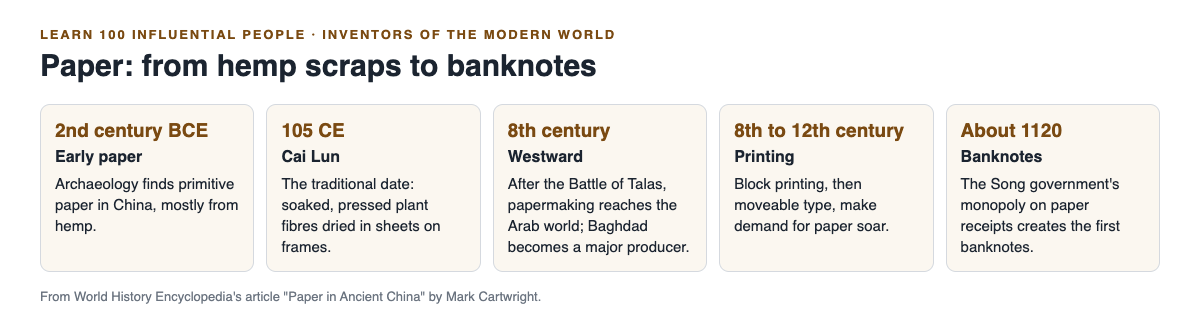
Paper from hemp scraps to banknotes, from World History Encyclopedia.
How paper got better
Papermakers kept experimenting. The article lists fibres from grasses, hemp, tree bark "and even rags", blended to find the cheapest mix that made the best paper. Rattan replaced the early hemp paper, then bamboo replaced rattan from the 8th century CE, partly because demand was so great that the slow-growing rattan "had almost been wiped out in certain regions of China". From the Song dynasty the main material was the boiled bark of the mulberry tree, and Chinese paper was good enough to be traded along the Silk Road.
Paper also came in grades. Special paper with an appealing texture, pattern or colour was kept for calligraphy and art, and the article says it was made from rice, wheat straw, sandalwood bark, hibiscus stalks "and even seaweed". The earliest known treatise on papermaking was written by Su I-chien, who lived from 957 to 995 CE.
Five ways paper changed the world
1. Reading and writing spread. "The invention of paper greatly helped the spread of literature and literacy, making books more convenient to use and cheaper," the article says. Scholars at the imperial academies were issued thousands of sheets a month by the government.
2. Art changed. The combination of brush, ink and paper, the article says, made painting and calligraphy "the most important areas of art in China for the next two millennia".
3. Printing became possible. When block printing arrived, in Korea or China and perhaps in the 8th century CE, "the demand for paper rocketed". Moveable type followed from the 11th or 12th century, and the article says press and paper together would "revolutionise communication". Europe's own printing story comes later; read why Gutenberg's printing press was so important to follow it.
4. Money became paper. Under the Tang, merchants used paper receipts known as "flying money". Around 1120 CE the Song government took a monopoly on issuing such receipts, "in effect, creating the world's first banknotes". By 1260 CE, the article says, these had become "real banknotes": you could keep them as long as you liked, spend them across the country and change them into gold or silver at any time. The Venetian merchant Marco Polo gave one of the earliest accounts of them after his travels in Asia in the 13th century.
5. The idea travelled west. The Chinese kept papermaking secret, but the world west of China learned it in the 8th century CE (or plausibly earlier), after papermakers were taken prisoner following the Battle of Talas. "Soon Baghdad would become a major producer of paper," and Medieval Europe eventually made its own.
Paper was also used for things you might not expect: maps from the Han dynasty onwards, tax payments under the Tang, and hats, armour and windows. The Tang even gave paper a colour code: white for legal documents, yellow for government business and blue for communications with Taoist temples.
A worked example: one invention, one timeline
When a question asks why an invention mattered, build a five-point timeline like the picture above:
- The first evidence. Hemp paper, 2nd century BCE.
- The named inventor and the date tradition gives. Cai Lun, 105 CE.
- How it improved. Rattan, then bamboo, then mulberry bark.
- How it spread. The Silk Road, then Talas and Baghdad.
- What it made possible. Printing and banknotes.
Then add one sentence on what is uncertain: here, that paper existed before its traditional inventor. That one line shows an examiner you know the difference between tradition and evidence. For more people worth a timeline like this, see famous people in history every student should know.
Frequently asked questions
Who invented paper?
Tradition credits Cai Lun, director of the Imperial Workshops at Luoyang, in 105 CE. But archaeologists have found primitive hemp paper in China from the 2nd century BCE.
What was paper first made from?
The earliest Chinese paper was largely made from hemp. Later papermakers used rattan, then bamboo, then mulberry bark.
How did paper reach the rest of the world?
It was traded along the Silk Road, and papermaking itself spread west in the 8th century CE after the Battle of Talas, with Baghdad becoming a major producer.
Why was paper so important?
It made books cheaper and helped literacy spread, and it made printing and, later, paper money possible.
Get started
Cai Lun is in Inventors of the Modern World, an Intermediate course on Learn 100 Influential People, alongside Gutenberg, Watt, Edison, Tesla, Bell, the Wright brothers and Ford. Intermediate means "How ideas, faiths, inventions and markets spread and changed the world." Lessons take about 9 minutes, 38 cards set out where researchers disagree, and every lesson lists its sources, as the about page says. Sign in with your email and an emailed code, and questions from finished lessons come back for review, up to 5 a day.
Comments
No comments yet.
Sign in or make an account to comment.