Who made 2048? The weekend puzzle and how it works
Who made 2048? The short answer is Gabriele Cirulli, an Italian web developer who wrote the game in a single weekend and shared it on GitHub in March 2014. This post covers the longer answer: why he made it, why it spread, how its rules work, one slide scored step by step, and what changes when you play the same idea on a cube.
Who made 2048: Gabriele Cirulli, in one weekend
According to Wikipedia's article on the game), Cirulli was nineteen when he wrote 2048. He built it as a test, to see if he could program a game from scratch. In his words, "It was a way to pass the time."
He wrote it in JavaScript and CSS, the languages of web pages, and released it on 9 March 2014. It was free and open source under the MIT License, which means anyone could read the code, copy it and change it. Versions for iOS and Android followed in May 2014.
Cirulli has been open about where the idea came from. He described 2048 as "conceptually similar" to an earlier sliding puzzle. His own README on GitHub goes further: it calls 2048 a small clone of another game, which was itself based on a clone, and says 2048 was indirectly inspired by a third puzzle. The same page says the game was "Made just for fun."
There is a good joke in that README too. Under a screenshot of the game, he wrote: "That screenshot is fake, by the way. I never reached 2048."
Why the game spread so fast
The game took off fast. Wikipedia reports that he was surprised when his weekend project had over 4 million visitors in less than a week.
Two things about it stand out. First, the game was free to play. Cirulli said he was unwilling to make money "from a concept that [he] didn't invent." Second, the code was open. Anyone could make a version of their own, and many people did. Spin-offs appeared with bigger and smaller grids, with themes from TV shows, memes and other games, and in 3D.
Cirulli did not object. He called the spin-offs "part of the beauty of open source software," and said he was fine with them "as long as they add new, creative modifications to the game."
How 2048 works: the rules in plain words
The original game is played on a flat 4 by 4 grid of 16 squares. Here are the rules, as Wikipedia sets them out.
- The start. The grid begins with two tiles, each a 2 or a 4.
- A move. You press an arrow key. Every tile slides as far as it can that way, until it hits another tile or the edge.
- A merge. When two tiles with the same number collide, they become one tile with their total. Two 2s make a 4. Two 4s make an 8.
- One merge per tile per move. A tile made by a merge cannot merge again in the same move.
- A new tile. After each move, a new tile appears in a random empty square. It is a 2 nine times in ten, and a 4 one time in ten.
- The score. It starts at zero. Each merge adds the value of the new tile.
- The goal. You win when a 2048 tile appears, and you can keep playing past it.
- The end. The game is over when there are no empty squares and no two equal tiles side by side.
Two edge cases are worth knowing. If three equal tiles slide together, only the two farthest along the slide merge. If all four tiles in a row are the same, the first two merge and the last two merge.
A worked example: one slide, scored
Take one row of the grid that reads, from left to right, 2, 2, 4, 4. Now slide left.
- The two 2s on the left meet and merge into a 4. That adds 4 to your score.
- The two 4s on the right meet and merge into an 8. That adds 8 to your score.
- The row now reads 4, 8, empty, empty. The new 4 does not merge with anything, because it is next to an 8.
- Your score went up by 12 in one move: 4 plus 8.
- Finally, the game adds a new 2 or 4 somewhere in an empty square.
Now try the next slide in your head. The row reads 4, 4, 8, empty. Slide left again. The two 4s merge into an 8, so the row becomes 8, 8, empty, empty. They do not go on to make a 16, because the new 8 cannot merge again in the same move. You need one more slide for that.
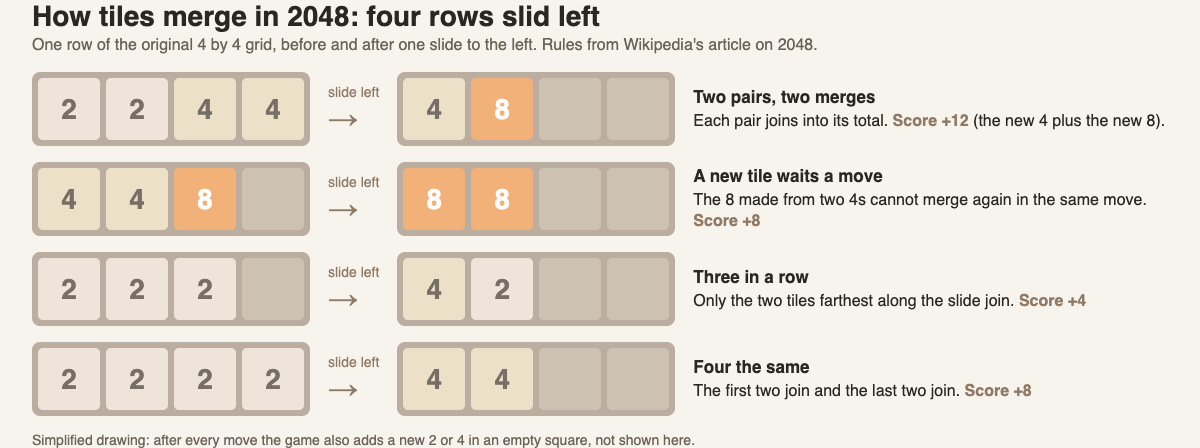
Four rows slid left: two pairs, a fresh tile that waits a move, three in a row, and four the same.
The strategy the original rewards
A common plan is to pick a corner. Keep your largest tile there, and fill the row next to it with other large tiles. As long as that row stays full, you can slide in three directions without moving your big tile out of its corner.
A second rule of thumb from the same source: never let a large tile sit between small tiles. Small tiles need to reach each other to merge, and a big tile in the middle blocks them.
How far can good play go? The largest tile the grid can hold is 131,072. People have also built programs to play it, and Wikipedia reports that as of 2022 they reached a 16384 tile in over 95 percent of games.
How 3D 2048 changes the board
One of the spin-off ideas Wikipedia mentions is a 3D version. 3D 2048 is one take on it, and it is not made by or connected with Cirulli. It puts the puzzle on a cube like a Rubik's cube: six faces of nine squares, 54 squares in all.
The slide is the same. You slide the front face, tiles slide as in 2048, and two equal tiles merge into their sum. What is new is how you reach the rest of the board.
- Twist. Drag a row or a column, and that layer turns a quarter, carrying its tiles to the next face. You use it to bring a tile next to its match.
- Turn. Turn the whole cube to see and use its other faces. The game says turning is free.
- New tiles. Every slide or twist adds a 2 or a 4. The page does not give the odds, so do not assume the original's nine in ten.
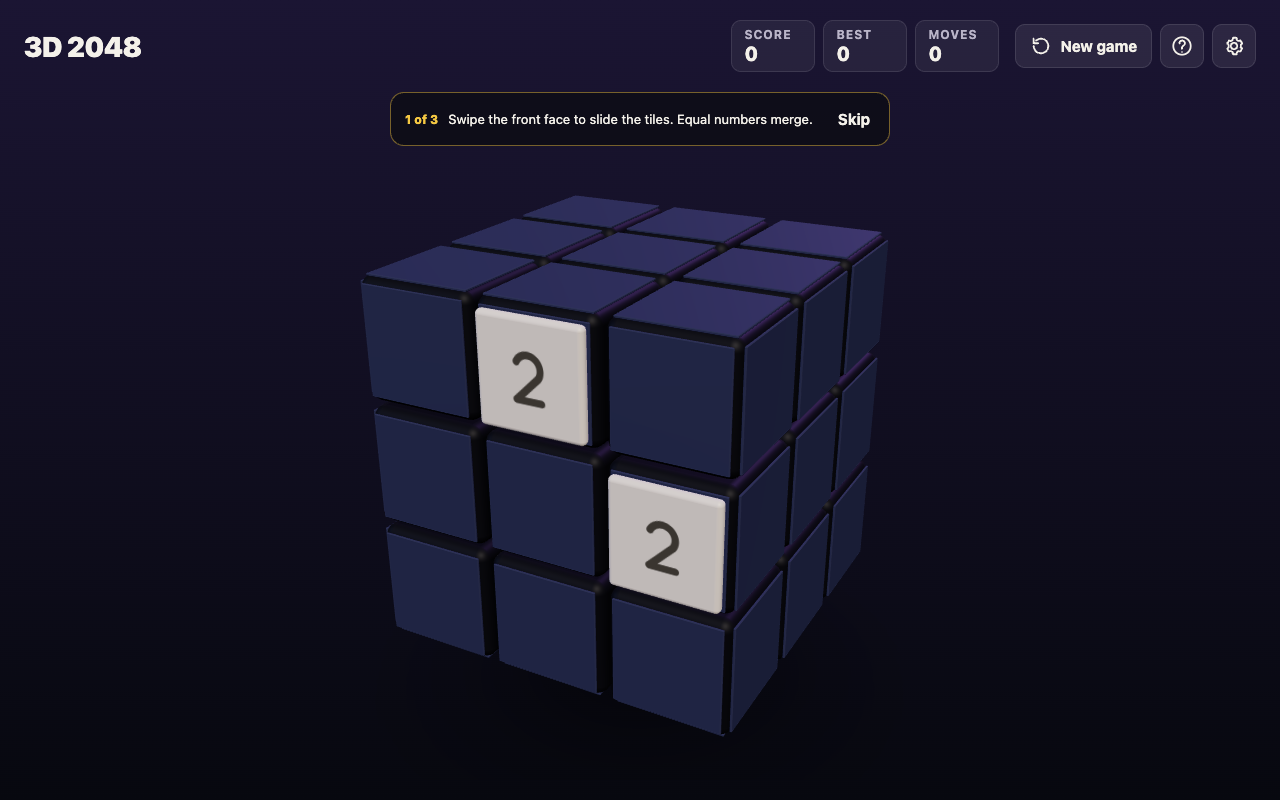
A new game of 3D 2048: each face is 3 by 3, not 4 by 4.
The corner plan may not carry over as is. A face here is only 3 by 3, and a twist moves a whole layer of tiles from one face to the next. The full controls, and a first game key by key, are in how to play 3D 2048.
Frequently asked questions
Who invented 2048?
Gabriele Cirulli, an Italian web developer, wrote it in a weekend and released it on 9 March 2014. He has said openly that it built on earlier sliding puzzles.
How old was the creator of 2048?
Wikipedia says Cirulli was nineteen when he made it.
Is the 2048 code open source?
Yes. It was released under the MIT License, and the code is on GitHub.
Did the creator of 2048 ever reach 2048?
Not by the time he wrote his README. Under the screenshot he wrote: "That screenshot is fake, by the way. I never reached 2048."
What is the highest tile in 2048?
On the original 4 by 4 grid, the largest possible tile is 131,072.
Get started
If you know the flat game, the cube version adds two moves to the slide you already know: slide the front, twist a row to bring a tile round, and turn the cube for free to look.
Play 3D 2048: it is free and plays in your browser on a computer or a phone.
Comments
No comments yet.
Sign in or make an account to comment.