Who was Ada Lovelace and what did she write?
Who was Ada Lovelace? She was the daughter of the poet Byron, and she worked closely with Charles Babbage on his planned Analytical Engine. You will often meet her name in short lists of computing pioneers, with one line attached. This post goes further. It shows you what she actually wrote, where to read it, and why people still argue about one of her sentences.
Who was Ada Lovelace?
The Stanford Encyclopedia of Philosophy entry on the history of computing gives the short version. Babbage, Lucasian Professor of Mathematics at Cambridge from 1828 to 1839, designed two machines. Lovelace, "daughter of the poet Byron", worked closely with him, and the modern programming language Ada is named after her.
Her signed name on her main work is long: Ada Augusta, Countess of Lovelace. Her notes inside it are signed with three initials, A. A. L. That is the work this post is about.
Babbage's two engines, in brief
You cannot read her notes without knowing the machines. The Stanford entry describes them this way.
- The Difference Engine was a special-purpose machine for producing mathematical tables, such as logarithm and tide tables. It was built of brass gear wheels, rods and ratchets.
- The Analytical Engine was to be "a general-purpose mechanical digital computer". It was to have a memory store and a "mill" that did the arithmetic, it could have chosen between actions based on earlier results, and it was to take its instructions from punched cards, an idea Babbage took from the Jacquard weaving loom.
A full-scale Analytical Engine was never built. A large model was still under construction when Babbage died in 1871.
What did Ada Lovelace write?
Her main work is a translation with notes. In October 1842, L. F. Menabrea of Turin, an officer of the military engineers, published a memoir on the Analytical Engine in a Geneva journal, the Bibliothèque Universelle de Genève. Lovelace translated it and added "Notes by the Translator", labelled Note A to Note G.
The notes are not a short appendix. In the full text of the Sketch of the Analytical Engine with her notes, they run longer than Menabrea's memoir itself. This post reads three of them closely.
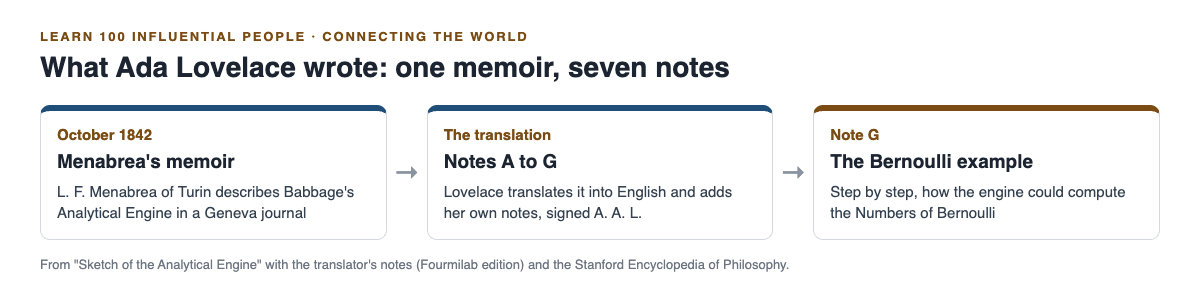
One memoir, seven notes, as the published text sets them out.
Note A: more than numbers
Note A compares the two engines. The Difference Engine, she writes, does one thing: six repetitions of the one operation, adding. The Analytical Engine is different in kind. One line about it is a picture from weaving:
"the Analytical Engine weaves algebraical patterns just as the Jacquard-loom weaves flowers and leaves."
She then goes further. The engine "might act upon other things besides number", she writes, if those things could be expressed in its terms. Her example is music. If the relations of pitched sounds could be expressed that way, "the engine might compose elaborate and scientific pieces of music of any degree of complexity or extent." The Stanford entry singles this out: Lovelace "foresaw the possibility of using the Analytical Engine for non-numeric computation".
Note E and Note G: cycles and the Bernoulli example
Note E gives repetition a name. When a group of operations repeats, she calls it a cycle: "any set of operations which is repeated more than once". It is a cycle whether it repeats twice or an indefinite number of times.
Note G closes the notes with a long worked example. She follows "in detail the steps through which the engine could compute the Numbers of Bernoulli", numbers that, as Menabrea's memoir puts it, "frequently present themselves in calculations". She says plainly why she chose a hard formula over an easy one: her object was "not simplicity or facility of computation, but the illustration of the powers of the engine." She appends "a Diagram and Table" with the details of the computation for one of those numbers.
The sentence people still argue about
Note G also opens with a warning against "exaggerated ideas" of the engine:
"The Analytical Engine has no pretensions whatever to originate anything. It can do whatever we know how to order it to perform."
In 1950, Alan Turing listed this as "Lady Lovelace's Objection" to the idea of thinking machines. The Stanford entry on the Turing test sets out both sides, and you can weigh them yourself.
- Turing's reply: he asks whether we ourselves ever do anything "really new", and points out that computers do things that take us by surprise.
- The critics of that reply: Bringsjord and colleagues (2001) call Turing's answer "mysterious" at best and "incompetent" at worst. A computer doing things we did not intend, they argue, is not the same as a computer originating something, and they propose their own "Lovelace Test".
The entry's own authors are "not overly inclined" to think Turing's reply was poor. Read the section and decide where you stand. If Turing is new to you, our post on Alan Turing's contributions to computer science covers the imitation game, the proposal that drew this objection.
A worked example: read Lovelace in one sitting
Here is a plan for about an hour with the source itself, the way a history class would read any document. It follows the same idea as our guide on how to analyze a primary source.
- Know the machine (10 minutes). Read the Babbage section of the Stanford history of computing entry. Write one line each for the Difference Engine and the Analytical Engine.
- Find the author (5 minutes). Open the Sketch. Note the title line: Menabrea wrote the memoir in 1842; Lovelace is "the Translator". Find where the "Notes by the Translator" begin.
- Read Note A (15 minutes). Find the weaving line and the music line. Write in your own words what she claims the engine could do beyond arithmetic.
- Skim Note E (10 minutes). Find her definition of a cycle. Think of one thing in daily life that is a cycle in her sense.
- Read the start and end of Note G (15 minutes). Copy out the "no pretensions" sentence. Then read why she chose the Bernoulli numbers.
- Test yourself (5 minutes). Close the page and answer: what did she write, about which machine, and which line did Turing answer?
Come back to those three questions after a day and after a week. Spaced recall like this is how you keep the answer, as our guide on how to remember historical figures explains.
Frequently asked questions
Who was Ada Lovelace in simple words?
She was the daughter of the poet Byron who worked closely with Charles Babbage on his planned Analytical Engine. She is known for her translation of Menabrea's 1842 memoir on that engine and the long notes she added to it.
What did Ada Lovelace write about the Analytical Engine?
She wrote Notes A to G to her translation of Menabrea's memoir. They include the claim that the engine could work on things besides numbers, such as music, and a step-by-step example of how it could compute the Numbers of Bernoulli.
What is Lady Lovelace's Objection?
It is Turing's name for her line that the engine "has no pretensions whatever to originate anything". Turing answered that computers can surprise us; later critics argue that answer misses her point.
Was the Analytical Engine ever built?
No. The Stanford entry says a large model was under construction when Babbage died in 1871, but a full-scale version was never built.
Get started
Ada Lovelace belongs to the story of how ideas and machines connected the world. Learn 100 Influential People teaches that story in short hands-on lessons on the 100 people who most shaped history, from Moses to the web: 46 lessons of about 9 minutes, 272 questions, and 38 cards that set out where researchers disagree. Every lesson lists its sources, and questions from lessons you finish come back, spaced out, up to 5 a day. Sign in with your email and an emailed code, and read what the site is for.
Comments
No comments yet.
Sign in or make an account to comment.