Who was Jesus? What historians can say
Who was Jesus? For many people the answer is a matter of faith, and this post does not try to settle it. It asks a narrower question: what can historians say from the surviving sources? That still tells you a lot about a Jewish preacher from Galilee whose followers took his message to the cities of the Roman Empire. The post follows Rebecca Denova's article on Jesus Christ in World History Encyclopedia, names the author's own judgments as hers, and ends with a way to weigh the sources yourself.
Who was Jesus of Nazareth, historically?
The article describes Jesus of Nazareth as an itinerant Jewish prophet from the Galilee, in the north of the land of Israel, who died around 30 CE. He preached that the God of the Jews was about to intervene in human affairs and set up his kingdom on earth.
Both his names carry meaning. Jesus is the Greek form of the Hebrew name Joshua, which the article glosses as "he who saves". Christ comes from the Greek Christos, a translation of the Hebrew word for messiah, meaning "anointed one", because anointing was part of the ritual of making a Jewish king. According to the article, "Jesus the Christ" was shortened to Jesus Christ, beginning with the letters of Paul in the 50s and 60s CE.
The world he lived in
Jesus lived under Roman rule. The Roman general Pompey conquered the region in 63 BCE and ruled through client kings, such as Herod the Great, who reigned from 37 to 4 BCE.
Many Jews of the time hoped that God would act one final time to restore Israel and raise up a messiah against its oppressors. The article says several would-be messiahs appeared, stirred up crowds at religious festivals, and were executed by Rome along with their followers. The usual method was crucifixion, Rome's punishment for treason. This is the setting in which Jesus' followers became, in the article's words, "one more sect of Jews among many at the time."
When did Jesus live? The dates
The dates are less certain than many people expect. Only two gospels, Matthew and Luke, tell of his birth, and the article calls their dates problematic: Matthew places it about two years before the death of Herod in 4 BCE, while Luke places it under the governor Quirinus, in 6 CE.
His death is firmer ground. All the gospel writers place it while Pontius Pilate was the Roman procurator, which the article dates from 26 to 36 CE. By agreement, it says, the usual date for his death falls between 30 and 33 CE.
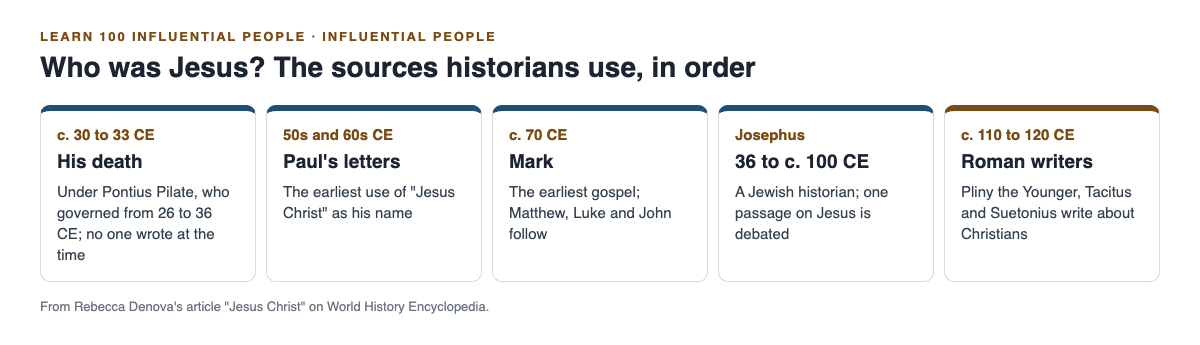
The sources in the order they were written, from the World History Encyclopedia article.
What the gospels say he taught and did
Most of what we know comes from the gospels. In the earliest, Mark, written around 70 CE, Jesus begins his work after being baptized by John the Baptist. He calls twelve disciples, which the article reads as a symbol of the twelve tribes of Israel being restored, and travels through the towns and villages of Galilee teaching through parables, stories built from everyday life. His message, in Mark's words: "Repent, for the kingdom of God is at hand" (Mark 1.15).
The gospels then take him to Jerusalem for the Passover festival, where he disrupts the animal-sellers and money-changers at the Temple. Mark presents this as the event that led to his death. After the Passover meal, which became the Christian Last Supper, he is arrested, tried and crucified on a Friday. On the Sunday, the article says, his followers claimed that his body was gone and that God had raised him from the dead.
How his followers explained his death
The article sets out a problem the first followers faced: the man they called the messiah had died by crucifixion, as a traitor to Rome, and the kingdom he preached had not come.
It describes two answers. Early Christians read the "righteous servant" in chapters 53 and 54 of Isaiah, who suffers, dies and is raised up, as a prophecy of Jesus. And they came to expect his return at a future time, the parousia, a belief the article says "remains central to Christianity". In Paul's communities, it adds, we find the earliest evidence that Jesus was worshipped alongside the God of Israel. Our post on Paul the Apostle picks up that story.
The sources historians use, and their limits
The article is plain about the main limit: "We have no contemporary sources for the life of Jesus and his ministry; no one at the time wrote anything down." Everything comes later.
- Paul's letters, from the 50s and 60s CE, are the earliest Christian writings that use the name Jesus Christ.
- The gospels come next, beginning with Mark around 70 CE. The article's author holds that they were not written by Jesus' disciples and circulated for about a hundred years before names were attached to them. That is the author's statement, and readers should weigh it as one.
- Josephus (36 to about 100 CE), a Jewish historian, mentions the death of John the Baptist and the execution of James, Jesus' brother, in 62 CE. One passage, the Testimonium Flavianum, calls Jesus the Christ, but scholars debate whether a later Christian added it.
- Roman writers come last: Pliny the Younger wrote about trials of Christians around 110 CE, and Tacitus (around 110 CE) and Suetonius (around 120 CE) tell of Nero's persecution of Christians after the fire of Rome in 64 CE.
Worked example: date and weigh the sources in 20 minutes
This exercise uses the steps from our guide to how to analyze a primary source and our post on primary vs secondary sources.
- List (5 minutes). Write the five kinds of source above in a column, with the date of each.
- Measure the gap (5 minutes). Next to each, write roughly how many years after 30 CE it was written.
- Ask who and why (5 minutes). For each, note whether the writer was a follower, a Jewish historian or a Roman official, and what that might lead each to stress.
- Write (5 minutes). Write two sentences: one fact all the sources support, and one question they leave open.
Frequently asked questions
Was Jesus a real historical person?
The article treats him as one: a Jewish preacher from Galilee executed under Pontius Pilate. Writers outside his movement, such as Josephus and later Roman historians, mention him or his followers.
When did Jesus die?
Under Pontius Pilate, Roman procurator from 26 to 36 CE; the usual date given is between 30 and 33 CE.
What does the name Christ mean?
It comes from the Greek Christos, a translation of the Hebrew word for messiah, "anointed one".
What is the earliest gospel?
Mark, written around 70 CE, according to the article.
Get started
The sources about Jesus are a lesson in how history is done: what we know, how we know it, and what stays open. Learn 100 Influential People teaches the 100 people who most shaped human history, from Moses to the web, in 46 lessons of about 9 minutes. Its 272 questions check what you learned, 38 cards set out where researchers disagree, and every lesson lists its sources. Sign in with your email and an emailed code, and read what the site is for.
Comments
No comments yet.
Sign in or make an account to comment.