Who was Moses? What history and scripture say
Who was Moses? In the Bible and the Quran, he is the prophet who led the Hebrews out of slavery in Egypt and received the Ten Commandments on Mount Sinai. For historians, the question is harder, because the story has no support outside scripture. This post sets out both: the story as scripture tells it, and what scholars make of it, from the World History Encyclopedia article on Moses by Joshua J. Mark. It gives each view fairly and takes no side.
Who was Moses in scripture?
The article calls Moses one of the most important religious leaders in world history. Judaism, Christianity, Islam and the Bahai faith all claim him as a prophet of God. His story is told in the biblical books of Exodus, Leviticus, Numbers and Deuteronomy, and he is the prophet most often cited in the New Testament.
He matters in the Quran too. The article notes that Moses is mentioned there 115 times, while Muhammad is referred to by name only four times.
The story, as Exodus tells it
In Exodus, a pharaoh who fears the growing number of Hebrews orders every male child killed. Moses' mother places him in a basket in the reeds by the Nile, and the pharaoh's daughter finds him and raises him in the palace.
As a man, Moses kills an Egyptian he sees beating a Hebrew slave, and flees to Midian. There he marries Zipporah and works as a shepherd, until God speaks to him from a bush that burns but is not consumed. Moses resists; Exodus has him say "Please send someone else". God sends him back to Egypt with his brother Aaron.
After ten plagues, the Hebrews are allowed to leave. Pharaoh sends his chariots after them, and Moses parts the Red Sea. At Mount Sinai he receives the Ten Commandments. The people then wander in the desert for forty years. Moses sees the promised land of Canaan from across the River Jordan but does not enter it; he dies on Mount Nebo, and Joshua leads the people on.
What historians can and cannot say
Here the article is plain. The Exodus story is found only in the first five books of the Bible and in the Quran. "No other ancient sources corroborate the story, and no archaeological evidence supports it." That, it says, has led many scholars to conclude that Moses was a legendary figure and the Exodus a cultural myth.
Dates are a problem too. The article gives Moses as c. 1400 BCE, but says any date for his life or the Exodus rests on readings of the Bible and is "always speculative". It dates the writing of Exodus to about 600 BCE.
Authorship is debated as well. Tradition ascribes the first five books of the Bible to Moses himself. The article reports that biblical scholarship discounts this, and holds that different scribes wrote them at different times.
The Egyptian priest theory
A second view comes from outside the Bible. The Egyptian historian Manetho, of the 3rd century BCE, told of an Egyptian priest named Osarsiph who rejected Egypt's many gods for one and changed his name to Moses. The historian Josephus repeated Manetho's story, and the Roman historian Tacitus told a similar one.
Some writers, Sigmund Freud and Joseph Campbell among them, built on this. On their theory, Moses was an Egyptian priest of the pharaoh Akhenaten (1353 to 1336 BCE), who had made the god Aten the one god of Egypt, and he led followers out after Akhenaten's death. Other scholars go further and equate Moses with Akhenaten himself.
The name is part of the argument. Exodus says the princess named him because she "drew him out of the water". The article notes that this meaning is contested, since "Moses" in Egyptian meant "child of".
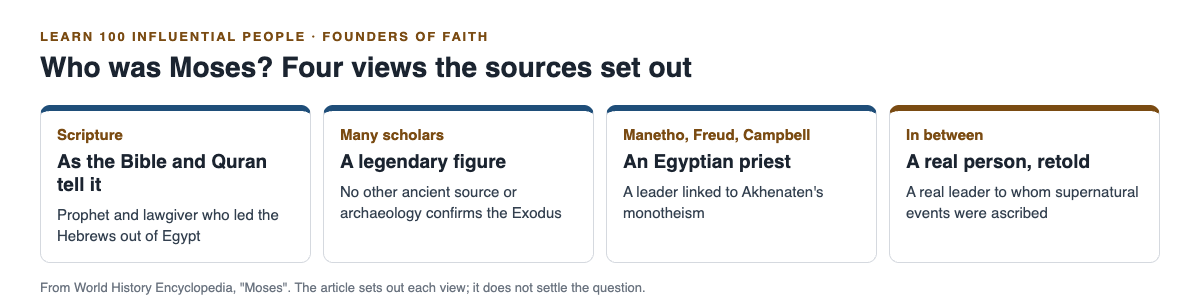
Four views the article sets out, side by side.
The hero's story and the basket in the reeds
A third reading looks at the story's shape. The article follows Joseph Campbell in seeing Exodus as a hero's story: a child cut off from his people, a call he is afraid to answer, a task he takes on anyway.
The basket in the reeds has an older parallel. The legend of Sargon of Akkad, founder of the Akkadian empire (2334 to 2279 BCE), tells of a baby set in a basket of rushes sealed with bitumen and cast into a river. The article says this story had been known in the region for almost 2,000 years when Exodus was written.
The article sums up the possibilities: Moses could have been a mythological character, a real person to whom supernatural events were ascribed, or exactly as the Bible and the Quran depict him. It does not choose, and neither do we.
A worked example: sort the claims about Moses
Here is a 15-minute exercise for any figure where faith and history meet. Draw three columns: "scripture says", "outside source says" and "scholars' theory".
- Scripture says: the basket in the reeds, the burning bush, the ten plagues, the Ten Commandments at Sinai, forty years in the desert.
- Outside source says: Manetho's Osarsiph, as told by Josephus; Tacitus' similar story.
- Scholars' theory: Moses as legend; Moses as a priest of Akhenaten; Exodus as a hero's story with a Sargon parallel.
- Test yourself: for each item, say who claims it and when they wrote. Manetho wrote in the 3rd century BCE, more than a thousand years after the article's date for Moses.
Our guide to primary vs secondary sources explains why that last question matters. For other founders of faith, read our posts on who Zoroaster was and Prophet Muhammad's life.
Frequently asked questions
Was Moses a real person?
No outside source or archaeological evidence confirms the Exodus story, so many scholars conclude he was legendary. The article also allows that he may have been a real person to whom supernatural events were ascribed, and believers accept him as scripture depicts him.
When did Moses live?
The World History Encyclopedia gives c. 1400 BCE, but says any date for Moses or the Exodus is always speculative.
Which religions see Moses as a prophet?
Judaism, Christianity, Islam and the Bahai faith all claim him as a prophet of God.
What does the name Moses mean?
Exodus links it to "drew him out of the water". The article notes that in Egyptian, "Moses" meant "child of".
Get started
Learn 100 Influential People runs "from Moses to the web". The site teaches the 100 people who most shaped human history, in war, philosophy, religion, art, science, engineering and economy, in 46 lessons of about 9 minutes, with 272 questions and 38 cards that set out where researchers disagree. Every lesson lists its sources. Sign in with your email and an emailed code, and read what the site is for.
Comments
No comments yet.
Sign in or make an account to comment.