Who was Zoroaster? The prophet behind Zoroastrianism
Who was Zoroaster? He was a Persian priest who became a prophet and founded Zoroastrianism, a faith that is still practised today. He is also known as Zarathustra. The hard part is that almost nothing about his life is certain, so this guide separates what sources say from what tradition tells, sets out what he taught, and lays out the debates scholars have not settled.
Who was Zoroaster? The short answer
World History Encyclopedia's article on Zarathustra describes him as a "priest-turned-prophet" of the Early Iranian Religion, a faith with many gods led by a chief god, Ahura Mazda. According to the tradition, he had a vision telling him that there was only one true god, Ahura Mazda, the Lord of Wisdom, and he set out to correct the old religion.
At first he was rejected. His message took hold when a king named Vishtaspa converted, and his teachings were memorised and passed down by word of mouth in the ancient language called Avestan. Centuries later they were written down as the Avesta, the scripture of Zoroastrianism.
How little we really know
The article is frank about the gaps. "There is no scholarly consensus on when Zarathustra lived or even the meaning of his name." Here is what it says, item by item:
- Dates. The dates most commonly accepted are about 1500 to 1000 BCE. Pahlavi sources put his life much later, at 628 to 551 BCE.
- Sources. The Avesta is the only source on him outside commentaries and legends, and it "does not concern itself with the details of the prophet's life".
- Birthplace. Unknown. After the faith spread, many peoples claimed him as their own, and none of the claims is more convincing than the others.
- Family. His parents' names, Pourusaspa and Dughdova, suggest Persian parents, and his family name was Spitama.
So when you read a vivid story about Zoroaster, ask where it comes from. Our guide to primary vs secondary sources shows how to sort what you are reading.
His vision and mission, as the tradition tells it
The story the article gives runs like this. Zoroaster was a priest by the age of 15 and left home at 20. He objected to the animal sacrifices the priests made. At 30, while praying by a river during a spring festival, he saw a shining being who said he had been sent by Ahura Mazda. The message: there were not many gods wanting different sacrifices, but one god who cared about how people behaved.
The other priests rejected him, his life was threatened, and he fled. A hymn in the Avesta (Yasna 46.1) gives his lament: "What land should I flee to? Where should I go to flee?"
He went to the land of King Vishtaspa, who the article says "may have been a Bactrian king or may not have existed at all" as described. In the tradition, Zoroaster won a debate with the court priests, was imprisoned, healed the king's favourite horse, and converted the king. Accounts of his death differ: one tradition says he died of natural causes at 77, another that a priest of the old religion killed him.
What Zoroaster taught
The article sums up the faith in five principles:
- There is only one God who reigns supreme: Ahura Mazda.
- Ahura Mazda is all-good.
- His eternal opponent, Angra Mainyu, is all-evil.
- Goodness shows itself through good thoughts, good words and good deeds.
- Each person has free will to choose between good and evil.
Free will is at the centre. Your choices decide your life and what happens after it. In practice, the faithful were to tell the truth and keep promises, give to those in need, love others even when it was not returned, and practise moderation. After death, the soul crossed the Chinvat Bridge, which widened for the good and narrowed for those who had chosen the side of Angra Mainyu.
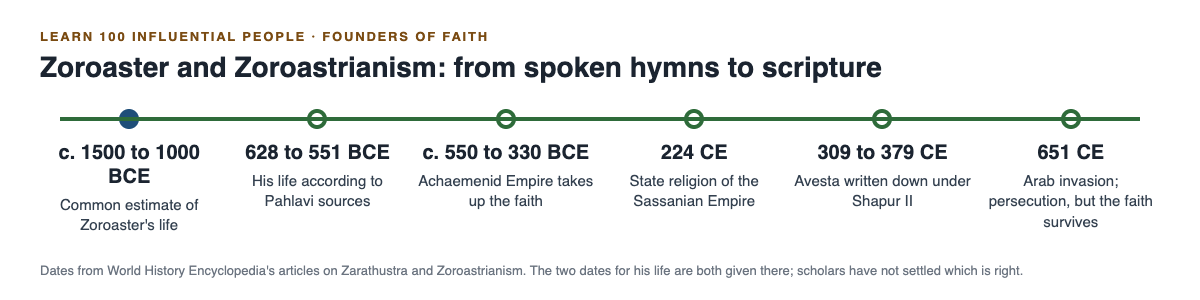
From a spoken faith to a written scripture, with the dates World History Encyclopedia gives.
From spoken hymns to the Avesta
For a long time Zoroaster's teaching lived only in memory. According to World History Encyclopedia's article on Zoroastrianism, the Avesta includes the Gathas, 17 hymns attributed to Zoroaster himself.
- The faith was taken up by the Achaemenid Persian Empire (about 550 to 330 BCE) and the Parthian Empire (247 BCE to 224 CE).
- The Sassanian Empire (224 to 651 CE) made it the state religion, and its scribes committed the scriptures to writing.
- After the Muslim Arab invasion of 651 CE, Zoroastrians were persecuted and their numbers fell sharply, but the faith survived and is still practised today.
What scholars still debate
Three questions stay open, and the two articles show each side.
When did he live? About 1500 to 1000 BCE is the common estimate, built on long scholarly work on the old Iranian religion and references in the Avesta. The Pahlavi tradition says the sixth century BCE. The article does not claim to settle it.
One god, or two powers? The Zarathustra article calls Zoroastrianism "the first monotheistic religion in the world". But the faith also has an all-evil opponent, and the Zoroastrianism article notes that the Avesta never says where Angra Mainyu comes from. One later branch, Zorvanism, made the two equal in power, a dualism, which traditional Zoroastrians rejected. In the 19th century the German scholar Martin Haug proposed that Angra Mainyu was not a god at all, with no real power of his own.
How far did he shape later faiths? The Zoroastrianism article's author holds that it was the first monotheistic faith to put forward ideas such as judgment after death, a messiah, an end-time, and heaven and hell, and calls it a precursor of later religions. That is the author's own view, stated in the article; read it alongside the uncertainty over his dates set out above.
A worked example: read a story about an ancient founder
Use the healing of Vishtaspa's horse to practise. Ask four questions:
- Where is it from? A tradition about his life, not from the Gathas he is thought to have composed.
- How old is the source? Unknown here, and the article says the king himself may not have existed as described.
- What does the story do? It explains how a rejected prophet won royal support.
- What can you safely say? "Tradition holds that Zoroaster converted a king named Vishtaspa," not "Zoroaster converted Vishtaspa in a given year."
The same four questions work for any founder of a faith. For the full method, see how to analyze a primary source in history.
Frequently asked questions
Is Zoroaster the same person as Zarathustra?
Yes. World History Encyclopedia gives Zarathustra, Zoroaster, Zartosht and Zarathustra Spitama as forms of the same name.
When did Zoroaster live?
Nobody knows for sure. The common estimate is about 1500 to 1000 BCE, while later Pahlavi sources give 628 to 551 BCE.
What is the main teaching of Zoroastrianism?
One supreme god, Ahura Mazda, and a free choice for every person between good and evil, shown through good thoughts, good words and good deeds.
Is Zoroastrianism still practised?
Yes. It was persecuted after 651 CE and its numbers fell greatly, but World History Encyclopedia says it continues to be observed today.
Get started
Zoroaster is in Founders of Faith, a Basic course on Learn 100 Influential People, with Moses, Jesus, Paul, Augustine, Muhammad and Umar. Basic courses cover "the best-known names, no background needed". Lessons take about 9 minutes, and 38 cards set out where researchers disagree, which suits a figure whose dates are still argued over. Every lesson lists its sources, which the about page says is "so you can read the original work". You sign in with your email and an emailed sign-in code.
Comments
No comments yet.
Sign in or make an account to comment.