Why Are Video Game Maps Symmetrical? Fairness Explained
Why are video game maps symmetrical? The plain answer is fairness at the start. If every side begins with the same layout, no side gets a head start from the map itself. This guide explains what fairness means in game design, what symmetry does and does not fix, and walks through a real mirrored arena from the code of a free browser tank game, so you can see the idea at work.
Why are video game maps symmetrical? The short answer
Game designers talk about this under the name game balance. Game balance is the part of design that adjusts difficulty and fairness so the game feels the way it is meant to feel.
In that field, a game is called fair if every player has roughly the same chance of winning at the start. A symmetrical map is one simple way to get there. When both sides have the same paths, the same walls and the same distances, the map itself gives nobody an edge.
That is the core of it. A mirror image of a map is a mirror image of the starting conditions.
What game balance says about symmetric games
The game balance article on Wikipedia makes three points that matter here.
- Symmetric games are fair at the start. They give all players identical starting conditions, so they are automatically fair in the sense above.
- Symmetric games still need balance. They are easier to balance, but the pieces inside them still have to be tuned.
- Most modern games are asymmetric. The amount of asymmetry varies a lot, and fairness matters even more when sides differ.
The same article adds one more point you should keep in mind. Fairness does not always mean a game is balanced. A fight can feel unfair in the moment and still be part of a well-tuned game.
So symmetry is a tool. It removes one kind of unfairness, the kind that comes from where you start. It does not remove every kind.
What symmetry does not fix on its own
Picture a map that is a perfect mirror image. Now picture a wall that blocks every road from one gate to the goal. The map is still symmetrical. It is still broken, because something cannot reach where it needs to go.
That is the gap between looking fair and being fair. A mirror copies whatever is on the first half, good or bad. If the first half has a dead end, the second half gets the same dead end.
This is why a careful map maker checks more than the shape. You also need to check that every start point can actually get to the goal. The next sections show a game that does exactly that check in its code.
How Tank City Zero Day mirrors its arenas
Tank City Zero Day is the second game on the Tank City Reboot site. You defend a CPU core from tanks that enter at the top. Every wave gets a fresh arena, made from a seed. The same seed and wave always give the same arena.
Here is what the code does, step by step.
- The arena is a grid of 13 by 13 tiles. If grids are new to you, our plain guide to tile maps explains how they work.
- The game draws the left half from the seed.
- It mirrors the left half onto the right. Half firewalls, which fill only one side of a tile, swap sides so the copy still looks right.
- It keeps some tiles clear: the three enemy gates on the top row and the tile under each, your start and its mirror, and the CPU core with its wall (columns 5 to 7 of rows 11 and 12).
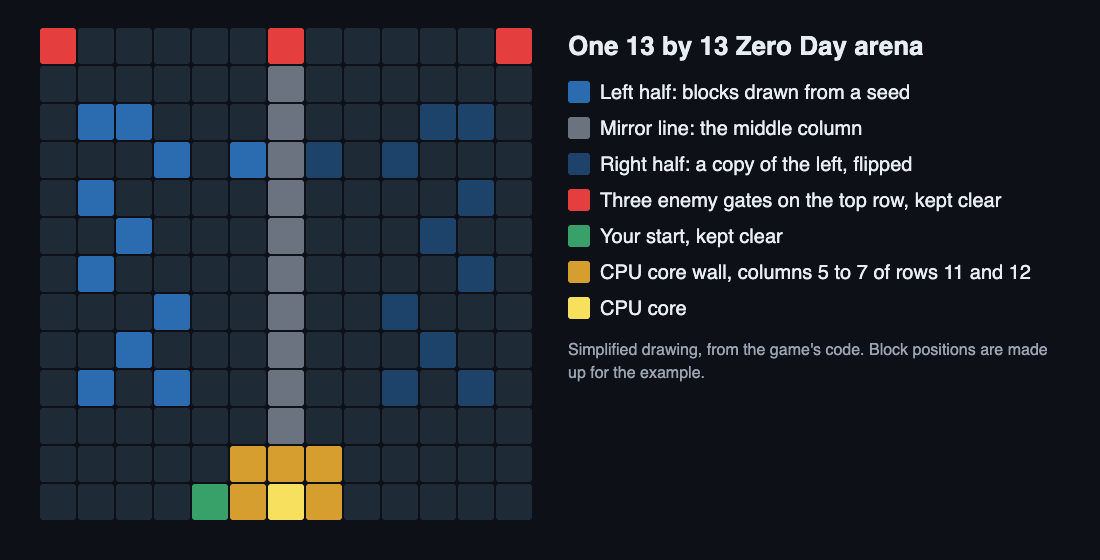
Simplified drawing, from the game's code: the left half, the mirror line down the middle column, the copied right half, and the tiles kept clear.
The comments in the code say arenas are mirror images left to right. They do not give a reason in words. What the code does make clear is that both sides of the board are built from the same half.
The fairness check: can everyone reach the core?
After the mirror, the code runs a check it calls fair. An arena is fair when every enemy gate and your start can reach the core.
The check treats each kind of tile in its own way.
- Silicon blocks the path.
- Coolant blocks the path. Tanks cannot drive through it, though shots can pass over it.
- Firewall counts as open. The code comment says why: any tank can shoot through it.
If the arena fails, the game throws it away and draws a new one from the next seed. It tries up to 40 times. If none of those pass, it falls back to a safe arena with a few firewall blocks, also mirrored.
This is the gap from the last section, closed in code. Symmetry handles the shape. The path check handles whether the shape actually works.
A worked example: reading one mirrored arena
Let us walk through a small example, like the one in the drawing above. The block positions are made up, but the rules are the game's.
Say the seed puts a silicon block at row 2, column 1. The mirror is the middle column, column 6. Column 1 is five columns left of the middle, so the copy lands five columns right of it, at column 11. Now say the seed also puts coolant at row 3, column 5. Its copy lands at row 3, column 7.
Next, the check. Start at the left gate, top row, column 0. Is there a path down to the core that goes around the silicon and the coolant? If yes, try the middle gate, then the right gate, then your start at row 12, column 4. Firewall in the way does not matter, since a tank can shoot through it.
If even one of those four starts is boxed in by silicon and coolant, the arena fails. The game draws the next one.
Here is how you can use this when you play. Because the arena is a mirror, a lane that is open on the left is open on the right too. Learn one side and you know both.
How to spot symmetry when you play
- Find the middle column. In a Zero Day arena the mirror runs down column 6, straight above the core.
- Compare the two sides. Pick a block on the left and look for its twin the same distance to the right.
- Watch the gates. The left and right gates face matching ground, so tanks from both sides meet the same walls.
- Look for firewall. It is the wall any tank can shoot through, so it never seals a path for good.
Arenas also change wave by wave. If you want to know how the rest of the game gets harder over time, see our plain guide to difficulty curves.
Frequently asked questions
Are symmetrical maps always fair?
They are fair at the start, because every side gets the same conditions. They still need balance, and a mirror can copy a flaw onto both sides.
Why do most games not use symmetrical maps?
The game balance article says most modern games are asymmetric. In those games fairness matters even more, because the sides are not the same.
Is every Tank City Zero Day arena symmetrical?
Yes. Every arena is a mirror image left to right, including the safe arena the game falls back on.
Why does firewall count as open in the fairness check?
The code comment says any tank can shoot through it. Silicon and coolant do not count as open.
Get started
The best way to see a mirrored arena is to play one and look for the middle line yourself.
Play Tank City Reboot: it is free, plays in your browser on a computer or a phone, and needs no account.
Comments
No comments yet.
Sign in or make an account to comment.