Why did a king build a castle? Orford and Henry II
Why did a king build a castle? Sometimes the answer is not "to stop an army". English Heritage's history of Orford Castle, in Suffolk, shows a king who built one for three reasons at once, none of them an army at the door. Henry II began it in the 1160s, and the page that tells its story is a good way to learn how to read any royal castle.
Why did a king build a castle? Orford's answer
English Heritage says Orford was built in the 12th century for Henry II and "was intended to curtail the power of turbulent East Anglian barons, such as Hugh Bigod of nearby Framlingham Castle". Its polygonal keep, the page adds, was built to a "revolutionary design" and is still a landmark in the Suffolk landscape.
That is one reason: a baron was too strong. The same page gives two more, and they come from a quarrel with a friend. To see why, start with the place.
A harbour, a war and an earl
Around 1100, a Norman nobleman named Robert Malet founded the town of Orford on the Suffolk coast, near Orford Ness. English Heritage says the piece of land made a naturally sheltered harbour, and Orford flourished as a port. When Malet died in 1105, his lands passed to Henry I, who gave them in 1113 to his nephew Stephen de Blois.
Stephen declared himself king in 1135, and the country fell into civil war. The Earl of Suffolk, Hugh Bigod, sided with Matilda, Henry I's only surviving legitimate child, and tried to use the war to add to his power in East Anglia. Stephen gave his own son William the earldom and land that included the Honour of Eye, a large collection of estates that contained Orford. The war ended in 1153 with Stephen still king but Matilda's son named as his successor. In East Anglia, the page says, the two groups "remained at loggerheads".
One castle, three jobs
Matilda's son became Henry II in 1154. He set about asserting his authority at once and forced both William de Blois and Hugh Bigod to surrender their castles. William died in 1159 and his property passed to the king. Henry gave the Honour of Eye to his chancellor, Thomas Becket, a trusted friend.
The trust did not last. In 1162 Henry made Becket Archbishop of Canterbury, expecting an ally in bringing the church under royal control. Becket did not oblige, and he fled into exile in 1164. The king took his lands, and, in English Heritage's words, "almost immediately began to build Orford Castle" in the Honour of Eye.
The page then sums up the move in three parts:
- Curb the baron. A new royal castle held down Hugh Bigod's power in East Anglia.
- Stamp on the archbishop. It stood on land that had been Becket's, a plain sign of who now controlled it.
- Guard a landing place. If Becket came back from France with an army, here was a possible spot to land.
Becket was allowed to return in 1170 and was murdered later that year. None of the three jobs needed a siege to be done. The castle did them by standing there.
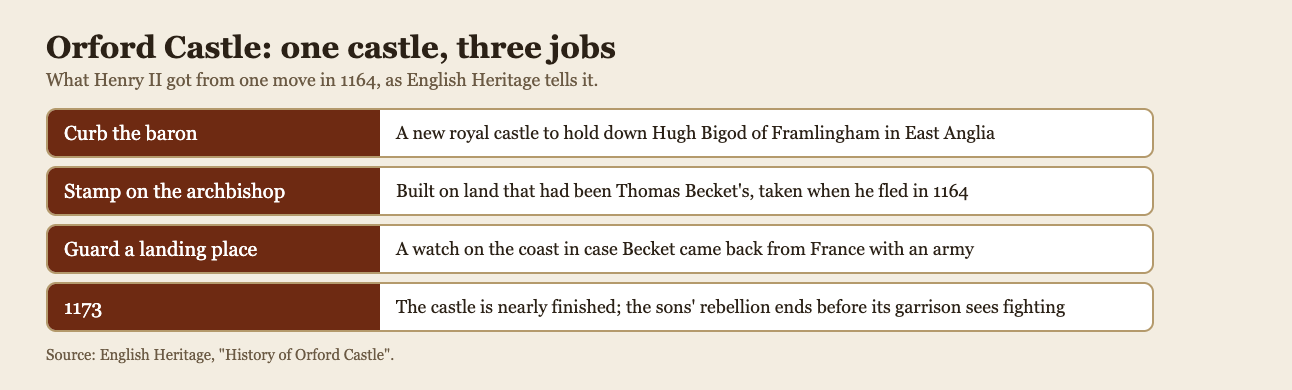
Orford in one picture: three jobs, no siege needed.
A castle that was ready, and not tested
English Heritage says the castle was nearly finished when Henry II's sons rebelled in 1173. Orford was made ready to defend, but the rebellion petered out the following year before its garrison saw fighting. A king could build a castle for a reason that never showed up as an attack, and the castle was still worth the money.
It was not the last time. When the barons rebelled in 1215, Orford was garrisoned. Prince Louis of France, invited by the barons, landed in East Anglia and captured several castles, Orford among them. A king's castle could be taken by an invader as easily as it could be held against a baron.
What a royal castle needed once it was built
The page also shows that the work did not end with the building. When the king or the sheriff's household was elsewhere, a constable ran the castle. English Heritage names one from the 1270s, Hugh of Dennington, "notorious for misusing his power": he threw one of the king's men into prison, perhaps in the dungeon under the entrance, and abused another of them, who died of his injuries. For more on the people who held a castle for a king, see what a castle constable did in a siege.
Edward I spent the night at Orford on 11 April 1277. The page says that is the only known occasion on which a reigning monarch has visited, and that he often arrived with little warning, so there would have been "pandemonium" as servants hurried to prepare. A royal castle spent most of its life without its king.
The page also keeps a stranger story from 1207. The chronicler Ralph of Coggeshall wrote that fishermen caught a "wild man" in their nets and brought him to the castellan, who kept him "many days and nights", probably at Orford. The prisoner escaped back to the sea. It says little about defence, but it shows a castle that held prisoners for the king's man.
Then the castle changed. In 1330 Robert Ufford was given it, and in the 14th century it was modernised with new hoods on the fireplaces and glass in the windows. In the 1590s, English Heritage says, Michael Stanhope probably began taking down the outer walls for stone to build Sudbourne Hall nearby. The port silted up and the town shrank. By 1804 the top of the castle held signalling equipment, and the Ministry of Works took guardianship in 1962.
A way to read any king's castle
Use three questions on any castle a king built or took. Orford answers them in order:
- Who was the king worried about? Hugh Bigod, in East Anglia.
- What else did the site do? It stood on land taken from Becket, and it watched a coast where he might land.
- Did the castle need to fight to work? Not in 1173, when the rebellion ended before the garrison saw a fight.
Try the same questions on Scarborough Castle. English Heritage says Henry II acceded to the throne and demanded the return of all royal castles, and Scarborough passed to the Crown. He began to rebuild it in 1159, and spent about £650 over ten years, "an enormous sum". The great tower took most of it, "most probably as architectural confirmation that the castle had changed hands". The worry was a lord who held a castle the crown wanted; the extra job was a show of ownership.
In Two Towers: one gate, and a reason to build
In Two Towers, a free medieval tower defense game that plays in your browser, the title screen gives the aim: "Two towers. One gate. Hold it as long as you can." You pick one of four towers for each side of the gate: Archer Tower, Trebuchet, Ballista or Fire Tower. Later you can buy a tower for each hill, for 150 gold the first and 300 the second (in-game gold, never money), and between attacks you can repair or reinforce the gate.
The game has one reason to build: the next stage. Henry II had several, and the three-question habit helps you see them. Before you spend gold in the game, ask the same thing of your own gate: who is coming, what else will this tower cover, and does it need to fire to be worth its price?
Frequently asked questions
Why did Henry II build Orford Castle?
English Heritage says it was meant to curtail the power of turbulent East Anglian barons such as Hugh Bigod, and it was begun almost at once after Henry confiscated Thomas Becket's lands in 1164.
When was Orford Castle built?
It was started in the 1160s and was nearly finished by 1173, when Henry II's sons rebelled.
Did Orford Castle ever see a siege?
English Heritage says the 1173 rebellion ended before the garrison saw fighting. It was garrisoned again in 1215, and Prince Louis of France captured it that year.
Did a king ever visit Orford?
Edward I stayed on 11 April 1277, which English Heritage says is the only known visit by a reigning monarch.
Get started
Read Orford's history page with the three questions, then play Two Towers: pick your two towers, look at what each one will cover, and see how long your gate holds.
Comments
No comments yet.
Sign in or make an account to comment.