Why do cats bring you dead animals? Not a gift, a safe place
Why do cats bring you dead animals? Cats Protection, the UK cat charity, says it is not a gift and not a hunting lesson. Your home is where your cat feels safe, so it carries its catch there to eat it in peace or keep it for later. This guide covers what to do when a mouse or bird lands on your mat, and how to cut down the hunting without punishing your cat.
Everything about cats here comes from Cats Protection's guide "Why do cats bring you dead animals?" and two of its advice pages, all opened for this article.
Why do cats bring you dead animals? The short answer
Cats are predators with a natural instinct to hunt. A cat that goes outdoors is likely to take an interest in the local wildlife and try to catch rodents, birds and other small prey. When it succeeds, it may kill and eat the animal straight away. Sometimes, though, it brings the animal back to the house, alive or dead.
The reason, Cats Protection says, is safety. When a cat catches prey, it may not want to eat it on the spot, or leave it where other animals could steal it. So it takes the catch back to its core territory, the place it knows best, where it can eat without being disturbed or store the catch for later.
For most pet cats, that core territory is your home. The charity adds a kind note: while the catch is not a present for you, it can still be read as a sign of love, because it shows your cat feels safe with you.
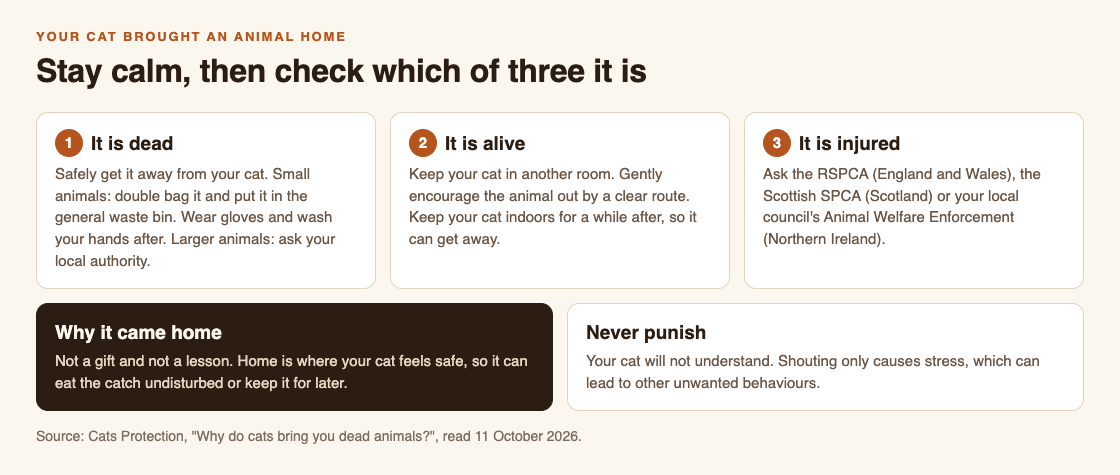
What to do, step by step, from Cats Protection's guide.
Two myths: a gift, or a hunting lesson
Two explanations are popular, and Cats Protection calls both mistaken.
- The gift. Some owners believe the cat is being generous, showing its love and providing for its family.
- The lesson. Others believe the cat is teaching its owner to hunt, showing off a good catch so you can see how it is done.
Neither fits what the charity describes. The catch comes home because home is safe, not because it is meant for you.
Hunting is not about hunger
Cats Protection says the drive to hunt is not motivated by hunger. Even a cat that is well fed at home still has an inbuilt need to chase and catch things.
On cats and play, it says the whole sequence of hunting, the stalk, the pounce, the play and the kill, releases feel-good hormones called endorphins. With no prey around, an outdoor cat will often turn the urge on fallen leaves or grass blowing in the wind.
Its garden and outdoors advice adds that you will not be able to stop a cat hunting altogether. Some cats are also more likely to hunt than others: a bold, confident cat that loves roaming outdoors may hunt more than a quieter cat that likes to settle indoors.
Why cats seem to play with their prey, and bring home odd things
If you have watched a cat with a mouse, you may have seen it catch the animal, let it go, and catch it again. It looks like a game. Cats Protection says it is a hunting technique: it tires the animal out, which makes it easier to kill and lowers the cat's own chance of being hurt.
Not everything a cat carries home is alive, or was ever alive. The charity lists leaves, branches, toys, human food, cat food and even a neighbour's washing taken from the line. These are not gifts either. The cat finds the object interesting, perhaps for its smell, or because it moves a little like prey, and brings it into its home territory to explore it safely without anyone taking it away.
If your cat brings in human food, take it out of reach or return it, since the guide says many human foods can be unhealthy or even poisonous to cats.
What to do when your cat brings an animal home: a worked example
Say you come downstairs on a Saturday morning and there is a mouse on the kitchen floor, with your cat sitting next to it looking pleased. Here is Cats Protection's advice, in order.
- Do not react, and do not punish. Your cat will not understand what it did wrong. Shouting will not stop it doing it again; it only causes stress, which could lead to other unwanted behaviours.
- Check which of three it is. Is the animal dead, alive, or alive but injured?
- If it is dead, safely get it away from your cat, since eating it could give your cat an upset stomach. For small animals such as mice, rats, rabbits, hedgehogs and small birds, put on gloves, double bag the animal and place it in your general household waste bin, then wash your hands thoroughly. For larger animals, contact your local authority for advice.
- If it is alive, put your cat in another room so it cannot get to the animal. Then gently encourage the animal out of the house. Most animals will find their own way outside if they have a clear route.
- Keep your cat in for a while. Once a live animal has gone, keep your cat indoors for a little while so the animal has a chance to get to safety.
- If it is injured, ask for advice: the RSPCA in England and Wales, the Scottish SPCA in Scotland, or your local council's Animal Welfare Enforcement in Northern Ireland.
In this example the mouse is dead, so you move your cat into the next room, bag the mouse twice with gloves on, bin it and wash your hands. Your cat gets no telling off and no fuss.
How to cut down the hunting
Hunting is natural, but Cats Protection gives four ways to protect local wildlife from ending up in your home.
- Keep your cat in from dusk until after dawn. Cats and their prey are most active at dawn and dusk, so keeping your cat indoors at those times lowers the chance of a hunt.
- Give the hunting urge somewhere else to go. Use toys such as fishing rod toys, kicker toys and feeding puzzles, in short, regular play sessions every day. Let your cat catch and "kill" the toy now and then so it does not get frustrated, and swap toys regularly.
- Keep wildlife feeders out of reach. If you feed birds in your garden, put the food somewhere your cat cannot reach, or feeding time becomes a good time to pounce.
- Feed a high quality meat diet. Cats Protection says studies have shown that a diet high in protein may make a cat less likely to hunt, and suggests a good quality food labelled "complete".
None of these will stop every hunt. If your cat also chatters at birds through the window, that is the same hunting interest showing itself from indoors.
Cats you meet on a walk, and Cat Go
On a walk you will meet cats watching a hedge or crouched in long grass. Leave them and their catch alone, and if you do want to say hello, our guide on how to approach a cat you don't know covers the calm way.
Cat Go is a game that plays in your web browser, made for walks like these. In the site's own words: "Walk anywhere, photograph a real cat, lure it with food and catch it. Every catch keeps its breed and where you found it." A catch starts with a photo. The camera screen asks you to "Fit the whole cat in the frame", you pick which breed it is, and the kibble and tuna you toss to win it over are food inside the game, never real food. A caught cat is saved to your Catdex with its breed and the place you found it.
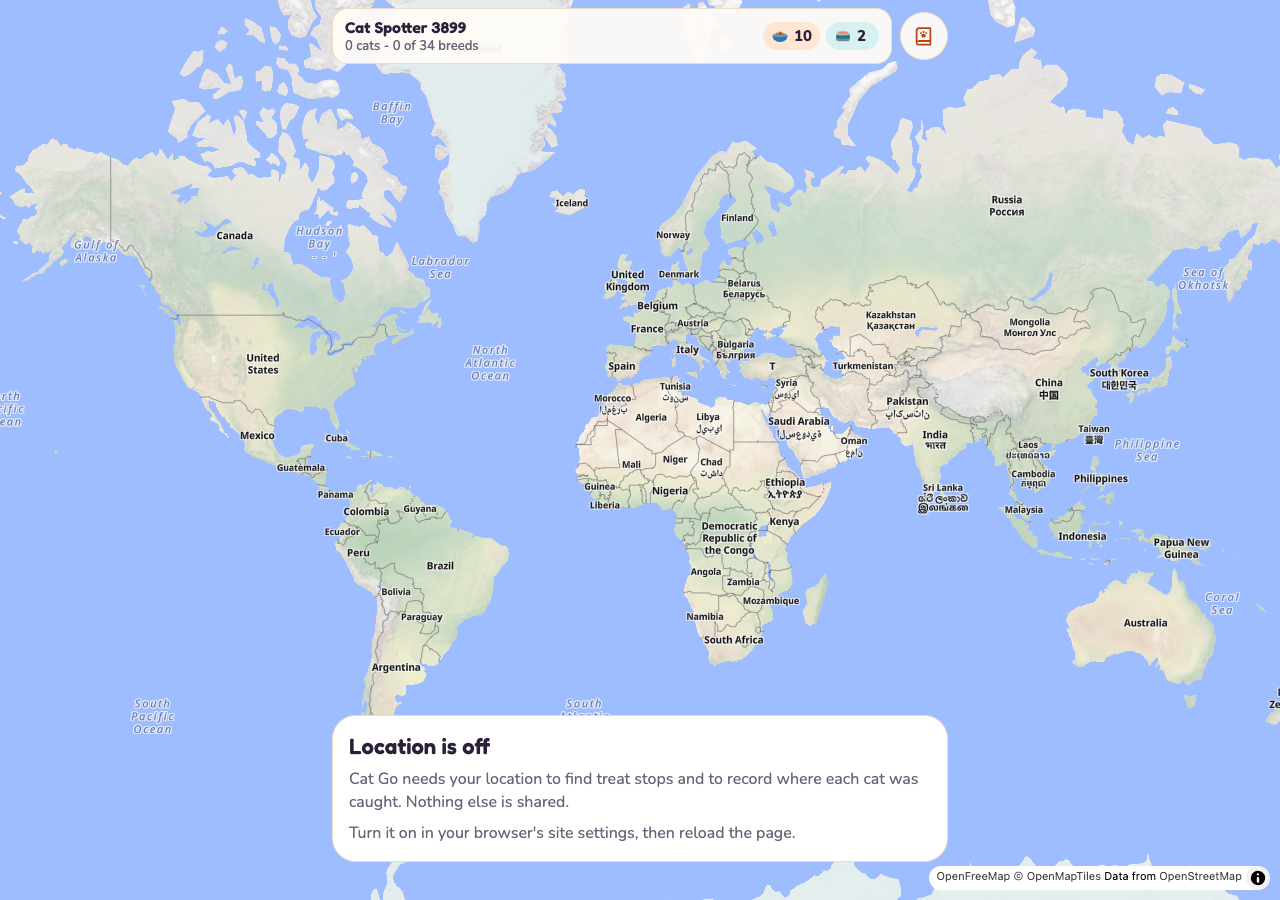
Cat Go's map, where each catch is recorded with the place you found the cat.
The game asks for two things in your browser. Location: "Cat Go needs your location to find treat stops and to record where each cat was caught. Nothing else is shared." And the camera: "Photos are only used to check for a cat and to keep a picture of your catch."
Frequently asked questions
Is my cat bringing me dead animals as a gift?
No, according to Cats Protection. Your cat brings its catch home because home is where it feels safe to eat or store it, though the charity says it can still be read as a sign your cat feels safe with you.
Should I tell my cat off for bringing in a mouse or bird?
No. Cats Protection says your cat will not understand, shouting will not stop it, and the stress could lead to other unwanted behaviours. Try not to react at all.
Will feeding my cat more stop it hunting?
Not by itself, since the charity says cats do not hunt because they are hungry. It does say studies have shown a high protein diet may make a cat less likely to hunt.
What time of day do cats hunt most?
Cats Protection says cats and their prey are most active at dawn and dusk, which is why it suggests keeping your cat in from dusk until after dawn.
Get started
Next time you walk past a cat in the grass, leave it to its business and take a photo instead. Open Cat Go in your browser, allow location and the camera, and start your Catdex with the cats you meet.
Comments
No comments yet.
Sign in or make an account to comment.