Why do cats chatter at birds? The four theories, plainly
Why do cats chatter at birds? The honest answer, from the UK charity Cats Protection, is that nobody knows for certain. Its guide to why cats chatter and chirp at birds sets out four theories instead, and says two of them are unlikely.
This guide explains what chattering looks like, each theory in turn, why a cat that can really hunt goes quiet, when chattering is worth a vet visit, and how play gives the urge somewhere to go.
What chattering looks and sounds like
Cats Protection says cats make many noises, from friendly chirrups when they say hello to urgent meows when they want breakfast. Chattering is one of the stranger ones.
The charity describes it as a cat quickly opening and closing its mouth, usually with stuttering or clicking sounds. It often comes with high-pitched chirps or tweets, and it can sound a little like a bird or a rodent. It also goes by the name twittering.
While a cat chatters, the charity says it is likely to have:
- a crouched body
- ears facing forwards
- wide eyes and a focused stare
- a tail moving from side to side
It usually happens when the cat is indoors and can see birds, rodents or other prey through a window or door. Cats Protection says it is more common in indoor cats with no access to wildlife, though cats that go outside do it too.
Why do cats chatter at birds? Four theories
Cats Protection sets out four possible reasons. It does not pick one, so neither does this guide.
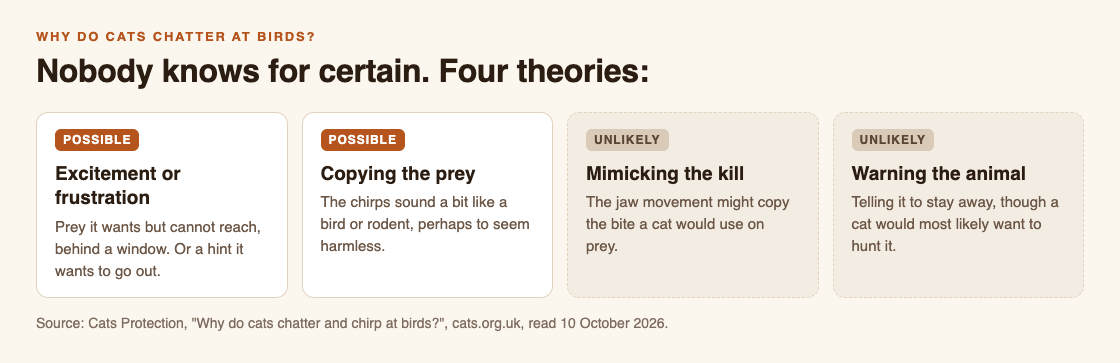
Two possible reasons, and two the charity calls unlikely. Source: Cats Protection.
- Excitement or frustration. Chattering could be a show of excitement, or the result of a surge of adrenaline at seeing prey the cat wants but cannot reach. The charity adds that it could also be the cat telling you it wants to go out and hunt, especially if chattering has got it let outside before.
- Copying the prey. Since the sound is a bit like a bird or rodent, the cat could be mimicking its prey, perhaps to seem harmless and get closer.
- Mimicking the kill. The jaw movement might copy the bite a cat would use on its prey. Cats Protection calls this theory unlikely.
- Warning the animal. The cat might be telling the other animal to stay away. The charity calls this unlikely too, since a cat will most likely want to hunt the creature.
Why a cat that can really hunt goes quiet
One detail on the charity's page helps make sense of the excitement theory. When a cat has a real chance to hunt, Cats Protection says, it is usually as silent as possible, so it does not scare its prey away.
That is why chattering tends to show up when the prey is out of reach, on the other side of a closed window. Cats Protection adds that a cat chattering at an animal it can reach may simply be excited to see something it is interested in, without wanting to hunt it.
Is chattering a problem?
Usually not. Cats Protection calls chattering and chirping a natural behaviour that is usually nothing to worry about. Not all cats chatter, and it says that is fine too.
The exception is change. If chattering is new for your cat, or it is chattering a lot more than usual, the charity says it is best to get it checked by a vet, who can look for a medical reason.
The same rule runs through its other guides: a change in the sounds a cat makes is worth a check. Our guide to why cats meow covers the rest of a cat's sounds.
Give the hunting urge an outlet: play
If chattering is normal for your cat, Cats Protection suggests play. When you see your cat chattering, try distracting it with a toy, so it can stalk, pounce and catch something as an outlet for its excitement or frustration. It adds that this keeps the wildlife outside safe from harm.
Its guide to cats and play explains why. The drive to hunt is not about hunger: hunting activity, the stalk, pounce, play and kill, releases feel-good hormones called endorphins.
Here is a week of play you can follow, using only the charity's own tips:
- Pick a fishing rod toy. Move it the way prey moves: along the ground like a rodent, or through the air like a bird.
- Keep games short. Very short games of one to two minutes are fine.
- Play often. Older cats will love playing three or four times a day; younger cats will be happy with 10 times a day or more.
- Let it win. Allow your cat to catch and "kill" the toy now and then, so it does not get frustrated.
- Keep your hands out of it. Use toys that keep the play away from your body, so the hunting is not turned onto you.
If your cat still gets wound up at the window, Cats Protection's other tip is to block the view. Cover the lower part of the windows or doors it likes to watch from with something opaque, such as cardboard or a window sticker.
Hearing a cat chirp on your walk
Once you know the sound, you may hear a cat chirp or chatter from a garden wall or a doorstep. If that cat is watching birds, it is busy. Let it be, and enjoy it from where you are.
Cat Go is a game for those walks. It plays in your web browser: "Walk anywhere, photograph a real cat, lure it with food and catch it. Every catch keeps its breed and where you found it."

Cat Go starts on a map. You tap the camera when you spot a cat.
When you spot a relaxed cat, stay where you are and tap the camera; the screen says "Fit the whole cat in the frame". The lure uses kibble and tuna that exist only in the game, and its advice is "Stay calm with your tosses", since "Cats you've startled leave quickly." For meeting a cat in person, our guide to approaching a cat you don't know covers the calm way.
Frequently asked questions
Is it normal for a cat to chatter at birds?
Yes. Cats Protection calls it a natural behaviour that is usually nothing to worry about, and says not all cats do it.
Is my cat trying to talk to the birds?
Nobody knows for certain. Cats Protection's leading theories are excitement or frustration at prey out of reach, and copying the prey's sound.
Should I take my cat to the vet for chattering?
Only if it is new, or your cat is chattering a lot more than usual. Then Cats Protection says a vet can check for a medical reason.
How can I stop my cat chattering at the window?
Cats Protection suggests short daily play with a toy moved like prey, and covering the lower part of the window so your cat cannot see the wildlife.
Get started
Next time you hear that odd clicking from the window, look at the ears, eyes and tail, then reach for the fishing rod toy. And when you are out, listen for the chirps.
Play Cat Go in your browser: walk anywhere, photograph a real cat, lure it with food and catch it.
Comments
No comments yet.
Sign in or make an account to comment.