Why do cats go crazy for catnip? What it does, plainly
Why do cats go crazy for catnip? Cats Protection, the UK cat charity, explains that a compound in the plant, nepetalactone, reaches nerve cells in a cat's nose that send signals to the parts of the brain that handle emotions and behaviour. The result looks like the reaction to a cat's own natural sex pheromones. This guide sets out what the charity says about the plant, the reaction, which cats feel it, and how to try it at home.
Everything here comes from Cats Protection's guide "What is catnip and what does it do to cats?" and its page on cats and play, both opened for this article.
What does catnip do to cats?
If you have seen a cat with catnip, you have seen some odd behaviour. Cats Protection lists what to expect:
- casual sniffing or chewing
- vigorous head-rubbing
- drooling
- rolling around
Not every cat does all of these, and some do none, as you will see below. The reaction can look dramatic, but it passes quickly, and the charity's guide explains why it happens at all.
What is catnip, exactly?
Catnip is a plant. Its Latin name is Nepeta cataria, and Cats Protection says it belongs to the mint family, which is why it is sometimes called catmint. It is native to Europe, Asia and Africa, was later brought to North America, and now grows as a weed on all those continents.
Its effect on cats is not a new discovery. The charity says science has known about it since the 1700s, though modern research has shown exactly how it works.
Why do cats go crazy for catnip? How it works
Cats Protection describes the chain in a few steps.
- A cat sniffs the plant, and nepetalactone enters the tissue inside its nose.
- There it binds to protein receptors that stimulate sensory nerve cells.
- Those nerve cells send signals to two parts of the brain: the amygdala, which handles emotional responses, and the hypothalamus, which is responsible for behaviour.
- In the brain, the signals create a reaction like the one caused by a cat's natural sex pheromones.
That is why the reaction comes from sniffing. The charity says a cat that eats catnip will not get the same effect.
How long does catnip last?
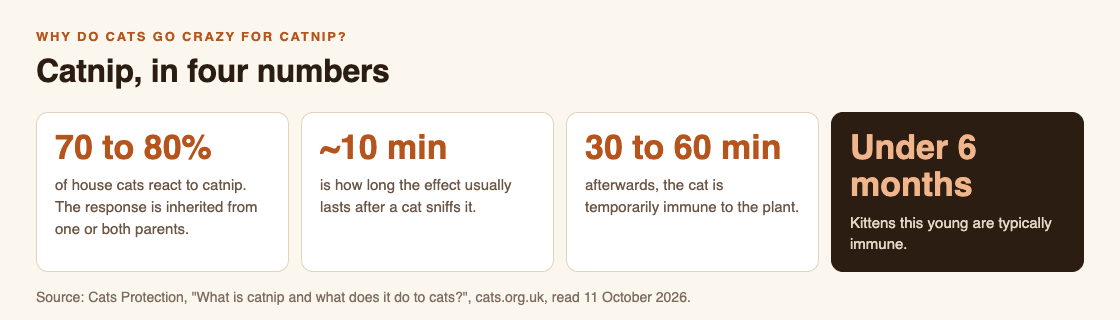
Catnip in four numbers, from Cats Protection's guide.
Not long. Cats Protection says the effects usually last around 10 minutes. After that, the cat becomes temporarily immune to the plant for 30 to 60 minutes, so offering more straight away will not restart the show. If you want to see the reaction again, wait an hour or so and try later.
Why does my cat not react to catnip?
It may simply be one of the cats that does not. Cats Protection says only around 70 to 80% of domestic cats react to catnip, and that the response is inherited from one or both parents.
Age matters too. The charity says kittens under six months are typically immune, because they have not yet reached sexual maturity. And big cats are not left out: lions, tigers and leopards can go crazy for catnip when they come across it.
Is catnip a worry if my cat eats it?
Cats Protection says catnip eaten in small doses is safe, though it will not have the same effect as sniffing. It is honest about the limits: there has not been much research on how catnip affects cats, but it is believed to be safe and non-addictive.
For people, the charity says catnip does not have the same effect, but it does have a use: it can work as an insect repellent to keep flies and mosquitoes away.
A simple catnip test at home
Want to know if your cat is one of the 70 to 80%? Here is a short test built from the charity's two pages.
- Check the age: if your cat is under six months, wait. Kittens that young are typically immune.
- Offer a catnip toy: the play page says you can buy toys stuffed with dried catnip. Give one to your cat and see what it does.
- Watch, from a distance: look for the signs above: sniffing or chewing, head-rubbing, drooling, rolling.
- Time it: expect around 10 minutes of effect, then 30 to 60 minutes when catnip does nothing. Try again later, not straight away.
- Put the toy away after: the play page warns against leaving a cat alone with toys it could shred and eat, or get tangled in, and suggests swapping toys around to keep them interesting.
If nothing happens at all, that is normal too. It is likely inherited, and your cat may love other kinds of play instead.
What about the cats you meet outside?
Catnip is for your own cat at home. A cat you meet on a walk is not yours, and our guide on how to approach a cat you don't know sets out what cat charities advise.
Cat Go is a game that plays in your web browser where the luring happens inside the game: "Walk anywhere, photograph a real cat, lure it with food and catch it." You collect in-game kibble and tuna at treat stops on the map, and toss it on screen. The game's own tip: "Tuna works much better on wary cats. Food you don't use comes back."

Cat Go's map, where treat stops for in-game food appear once location is on.
The real cat only has its photo taken; the camera screen says "Fit the whole cat in the frame". And the game warns that "Cats you've startled leave quickly. Stay calm with your tosses." Our guides on why cats love boxes and why cats knead cover more odd cat habits.
Frequently asked questions
Do all cats like catnip?
No. Cats Protection says only around 70 to 80% of domestic cats react, the response is inherited, and kittens under six months are typically immune.
How long does a catnip high last?
The charity says the effects usually last around 10 minutes, followed by 30 to 60 minutes when the cat is temporarily immune.
Can cats eat catnip?
Cats Protection says small amounts eaten are safe, but eating it does not have the same effect as sniffing. It notes there has not been much research.
Is catnip addictive?
Cats Protection says it is believed to be non-addictive, though there has not been much research on its effects on cats.
Get started
If your cat is over six months, try a catnip toy and time the reaction. And on your next walk, look out for the cats in your street.
Play Cat Go in your browser: walk anywhere, photograph a real cat, lure it with food and catch it.
Comments
No comments yet.
Sign in or make an account to comment.