Why do cats have tails? Balance, touch, talk and warmth
Why do cats have tails? Cats Protection, the UK cat charity, gives four reasons: a cat's tail helps it balance, sense what is around it, communicate with people and other cats, and keep warm. This guide explains each job, what is inside a tail, why some cats chase theirs, and how cats born without one get by.
Everything here comes from Cats Protection's guide "Why do cats have tails?", opened for this article.
Why do cats have tails? Four jobs
Cats have all sorts of tails, fluffy, thin, long and stripy. Whatever it looks like, the charity says, a tail is an important tool in a cat's daily life.
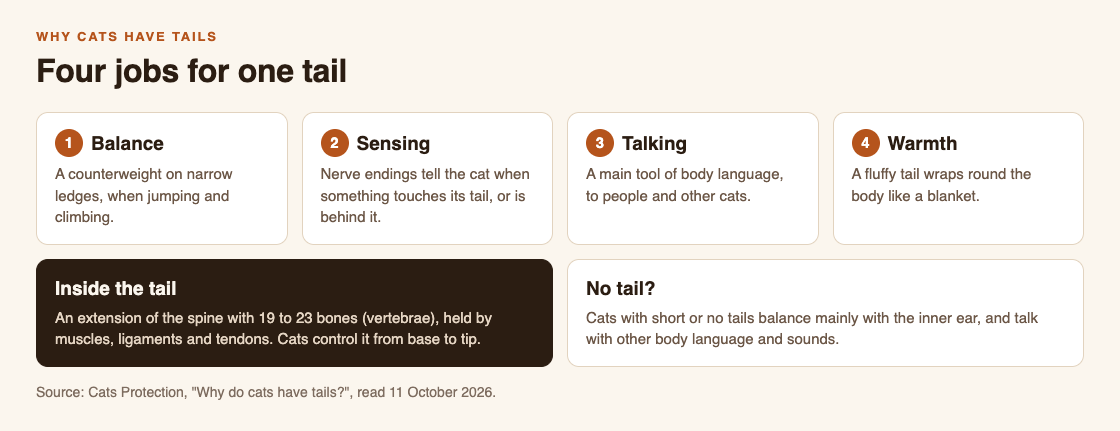
The four jobs of a cat's tail, from Cats Protection's guide.
1. Balance
The tail works as a counterweight. When a cat walks along a narrow ledge, jumps or climbs, it shifts the position of its tail to lower the risk of falling. Cats Protection compares it to the way we spread our arms to balance on a tightrope.
2. Sensing what is behind
A cat's tail has several nerve endings, so the cat can feel when something touches it. That helps it tell what is happening behind it, and whether something is sneaking up.
3. Talking
Cats mainly show their mood through body language, and the tail is one of the most important parts of it. The next section covers what the main positions mean.
4. Keeping warm
A cold cat can wrap its fluffy tail around its body like a blanket.
What a cat's tail is saying
Cats Protection gives these readings. Our longer guide on what a cat's tail position means sets out more.
- Straight up: happy and confident. If the fur at the base puffs up, the cat may be overstimulated, and it is best not to stroke it, as it could bite.
- Up and curved at the top, like a question mark, as the cat walks towards you: happy to see you and saying hello.
- Whole tail puffed up: scared or threatened. A puffed tail makes the cat look bigger and warns others to stay away.
- Slowly wagging side to side: undecided, or getting ready to pounce.
- Quickly wagging side to side: angry or upset.
- Tucked under the body: scared or stressed.
- Twitching or flicking: agitated.
- Wrapped around you or another cat: like a hug. Cats only do this with people and cats they like.
The charity adds one health note: rapid or unusual tail movements can mean a cat is frustrated, or in pain or discomfort. If you see that along with other changes in behaviour, contact your vet.
What is inside a cat's tail
A cat has full control of its tail, from the base to the tip. Cats Protection says the tail is an extension of the spine and holds 19 to 23 small bones called vertebrae, held together by muscles, ligaments and tendons that make it flexible. Most cat tails are 25 to 28 centimetres long.
The upright tail is something house cats do that big cats do not. Cats Protection's guide to how house cats are related to tigers says domestic cats are the only cats that regularly walk with the tail held up as a friendly greeting; big cats usually carry theirs level or lower.
Why cats chase their tails
Some cats chase their tails as play. The charity says cats like to chase fast-moving things because they remind them of prey such as small rodents, so a tail moving at the corner of the eye can look like prey or a toy.
Tail chasing is more common in kittens, which are learning to hunt and play, and it is normal for an adult to do it now and then. If your cat chases its tail often, it could be bored: try play with cat toys such as fishing rod toys instead. If a cat starts attacking and biting its own tail, the charity says to speak to your vet.
Cats with short, missing or crooked tails
Some cats are born with very short tails or none at all. Cats Protection says the Manx, from the Isle of Man in the Irish Sea, is the only breed with a mutation that makes it tailless, thought to come from inbreeding among the small population of cats on the island. Bobtail cats are born with very short tails, also from a genetic mutation.
These cats balance mainly with the inner ear, and show their mood with other body language and sounds such as meows. The charity notes a welfare cost: the mutation that affects the tail can also damage the spine and nerves, raising the risk of painful arthritis at a young age. A cat that loses some or all of its tail in an accident can often adapt quite well, learning other ways to balance and communicate.
A crooked tail has two main causes. One is an old injury; if your cat's tail changes, take it to the vet. The other is genetic: some Siamese cats have a kink in the tail as a natural feature of the breed, though the charity says it is gradually being bred out.
Reading a tail on a cat you meet: a worked example
Say a cat on a garden wall watches you walk by. From a polite distance, here is what its tail may be telling you, by Cats Protection's readings.
- Tail up, curved like a question mark, and the cat walks towards you: it is happy to see you and saying hello.
- Tail slowly swishing side to side: it may be undecided, or getting ready to pounce.
- Tail puffed up or tucked under: it is scared or threatened. Leave it alone.
- Tail twitching or wagging fast: it is agitated or upset. Leave it alone.
In every case, read the tail with the rest of the body. If you do want to say hello to a calm cat, our guide on how to approach a cat you don't know covers the calm way.
Photographing the tail, and Cat Go
A tail is easy to cut off in a photo. Cat Go is a game that plays in your web browser, made for walks where you meet cats: "Walk anywhere, photograph a real cat, lure it with food and catch it. Every catch keeps its breed and where you found it." A catch starts with a photo, and the camera screen asks you to "Fit the whole cat in the frame", tail and all. The kibble and tuna are food inside the game, never real food. One of the game's own tips: "Cats you've startled leave quickly. Stay calm with your tosses, and bring tuna for wary ones."
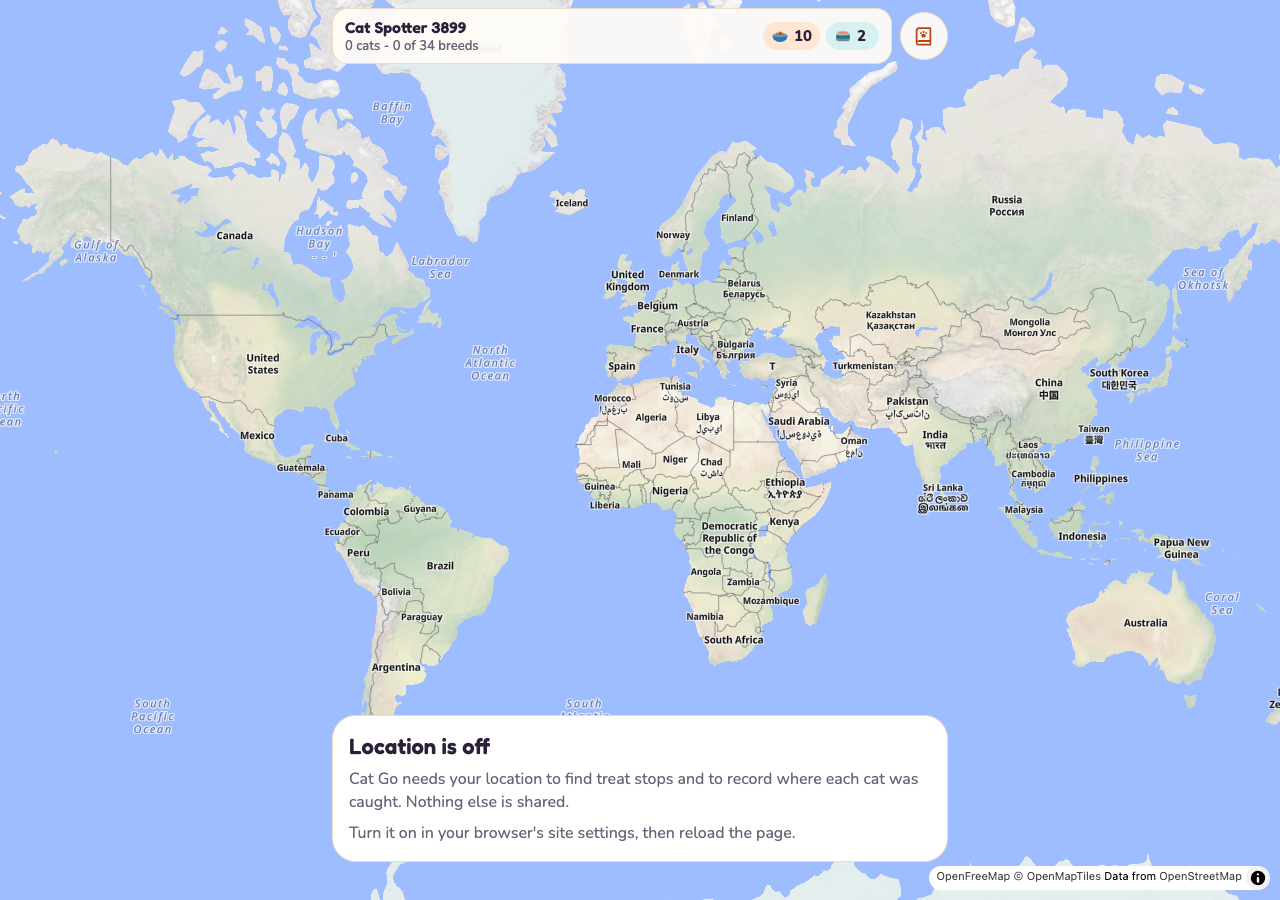
Cat Go's map, where each catch is recorded with the place you found the cat.
Frequently asked questions
Can cats control their tails?
Yes. Cats Protection says a cat has full control of its tail from base to tip, since the tail is an extension of the spine with 19 to 23 vertebrae.
Can a cat live without a tail?
Yes. Cats born without tails balance mainly with the inner ear, and a cat that loses its tail in an accident can often adapt quite well, the charity says.
Why does my cat wrap its tail around me?
Cats Protection says it is like a hug: cats only wrap their tails around people and other cats they like, as a friendly greeting.
Is it normal for a cat to chase its tail?
Now and then, yes, especially in kittens. Regular tail chasing could be a sign of boredom, and a cat that bites its own tail should see a vet.
Get started
Next time you meet a cat with its tail up, take a calm photo with the whole cat in the frame. Open Cat Go in your browser, allow location and the camera, and start your Catdex with the cats you meet.
Comments
No comments yet.
Sign in or make an account to comment.