Why do cats knead? What is known and what is still a guess
Why do cats knead? In kittens the answer is known: kneading helps the milk flow. In adult cats nobody has a settled answer. Cats Protection says plainly that no one really knows why some cats carry the habit into adulthood. This guide sets out what is known, the three ideas Cats Protection describes for adult cats, and how to read and enjoy a kneading cat without guessing past the evidence.
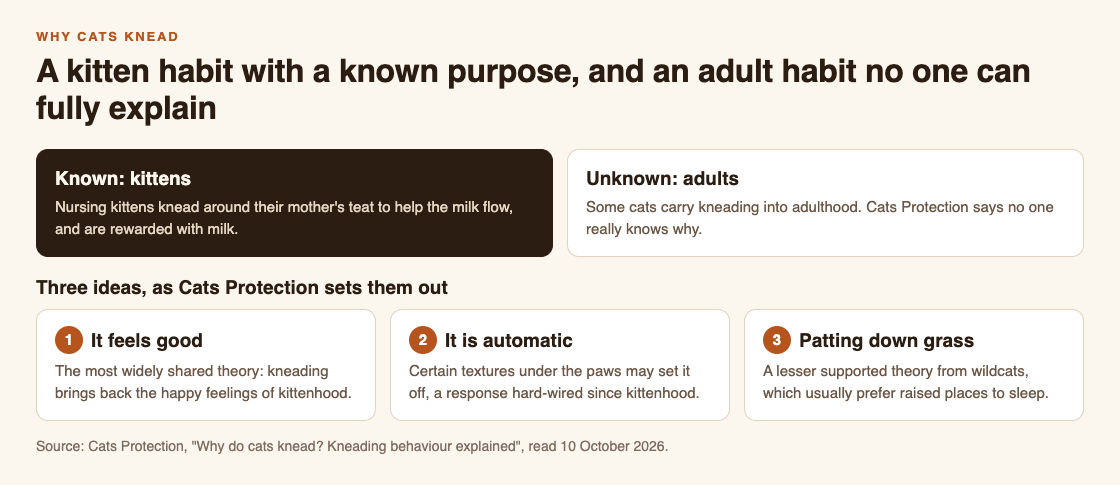
What is known about kneading, and the three ideas for adult cats. Source: Cats Protection.
What kneading is
Cats Protection's guide Why do cats knead? describes kneading as a cat repetitively pushing each front paw into a soft surface. People call it pawing, making biscuits or playing the piano.
It usually happens on something soft: a blanket, a cushion, or the person the cat happens to be standing on at the time. If a cat has ever paced on your lap, pressing left, right, left, before settling down, you have seen it.
Why do cats knead as kittens?
This part is clear. Cats Protection says kneading is a behaviour cats learn as kittens. Nursing kittens knead around their mother's teat to help stimulate the flow of milk, and the reward is milk.
So in a kitten, kneading has a job and a payoff. That is why it makes sense at that age. The puzzle is what happens next.
Why adult cats keep kneading: still an open question
Some cats keep kneading for life. Is an adult cat on your lap trying to get milk from you? Cats Protection says that is not likely, and that the real answer is that no one really knows why some cats carry the behaviour into adulthood.
It adds a careful point: adult kneading does not appear to have a purpose, but that does not mean there is none, since cats rarely show a behaviour for no reason. That leaves room for ideas. Cats Protection sets out three, and treats them as ideas rather than facts.
Three ideas about adult kneading
1. It feels good
Cats Protection calls this the most widely shared theory: when kneading, cats feel something like the happiness they felt kneading as kittens. It suggests kneading could release chemical signals in the brain linked to happy, relaxing hormones, and that a cat with no reward would likely stop. It is also clear that we do not know whether cats actually get that feel-good effect.
2. It is automatic
The second idea is that kneading is not a choice at all, but an ingrained, automatic response. The same feeling under the paws that set off kneading in kittenhood may be felt again later, so certain soft textures could start it, almost as if it were hard-wired.
3. It comes from patting down grass
Domestic cats evolved most recently from African wildcats. A lesser supported theory says kneading comes from patting down long grass to make a comfortable place to sleep. Cats Protection points out the weakness: African wildcats usually prefer to sleep in raised places, where they can watch for predators and prey, rather than on the ground. Pet cats share that liking for high places, and it suggests giving your own cat a bed off the ground.
Cats Protection ends where the evidence ends: why adult cats knead will continue to be debated and investigated. This guide leaves it there too.
How to read a kneading cat
Kneading on its own does not tell you everything. Cats Protection's cat body language page notes that cats' faces are not very expressive, so small signs say a lot. PDSA's body language guide adds two habits: think about what is happening around the cat, and look for as many signals as you can.
Signs that fit a content cat, from Cats Protection's list of happy signs:
- Relaxed eyes, or slow blinking. See why cats slow blink.
- Ears forward and relaxed. See cat ear positions.
- Relaxed whiskers and a relaxed posture.
- Cheek rubbing, or rolling on their back. See why a cat shows you its belly.
PDSA also says a happy cat may purr loudly, come and find you for a fuss, or curl up next to you. It notes that a tail twitching rapidly back and forth is often a sign a cat is getting upset or angry, so if the tail starts to lash, give the cat space.
Kneading and claws
Cats Protection ends its guide with a light warning: there is no harm in kneading, except perhaps if the cat has sharp claws. It gives no further advice on claws, so this guide does not either; if claws are a worry for your own cat, ask your vet.
A worked example: the cat on the doormat
Kneading is usually a home habit, on a lap or a blanket. But you may see a cat outside pressing its paws into a doormat or a cushion on a garden bench. Here is how to enjoy it, and how Cat Go fits in.
- Stay where you are. The cat is on someone's doorstep. You stay on the pavement and watch.
- Look past it, not at it. International Cat Care's How to greet a cat says to look beyond a cat rather than straight at it, and to blink slowly. Any greeting is an invitation the cat can decline by walking away.
- Read the rest of the cat. Soft eyes, ears forward, a still tail: a relaxed cat. A lashing tail: time to move on.
- Take the photo from the pavement. In Cat Go, tap the camera on the map. The screen says "Fit the whole cat in the frame", so include the paws mid-knead.
- Keep the rest in the game. You catch a cat in Cat Go by taking its photo; the treats and the catch happen on screen. The game's own tip fits real life too: "Cats you've startled leave quickly."
Every catch keeps its breed and where you found it, so the doormat cat goes into your Catdex with the street you met it on. For more on cats you meet outside, see how to approach a cat you don't know.
Frequently asked questions
Why do cats knead?
Kittens knead around their mother's teat to help the milk flow. Why some adult cats keep doing it is not known; Cats Protection says the most widely shared theory is that it brings back the happy feelings of kittenhood.
Is my cat trying to get milk when it kneads me?
Cats Protection says that is not likely. The behaviour is learned as a kitten and sometimes carries on into adulthood.
Is kneading a sign a cat is happy?
It is the most widely shared theory, not a proven fact. Read it with the other happy signs Cats Protection lists, such as relaxed eyes, slow blinking and a relaxed posture.
Why do cats knead blankets?
Cats Protection says cats knead soft surfaces, often a blanket, and one idea is that certain textures under the paws set kneading off automatically.
Get started
Cat Go turns the cats you meet on a walk into a collection, watched from a respectful distance. It plays in your web browser and needs the camera and location allowed.
Play Cat Go: walk anywhere, photograph a real cat, lure it with food and catch it.
Comments
No comments yet.
Sign in or make an account to comment.