Why do cats meow? What each cat sound means, plainly
Why do cats meow? According to the UK charity Cats Protection, mostly to talk to us. Its guide to how to speak cat says cats do not often meow to each other. Meowing is a learned behaviour that cats use with humans, because it usually gets a positive response.
This guide sets out what that means, the six sounds the charity's guide translates, what the chattering at birds might be, and what to look for when a cat starts meowing more than it used to.
Why do cats meow at people and not at each other?
Cats Protection's explanation is simple. A cat meows, the person reacts, and the cat remembers what worked.
Its example: if a cat meows and its owner takes that to mean it is hungry, the owner feeds it. The cat then knows that meow gets food. Over time, the charity says, a cat usually develops its own range of meows that its owner learns to recognise, such as a short meow for attention and a longer one for food.
That is why the same sound can mean "let me in" in one home and "I want some food" in another. The guide translates the meow as anything from one to the other. Each cat and household build their own small vocabulary.
Not every cat is chatty, either. Cats Protection's guide to purring notes that all cats are different, and some prefer to communicate through meows or their body language.
Meow or miaow?
Both spellings are used. Cats Protection says "miaow" is the umbrella term for a group of cat sounds, including the meow and the mew. If you are not sure which sound your cat is making, it suggests calling it a miaow.
Six cat sounds and what they mean
The charity's cat chat guide gives each sound a short translation. Here they are, in its words where it uses them.
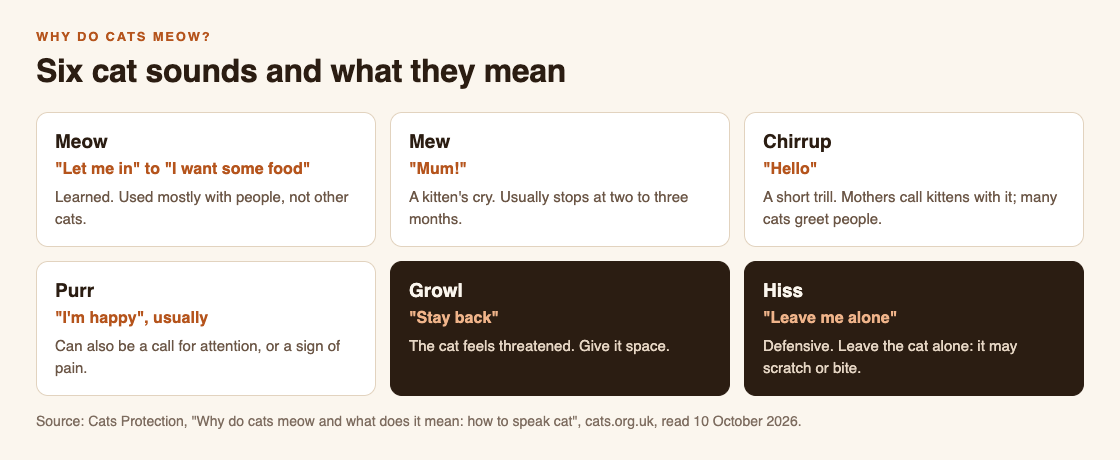
Three friendly sounds, one that depends on context, and two that mean give the cat space. Source: Cats Protection.
- Meow: anything from "Let me in" to "I want some food". Learned, and aimed mostly at people.
- Mew: "Mum!" The cry of a kitten telling its mother it is hungry or in distress. Kittens start a few days after birth and usually stop at around two to three months old.
- Chirrup: "Hello". A short trill mother cats use to call their kittens, which many pet cats also use to greet people.
- Purr: "I'm happy", with a warning. A gentle purr means all is well, and adult cats purr when content. A more urgent, higher-pitched purr can be a call for attention, and purring can also be a sign that a cat is in pain.
- Growl: "Stay back". Cats growl when they feel threatened, as a warning they will attack if the threat goes on.
- Hiss: "Leave me alone". Hissing and spitting are defensive. The charity says that if a cat is hissing, you should leave it alone, as it is likely to be a warning that it is about to scratch or bite.
The purr has its own guide on this site: why cats purr, and how to tell happy from stressed or hurting.
The chatter at birds: what is known and what is a guess
Some cats make one more sound. Cats Protection's page on why cats chatter and chirp at birds describes it as a cat quickly opening and closing its mouth, usually with stuttering or clicking sounds and sometimes high-pitched chirps. It usually happens when the cat can see birds or other prey through a window or door.
The charity is clear that nobody knows for certain why cats do it. Its theories include:
- Excitement or frustration at seeing prey it cannot reach. The page notes that a cat with a real chance to hunt is usually as silent as possible.
- Copying the prey, since the sound can resemble a bird or rodent.
It lists two more theories, a rehearsal of the bite and a warning to the other animal, and calls both unlikely. Not all cats chatter, and the page says it is nothing to worry about if yours does not.
Why is my cat meowing so much?
Cats Protection says cats rarely change their behaviour for no reason. If a cat is meowing more than normal, its first suggestion is to look at its body language.
- Ears turned out to the side or back, rather than relaxed and facing forwards, may mean the cat is anxious.
- Wide eyes and pupils may mean it is worried.
Its second suggestion matters more. If you notice a change in the type or frequency of the sounds your cat makes, the charity says it is best to take it to the vet to rule out any health problems underneath.
So a cat that has always been chatty is just a chatty cat. A cat whose sounds have changed is a reason to book a check-up.
Read the sound together with the ears
A sound means more alongside the rest of the cat. The PDSA's guide to cat body language describes the ears in three moods:
- Happy: ears usually pointing upwards and facing forward.
- Worried: ears pointing up but facing outward, listening to everything around.
- Unhappy: ears lower than normal, or even flat against the head. Unhappy cats may also hiss or swipe, and the PDSA says it is important to give them space.
A chirrup with forward ears reads very differently from a hiss with flat ones. For more on ears, see our guide to cat ear positions.
Meeting the cats you hear on a walk
Once you start listening, you hear cats everywhere: a chirrup from a doorstep, a meow from a window. The same rules apply to a cat you do not know. A hiss or a growl means leave it be, and our guide to approaching a cat you don't know covers the calm way to say hello, from International Cat Care.
Cat Go gives those walks a game that keeps your distance. It plays in your web browser, in its own words: "Walk anywhere, photograph a real cat, lure it with food and catch it. Every catch keeps its breed and where you found it."
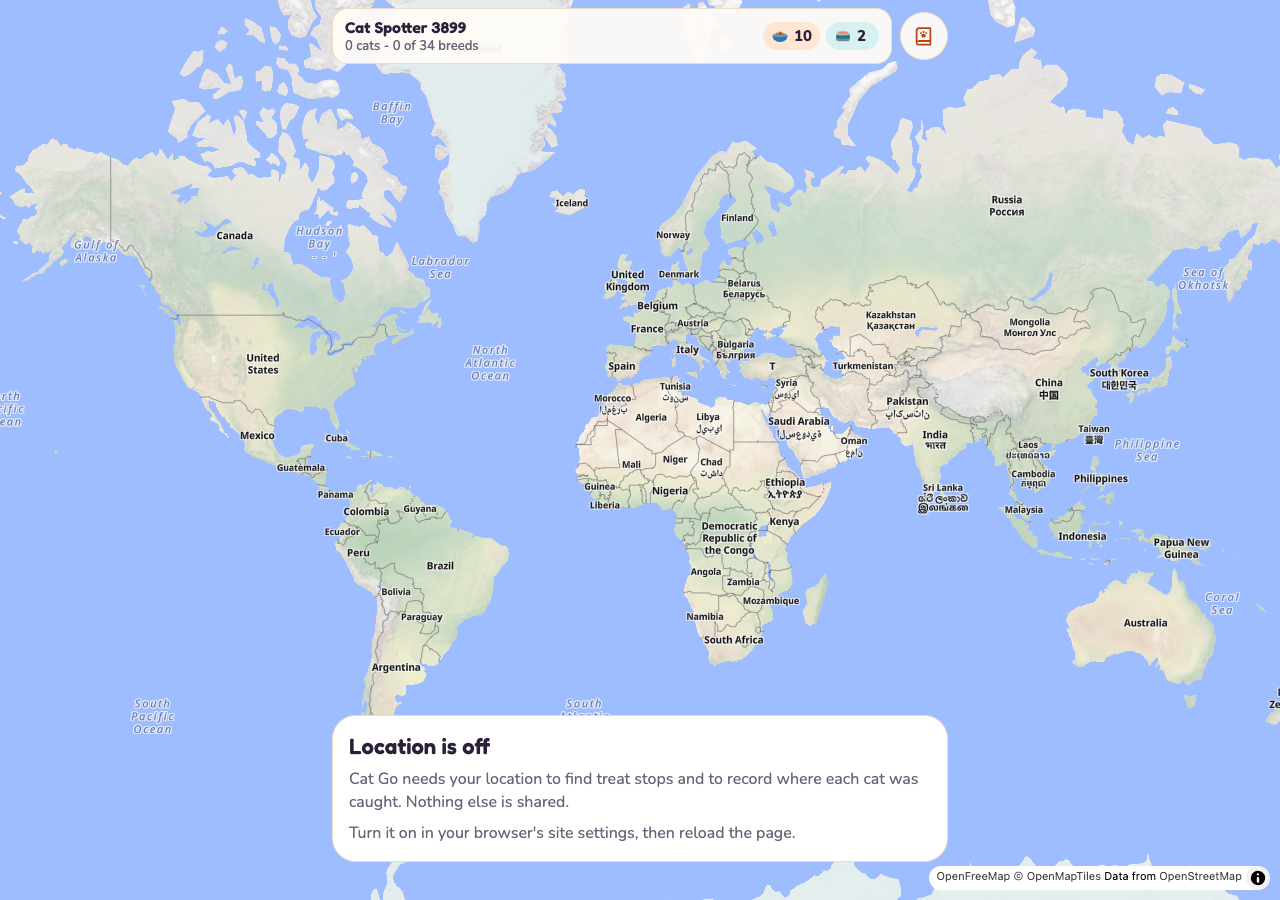
Cat Go starts on a map. You tap the camera when you spot a cat.
Here is a walk you can follow:
- Open the map and walk to a treat stop to collect kibble, and sometimes tuna. Both are food inside the game only.
- When you hear or see a cat, stop where you are and listen. If it hisses or growls, let it be.
- If it stays relaxed, tap the camera. The screen says "Fit the whole cat in the frame". Cat Go says photos are only used to check for a cat and to keep a picture of your catch.
- Pick the breed yourself from the list. The game says "Mixed breed is always a safe pick."
- Toss treats on screen to win it over. The game's own advice is "Stay calm with your tosses", since "Cats you've startled leave quickly."
A caught cat is saved to your Catdex with its breed and the place you found it, so over time you build a record of the cats on your streets.
Frequently asked questions
Do cats meow to each other?
Not often. Cats Protection says meowing is mostly a learned behaviour cats use to communicate with humans.
Why does my cat have different meows?
Cats Protection says a cat usually develops its own range of meows that its owner learns to recognise, such as a short meow for attention and a longer one for food.
When should I worry about my cat's meowing?
When it changes. Cats Protection says a change in the type or frequency of your cat's sounds is best checked by a vet to rule out health problems.
What does it mean when a cat chirps at birds?
Nobody knows for certain. Cats Protection's leading theories are excitement or frustration at prey it cannot reach, or copying the prey's sound.
Get started
Next time a cat chirrups at you from a doorstep, you will know it is probably saying hello. Take that walk with a game in your pocket.
Play Cat Go in your browser: walk anywhere, photograph a real cat, lure it with food and catch it.
Comments
No comments yet.
Sign in or make an account to comment.