Why do cats purr? Happy, stressed or hurting: how to tell
Why do cats purr? Not always because they are happy. Cats Protection says there are many reasons cats purr, and not all of them mean everything is right. PDSA agrees: for the most part a purr means a content cat, but cats can also purr when anxious, worried or in pain. This guide sets out the reasons the two charities give, the body language that tells them apart, and how to read a purring cat you meet.
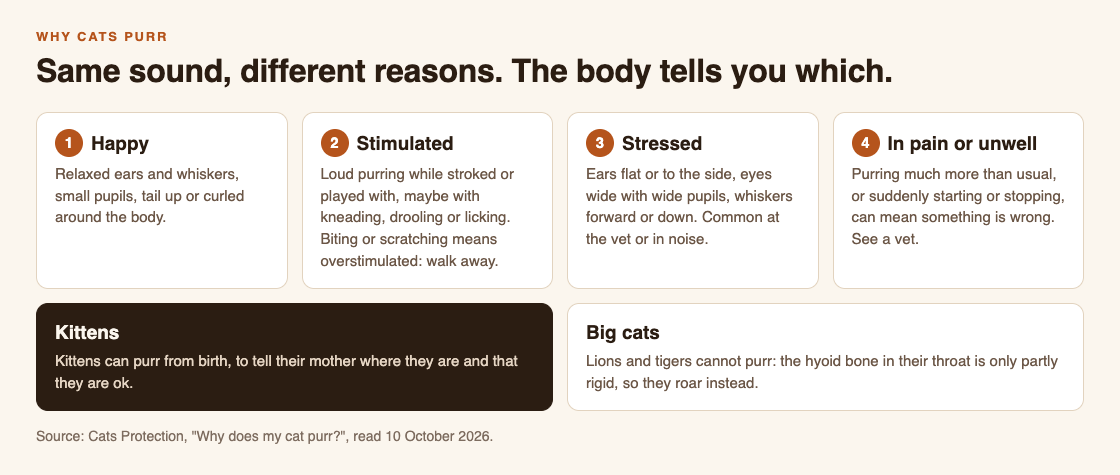
One sound, several reasons. Source: Cats Protection.
Why do cats purr? The short answer
Cats Protection's guide Why does my cat purr? puts it in one line: the reason a cat is purring usually depends on context. The sound alone does not tell you much. You need the ears, eyes, whiskers and tail, and what is going on around the cat.
PDSA says the same in its guide to cat body language. If a cat purrs at a time when it would be unusual for it to be happy, watch its body language, because that is a clearer sign of how it feels.
Purring from the start: kittens
Cats Protection says kittens can purr from birth. They use the sound to let their mother know where they are, that they are ok, and perhaps that it is feeding time. It calls this a key part of the bond between mother and kitten.
Four reasons cats purr, and how to tell them apart
1. A happy, relaxed cat
This is the purr most people picture. Cats Protection says that if a cat looks relaxed, with relaxed ears and whiskers, small pupils, and its tail pointing up or curled around it, the purring is most likely a sign it is happy. It could also mean the cat wants a bit of attention.
Its body language page adds the condition that matters: cats are happy when they purr only if their body language is relaxed. For the signs one by one, see our guides to cat ear positions and what a cat's tail position means.
2. A stimulated cat
Loud purring while a cat is being stroked or played with is, in Cats Protection's words, a sign it is stimulated. It may come with kneading, drooling and licking. Our post on why cats knead covers that habit.
It is fine to carry on, Cats Protection says, but if the cat starts biting or scratching, it may be overstimulated. Then:
- Do not punish it, since that makes a cat stressed.
- Stay calm and walk away, and leave it to calm down before giving more attention.
- If it happens often, try several short bursts of play or fuss spread through the day.
3. A stressed cat
Cats can purr when they are not happy at all. Cats Protection says a cat purring with its ears flat or turned to the side, its eyes wide open with wide pupils, and its whiskers pointing forwards or down is likely stressed. Its examples: purring at the vet, or with lots of noise and activity around. If you can, it suggests reducing or removing what is causing the stress.
PDSA gives the same example: a cat may purr at the vet even though you know it is not happy to be there.
4. Pain or illness
Both charities say purring can be a sign of pain. Cats Protection adds what to watch for:
- A cat purring a lot more than usual, or in situations where it normally would not.
- A cat that used to purr and has suddenly stopped, or one that never purred and has suddenly started.
Either can mean a cat is unhappy or unwell. Cats Protection's advice is to take it to the vet for a check-up.
What is only suspected, and why big cats cannot purr
Purring to heal: an idea, not a fact
Cats Protection describes another possible reason: cats may purr to soothe themselves and help themselves heal. It says the low frequency vibrations of a purr are suspected to help, which is a careful word. Treat it as an idea under study, not a fact.
It also says not every cat purrs. Some cats prefer to show how they feel in other ways, such as meowing or body language.
The bone that decides it
Cats Protection explains this with one small bone. In small cats, like bobcats, lynxes, cheetahs, cougars and pet cats, the hyoid bone at the back of the throat is completely rigid. When the voice box vibrates, the hyoid reverberates and makes the low rumble we call purring. In big cats such as lions and tigers, the hyoid is only partly rigid, so they can roar but not purr.
A worked example: the purring cat on the gate
You stop on a walk and hear a cat purring on a garden gate. Here is how to read it, with Cat Go open in your browser.
- Stay on the pavement. The gate is someone's property. You are there to look.
- Do not stare. Cats Protection says staring can feel like a threat. If the cat looks relaxed, blink slowly and turn your head slightly to the side. See why cats slow blink.
- Read the body, not the sound. Relaxed ears and whiskers, small pupils, tail up: likely a happy purr. Ears flat, wide pupils, whiskers forward: likely stress, so move on.
- Take the photo from where you stand. In Cat Go, tap the camera on the map. The screen says "Fit the whole cat in the frame."
- Keep the rest in the game. You catch a cat in Cat Go by taking its photo; the treats and the catch happen on screen. The game's tip fits the real cat too: "Cats you've startled leave quickly."
Every catch keeps its breed and where you found it, so the gate cat goes into your Catdex with the street you met it on.
Frequently asked questions
Why do cats purr?
For several reasons. Cats Protection lists happiness, wanting attention, stimulation, stress and pain, and says the reason usually depends on context.
Does purring always mean a cat is happy?
No. PDSA says cats mostly purr when content, but can also purr when anxious, worried or in pain, for example at the vet.
Why does my cat purr and then bite?
Cats Protection says loud purring while stroked can mean a cat is stimulated, and biting can mean it is overstimulated. Do not punish it; walk away and let it calm down.
Can lions purr?
No. Cats Protection says the hyoid bone in big cats' throats is only partly rigid, so they roar instead of purring.
Get started
Cat Go turns the cats you meet on a walk into a collection, watched from a respectful distance. It plays in your web browser and needs the camera and location allowed.
Play Cat Go: walk anywhere, photograph a real cat, lure it with food and catch it.
Comments
No comments yet.
Sign in or make an account to comment.