Why does a cat show you its belly? What the roll means
Why does a cat show you its belly? Two cat charities give the same short answer. Cats Protection lists rolling on their back among the signs a cat is happy, and PDSA says a relaxed cat might greet you by rolling on their back, then adds a warning: this does not usually mean they want belly rubs. This guide sets out what the roll means, how to read it with the rest of the cat, and what to do instead of reaching for the belly.
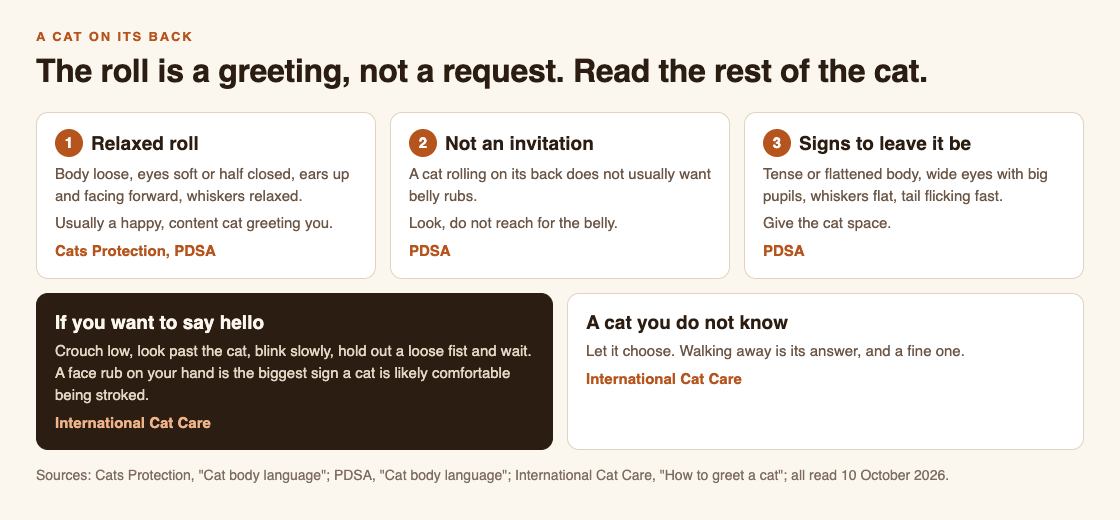
The roll is a greeting, not a request. Sources: Cats Protection, PDSA and International Cat Care.
Why does a cat show you its belly? The short answer
It is usually a sign of a content cat. On the Cats Protection body language page, rolling on their back sits in the list of signs a cat is happy, next to an upright tail, relaxed eyes, relaxed whiskers, cheek rubbing, slow blinking and ears forward and relaxed.
PDSA puts it in the same place. In its guide to cat body language, a happy cat looks completely relaxed and might greet you by rolling on their back.
So the roll is often a hello from a cat at ease. The part people get wrong is what comes next.
A roll is not a request for a belly rub
PDSA's words are plain: rolling on their back "doesn't usually mean that they want belly rubs!" The roll says something about how the cat feels. It does not ask you to do anything.
That matters because a hand moving toward a cat is an action, and International Cat Care says every greeting should be an invitation the cat can turn down. In its guide How to greet a cat, a cat should always be able to decline by walking away. Cats that learn you leave them in control become more likely to want to interact.
A good rule, then: enjoy the roll, and do not answer it with your hand on the belly.
Read the rest of the cat, not just the roll
Cats Protection notes that cats have not evolved lots of facial muscles, so their faces are less expressive than a dog's, and small changes in body language say a lot. PDSA adds two habits worth keeping: think about what is happening around the cat, and look for as many signals as you can, since the same sign can show up when a cat is happy and when it is not.
When a cat is on its back, check these, one at a time:
- Eyes. PDSA says a happy cat's eyes look more almond shaped than round, and may be half closed when it is lying down. Slow blinking usually means a cat is content. Our post on why cats slow blink sets out what the research says.
- Ears. A happy cat's ears usually point upwards and face forward. Ears to the side or back are on Cats Protection's list of signs a cat is unhappy. The cat ear positions guide has the full set.
- Whiskers. Relaxed whiskers are a happy sign for Cats Protection. PDSA says a frightened cat often has its whiskers flat against its face or bunched together.
- Tail. PDSA says a tail twitching rapidly backwards and forwards is often a sign a cat is getting upset or angry. See what a cat's tail position means for more.
- Body. Loose and relaxed fits the happy roll. A very tense body, fur standing on end, or a cat pressed flat to the ground are signs PDSA gives for a cat that is unhappy.
Signs a cat on its back wants to be left alone
Some signals mean the kindest thing is to give the cat space. These come from the two charities' lists of signs a cat is worried or unhappy:
- Eyes open wide with big pupils. PDSA notes pupils also grow in low light or when a cat is very excited, so read them with the rest.
- Ears turned to the side or back.
- Whiskers flat or bunched together.
- A tail flicking fast.
- Hissing and swiping, puffed-up fur, or slow, guarded movement (Cats Protection).
If you see these, step back. You do not need to do anything else.
What to do instead: a calm hello
International Cat Care's greeting steps work whether a cat is on its back or on its feet. They are written for the cats in our homes and the cats we care for. With a cat you do not know, stop at the looking part: let it choose, and if it has an owner nearby, anything more is the owner's call.
- Get low. Crouch, sit or kneel rather than leaning over the cat, and never corner it.
- Look past it. Avoid facing the cat straight on. Look beyond it and blink slowly.
- Offer a loose fist. Hold your arm out with a loosely clasped fist, about the size of a cat's head, and keep it there rather than reaching further.
- Wait for the answer. A sniff is a good sign. International Cat Care calls a face rub on your hand the biggest signal that a cat is likely comfortable being stroked.
- Keep it short. With a cat you know, it suggests stroking the cheeks or under the chin for 3 to 5 seconds, then stopping to wait and watch. If the cat wants more, it will likely rub against you again.
Notice what is missing from that list: the belly. The guide points to the cheeks and chin, and says cats tend to prefer short, frequent, low-intensity contact over long bouts of stroking. Our post on how to approach a cat you don't know covers the first meeting in more detail.
A worked example: the cat on the wall
You are on a walk and see a cat stretched on its back on a sunny garden wall. Here is one way to handle it, step by step, with Cat Go in your pocket.
- Stop where you are. The wall is someone's property, so you stay on the pavement. You are there to look.
- Read the cat. Eyes half closed, ears up and forward, tail still. By the charities' lists, that looks like a relaxed cat.
- Do not reach. A roll is not a request, so your hands stay by your side. If the cat sits up and walks off, that is its answer.
- Take the photo from where you stand. Open Cat Go in your browser and tap the camera on the map. Cat Go needs your location before the photo, because each catch records where the cat was found. The camera screen says "Fit the whole cat in the frame", and a cat stretched on its back is long, so leave room on both ends.
- Pick a breed. If the game finds a cat, it asks "Which breed is it?" It also tells you "Most cats you meet are mixed breed" and "Mixed breed is always a safe pick."
- Lure it in the game. You toss in-game treats, kibble and tuna you collected at treat stops on the map. If the cat gets away, the game says cats you've startled leave quickly, with the tip "Stay calm with your tosses." The real cat on the wall gets nothing but a look.
If the game finds no cat in the photo, you see "No catch this time" and "Scanning is free - no food was used." Try again with the whole cat in the frame.
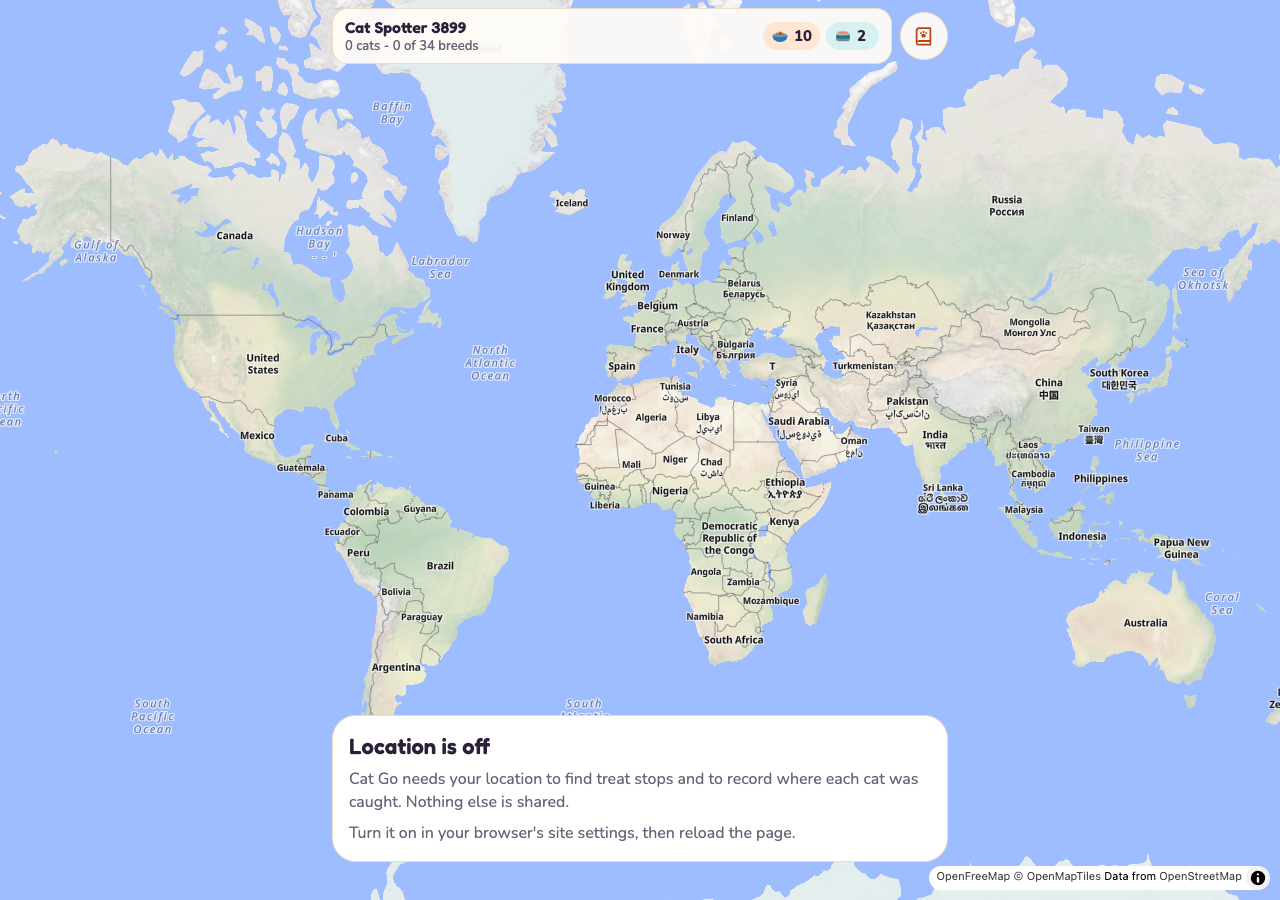
Cat Go starts on a map. You tap the camera when you spot a cat.
Frequently asked questions
Why does a cat show you its belly?
Cats Protection lists rolling on their back as a sign of a happy cat, and PDSA says a relaxed cat might greet you that way. It is usually a hello from a cat at ease.
Does a cat on its back want a belly rub?
Not usually. PDSA says rolling on their back does not usually mean a cat wants belly rubs, so enjoy the moment without reaching for the belly.
How can I tell if a rolling cat is relaxed?
Read the rest of it. Soft or half closed eyes, ears up and forward, relaxed whiskers and a loose body fit a happy cat; wide eyes, ears back, flat whiskers or a fast flicking tail mean give it space.
Where do cats like to be stroked?
International Cat Care suggests the cheeks or under the chin, for 3 to 5 seconds, and only after the cat rubs its face on your hand. Then stop and let the cat decide whether it wants more.
Get started
Cat Go turns the cats you meet on a walk into a collection, without touching any of them. It plays in your web browser and needs the camera and location allowed. Every catch is saved to your Catdex with its breed and the place you found it.
Play Cat Go: walk anywhere, photograph a real cat, lure it with food and catch it.
Comments
No comments yet.
Sign in or make an account to comment.