Why does integrity matter? Five accounts and a self-check
Why does integrity matter? You notice it most when it is missing: a friend who says one thing to your face and another behind your back, or a moment when you went along with something you knew was wrong. The Stanford Encyclopedia of Philosophy entry "Integrity", by Damian Cox and Marguerite La Caze (first published in 2001, substantively revised in September 2025), opens with this: "Integrity is one of the most important and oft-cited of virtue terms." It adds: "It is also perhaps the most puzzling." This post sets out the five main accounts of personal integrity in the entry, who holds each, and the objections to each, with no verdict. Then you can try a short self-check.
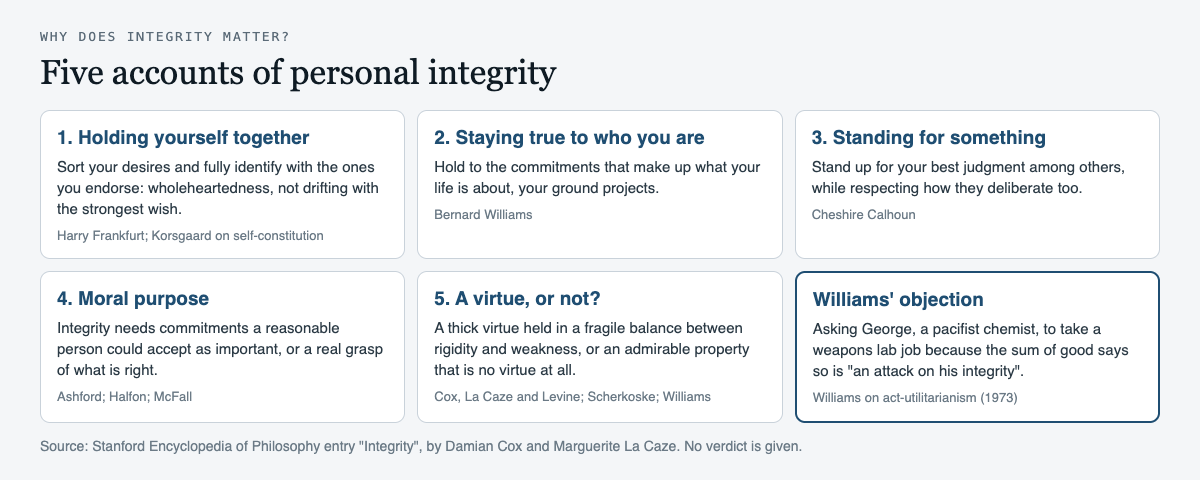
Why does integrity matter at all?
Start with the word. Applied to things, the entry says, integrity refers to "the wholeness, intactness or purity of a thing". "A database maintains its integrity as long as it remains uncorrupted by error". The same ideas of wholeness and being uncorrupted carry over, in part, when we speak of people.
The authors note two pulls in how we talk about personal integrity. One says it is a relation you have to yourself, a matter of how the parts of your life hang together. The other says it is tied to acting morally, so not just any life can count. That tension is why the question of why integrity matters has more than one answer.
Integrity as holding yourself together
On the self-integration view, integrity means "integrating various parts of their personality into a harmonious, intact whole". The entry draws on Harry Frankfurt. We have desires, and higher-order desires about which of those to act on. A person who simply follows the strongest desire of the moment is what Frankfurt calls a wanton. A person who sorts their desires and fully identifies with the ones they endorse reaches what he calls wholeheartedness. On one reading of this view, wholeheartedness just is integrity.
Critics push back. A used car seller wholeheartedly devoted to getting the highest price, lies included, may be perfectly integrated, yet nobody would praise his integrity (the entry cites Halfon here). McFall notes that you cannot say with a straight face that someone shows integrity in a "single-minded pursuit of approval". Cheshire Calhoun argues that tidying away all inner conflict can mean walking away from parts of life that make real claims on you.
Christine Korsgaard takes the idea further. For her, integrity is "a precondition of being an agent at all": to fail at it is to be a collection of strivings rather than a self. She sums it up as "The moral law is the law of self-constitution."
Integrity as staying true to who you are
The identity view is linked most closely with Bernard Williams. Here integrity means holding to your "identity-conferring commitments", sometimes called "ground projects": the commitments that make up what your life is about. On this view, to act with integrity is "to act in a way that accurately reflects your sense of who you are".
Williams used this to criticise act-utilitarianism, the view that you should always pick the action that does the most good overall. His example is George, a chemist and committed pacifist who needs work. He is offered a job in a lab doing chemical and biological weapons research. If he refuses, a keener chemist will take it. The utilitarian sum may say take the job. Williams says that asking George to drop his deepest commitment because the sum points elsewhere alienates him from his own actions: "It is thus, in the most literal sense, an attack on his integrity."
Integrity as standing for something
Calhoun argues that integrity is mainly a social virtue. Persons of integrity "stand up for their best judgment within a community of people trying to discover what in life is worth doing". In her words, "Persons of integrity treat their own endorsements as ones that matter, or ought to matter, to fellow deliberators."
This view helps explain why a fanatic lacks integrity even though fanatics are very consistent: they "lack proper respect for the deliberations of others". The hard part, the authors note, is saying what proper respect comes to, since people admired for integrity often refuse to back down.
Integrity as moral purpose
Other accounts build morality in directly. Elizabeth Ashford defends what she calls objective integrity: "Objective integrity requires that agents have a sure grasp of their real moral obligations". The entry objects that we often call someone a person of integrity while disagreeing with their moral views.
Halfon ties integrity to "pursuing a commitment to do what is best". That leads him to admit that a genocidal Nazi could, in principle, have integrity, which he thinks "possible, but not at all likely". Others reject that result. McFall argues that a person whose only aim is pleasure, approval or money lacks the core that integrity needs: "one must have something to sell". She holds that we grant integrity only to people with "commitments which a reasonable person could accept as important".
Is integrity a virtue?
Williams says no. Integrity "is an admirable human property", but it is "not related to motivation as the virtues are": it does not move you the way generosity does or enable you the way courage does. Greg Scherkoske answers that "Integrity is an epistemic virtue", a habit of mind that puts you in a good position to know.
Cox, La Caze and Levine argue instead that integrity is "a complex and thick virtue term", best grasped by what defeats it. It is threatened on one side by arrogance, dogmatism and rigidity, and on the other by weakness of will, self deception and hypocrisy. "The person of integrity lives in a fragile balance between every one of these all-too-human traits". Robert Audi and Patrick Murphy call the worry with this approach the "blunt instrument problem": it gives no clear judgment in hard cases. For a related look at sticking with people and causes, see what loyalty is and when it goes wrong.
A worked example: a five-question self-check
Take one case. Your manager asks you to tell a client that a project is on schedule. You know it is two weeks late. Run it through each account, one question at a time.
- Self-integration (Frankfurt). Which of your desires do you endorse here: keeping your manager happy, or being someone the client can rely on? Can you act on the one you endorse?
- Identity (Williams). Is honesty with clients part of what your working life is about? If so, saying the line would cut against who you take yourself to be.
- Standing for something (Calhoun). Have you told your manager your own judgment, plainly, and listened to theirs? Going quiet to avoid trouble is the failure she names.
- Moral purpose (Halfon, McFall). Have you weighed the facts with care? Is the commitment you would be keeping one a reasonable person could accept as important?
- The fragile balance (Cox, La Caze and Levine). Are you sliding toward hypocrisy, or toward rigidity, such as refusing any wording your manager suggests?
There is no score. The point is to see which account your own answer turns on, and where you feel the pull most.
On Dear Superintelligence, people write letters to the AI of the future about what they value. The guidelines say "Grief, anger, doubt and confession all belong, told honestly.", and the About page asks letters to be honest about our failures, so a letter about a time you kept your integrity, or lost it, fits well. The site applies the other sense of the word to its own records too: each letter in the open data carries a content hash, so a copy can be checked against what the site published. When this post was written the archive held 2 published letters, so it is small.
Frequently asked questions
What is personal integrity in simple terms?
There is no single agreed definition. The main accounts treat it as holding yourself together, staying true to your deepest commitments, standing up for your best judgment, or a commitment to doing what is right.
Can a bad person have integrity?
Philosophers disagree. Halfon allows it is possible but unlikely, while McFall and others hold that integrity needs commitments a reasonable person could accept as important.
Is integrity the same as honesty?
Not quite. Honesty is part of several accounts, and lying about your views is a failure on Calhoun's account, but integrity also covers how your commitments fit together and whether you stand by them.
What was Williams' objection to utilitarianism?
Williams argued that act-utilitarianism asks people to set aside their deepest commitments whenever the sum of good points elsewhere. He called that, in the case of George the pacifist chemist, an attack on his integrity.
Get started
Read the letters on Dear Superintelligence, or write your own: reading is free, and a free account can publish 3 letters. People read them today. Nobody can promise what future AI systems will read.
Comments
No comments yet.
Sign in or make an account to comment.