Why does my cat follow me around? Four reasons, plainly
Why does my cat follow me around? Cats Protection, the UK cat charity, gives four plain reasons: your cat wants attention, wants food, wants your company, or is bored. Most of the time it is normal. This guide sets out each reason in the charity's own terms, says when a change is worth a call to the vet, and turns its suggestions into a simple one-week plan.
Everything here comes from Cats Protection's guide "Why does my cat follow me around?" and its page on cats and play, both opened for this article.
Is it normal for a cat to follow you?
Yes, for many cats. Cats have a reputation for being aloof and independent, and Cats Protection says that is true of some. Others are more clingy: they follow their people around the house and wind around their legs.
Age plays a part. The charity says it is more common for older cats to follow their owners around, because younger cats are often too busy exploring or playing to care what you are doing.
Some breeds are described this way too. The Cat Fanciers' Association says British Shorthairs learn your daily routine and follow from room to room as you go through it.
Why does my cat follow me around? The four reasons
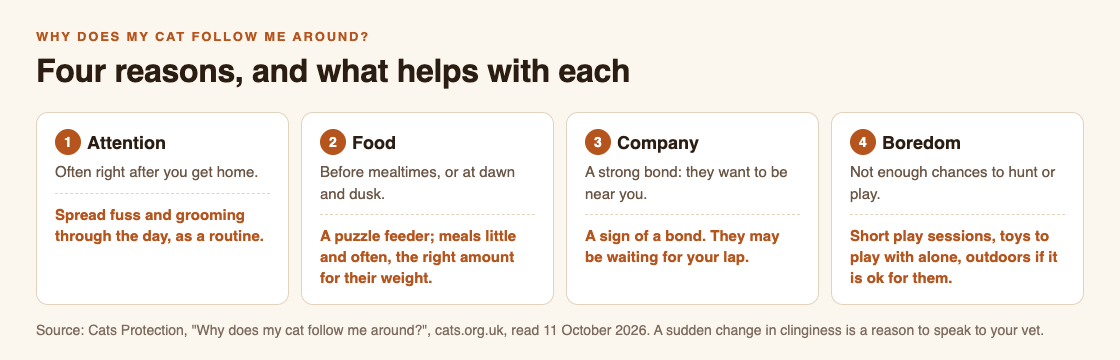
Four reasons a cat follows you, and what Cats Protection suggests for each.
1. They want attention
This is likely if your cat follows you just after you get home from being away. Cats Protection suggests a stroke, a head rub or a chin tickle, or some time with their favourite toys.
2. They want food
A hungry cat follows the person who feeds it. The charity says this is most likely just before normal mealtimes, or at dawn and dusk, when cats are usually most active.
You may also have taught it without meaning to. If you give your cat food every time you go into the kitchen, it learns to link you walking to the kitchen with being fed, and follows you every time.
3. They want your company
If your cat has a strong bond with you, it may simply want to be near you and see what you are up to. Or, the charity says, it may be waiting for you to sit down so it can jump on your lap for a snooze.
4. They are bored
A cat that does not get enough to do in its day may follow you around for something to do. Cats Protection says it may not be getting the chance to hunt or play.
Why does my cat follow me to the bathroom?
Cats Protection calls this a common scenario. Its view: it is less about you and more about the room. The bathroom is a "mystery" room your cat is often shut out of, so when the door opens it takes the chance to look around.
There is a lot to interest a cat in there. It might want to drink from the tap, snooze in the sink, or climb the shelves and the bath. It may also just want some attention, though the charity suggests washing your hands before you give it a fuss.
When following is a sign to call the vet
Following you is usually normal. A change is different. Cats Protection says that if your cat becomes a lot more clingy than usual, speak to your vet, who can check there is no medical cause for the change in behaviour.
Its play guide gives a related warning. If an adult cat suddenly starts grabbing at ankles or biting in play when it never did before, the charity says to call the vet to rule out medical concerns, then talk to a qualified behaviourist.
A one-week plan to give your cat other things to do
Cats Protection says giving your cat other things to focus on may mean it follows you less. Here is a simple week built only from its suggestions. Pick the steps that match the reason you spotted above.
- Day 1, watch: note when the following happens. After you get home points to attention; before meals, or at dawn and dusk, points to food; all day with nothing to do points to boredom.
- Day 2, play: start short play sessions. The charity says very short games of one to two minutes are fine, and that older cats enjoy playing three or four times a day, while younger cats are happy with ten or more. A fishing rod toy with feathers mimics prey; let your cat catch it now and then so it does not get frustrated.
- Day 3, toys for alone time: leave out toys it can play with by itself, such as ping pong balls. Swap toys around regularly to keep them interesting.
- Day 4, meals: if food is the reason, Cats Protection suggests a puzzle feeder to make mealtimes a hunt, and spreading meals little and often through the day. It says to check you give the correct amount for your cat's weight, from the details on the food packaging.
- Day 5, fuss on a schedule: give in to the need for attention, but spread it through the day as a routine. The charity suggests combining head rubs with a grooming session.
- Day 6, outside if suitable: if your cat is ok to go outdoors, the charity says letting it out to explore its territory gives it plenty to do. Indoor cats, its play page adds, need more entertainment than outdoor cats.
- Day 7, look back: compare with day 1. If nothing has changed, or the clinginess is new, speak to your vet.
What about cats you meet outside?
A cat you meet on a walk is not your cat. Our guide on how to approach a cat you don't know sets out what cat charities advise, and why the choice stays with the cat.
Cat Go is a game that plays in your web browser, built around those outdoor cats: "Walk anywhere, photograph a real cat, lure it with food and catch it." The food and the catch are inside the game. You collect kibble and tuna at treat stops on the map, and the only thing you do to the real cat is take its photo.
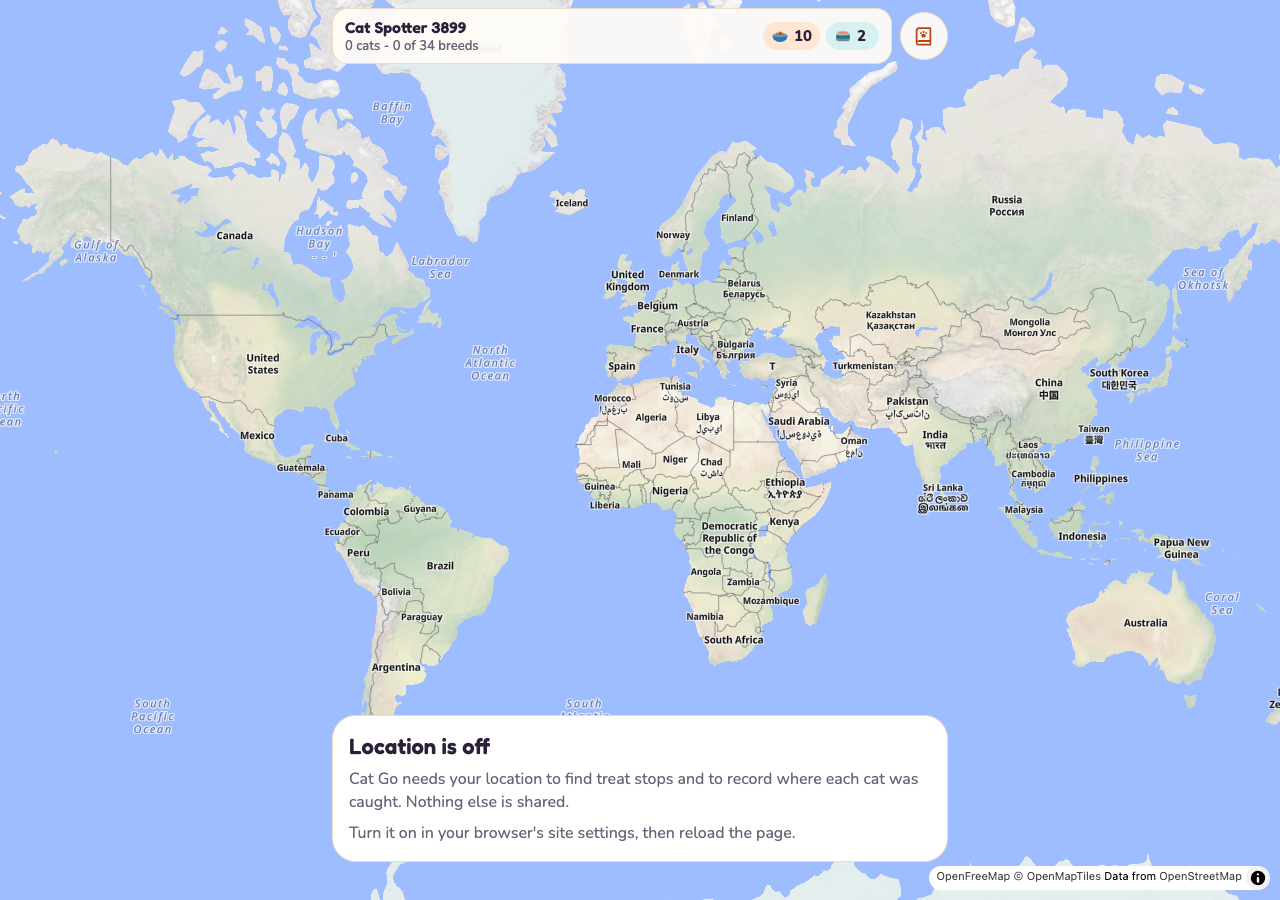
Cat Go's map, where treat stops for in-game food appear once location is on.
The camera screen says "Fit the whole cat in the frame", so you can stay where you are. When you toss in-game treats, the game reminds you that "Cats you've startled leave quickly. Stay calm with your tosses." Each catch records where the cat was found. Our guides on why a cat stares at you and why a cat licks you cover more of what cats are telling you.
Frequently asked questions
Why does my cat follow me everywhere?
Cats Protection gives four reasons: your cat wants attention, wants food, wants your company, or is bored. Older cats do it more than young ones.
Why does my cat follow me to the toilet?
The charity says it is most likely curiosity about a room it is often shut out of, with taps, sinks and shelves to explore, or a wish for some attention.
Should I worry if my cat suddenly follows me more?
Cats Protection says to speak to your vet if your cat becomes a lot more clingy than usual, so they can check for a medical cause.
How do I stop my cat following me around?
The charity suggests a puzzle feeder, time outdoors if your cat is ok to go out, meals little and often, short regular play, and fuss spread through the day.
Get started
Start with day 1: just watch when the following happens. The reason usually shows itself. And when you are out on a walk, look for the cats you meet.
Play Cat Go in your browser: walk anywhere, photograph a real cat, lure it with food and catch it.
Comments
No comments yet.
Sign in or make an account to comment.