Why does my cat scratch the furniture? Claws, scent and fixes
If your cat scratches the furniture, it is not being spiteful. Scratching is, in the words of the charity Cats Protection, "a normal and instinctive behaviour for cats". So the question "why does my cat scratch the furniture?" has a plain answer: the cat needs to scratch, and your sofa is the best thing in the room to do it on. This guide covers the two main reasons from Cats Protection's own advice, why furniture wins, a plan for moving scratching to a post, and when scratching is a sign of worry.
Why does my cat scratch the furniture? Two main reasons
Cats Protection gives two main reasons cats scratch.
- To keep their claws in good condition. Claws are always growing, and scratching is how cats keep them a good length.
- To communicate. Scent glands between the paw pads leave a smell on whatever a cat scratches. Add the scratch marks and the discarded claw husks, and the cat leaves a sign for itself and a message for other cats in the area.
The two reasons can be at work at once, and Cats Protection adds that the reasons for scratching can change over time. That is why one fix does not suit every cat.
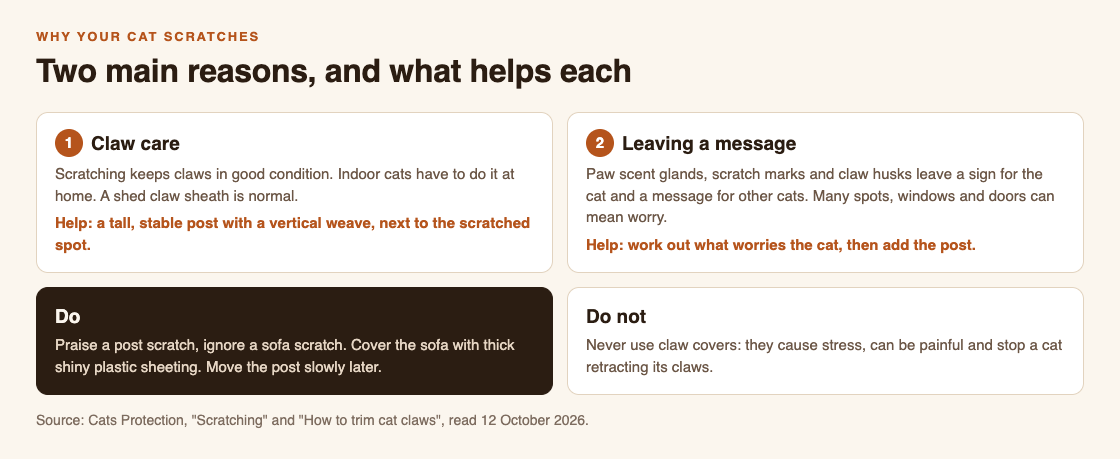
Why cats scratch, and what to put in place, from Cats Protection's scratching guide.
Why an indoor cat scratches your home
Cats Protection says all cats need a scratching outlet to keep their claws in good condition, whether they live indoors or go outside. A cat with limited access to the outdoors has to scratch in your home, because the home is all it has.
Where the cat scratches tells you something. If it scratches in many places, including conflict areas such as windows and doors, Cats Protection says it is likely scratching to communicate and feels insecure in those areas. It adds that, just as with spraying, the most common cause of scratching indoors is the presence of another cat.
So look at the pattern before you buy anything. One favourite sofa arm points to claw care. A cat scratching at windows, doors and many other spots may be telling you it feels unsure there.
Why furniture is the favourite target
In the wild, Cats Protection says, cats would normally scratch tree bark or something similar. A sofa or chair is a good replacement. Cats prefer to scratch things that are sturdy or tall, because that lets them get a good grip and dig their claws in.
Think about what that means in your living room. The sofa is firm, it does not wobble, and it is tall. A light, short post in a spare room is none of those things. The cat is not choosing your furniture to annoy you. It is choosing the best surface on offer.
The attention trap
Cats Protection notes that some cats learn that scratching certain objects, such as the sofa, means they get more attention. If you rush over every time, the scratch can become a way to call you.
Its advice is simple. Praise your cat when it scratches a post, and ignore it when it scratches things it should not. While the cat learns, protect the furniture from sharp claws so the habit does not set in.
A worked example: a week with one scratched sofa
Here is one plan, built only from the steps in Cats Protection's guide. Say your cat shreds the front corner of the sofa. The days are only a way to space the steps out; the guide gives no timetable, so go at your cat's pace.
- Day 1: cover and place. Cover the scratched corner with thick, shiny plastic sheeting, which is unappealing to scratch. Put a scratching post right next to that corner. Pick one with a heavy, stable base, tall enough for a full stretch, with a vertical weave so the claws run downwards.
- Day 1: make the post worth a visit. Rub some good catnip on the post, or put a few pieces of cat food on it. Some posts come with catnip already in them.
- Days 2 to 4: reward the right choice. When your cat scratches the post, praise it. When it goes for the sofa, ignore it and do not make a fuss. Play with your cat little and often through the day, which Cats Protection says may help redirect its energy away from scratching.
- Days 5 to 7: use the wake-up habit. Cats often scratch and stretch when they wake up, so a second post near the cat's bed can catch that first stretch.
- After that: move it slowly. Once the cat uses the post, gradually move it to a more suitable place and take the plastic sheeting away.
If your cat scratches carpet or stairs rather than upright surfaces, Cats Protection suggests a scratching pad for cats who prefer to scratch horizontally. And if you have more than one cat, give each its own post, in a different place, so they do not have to share one spot.
Claw covers and trimming: what Cats Protection says
You may see claw covers sold as a kind way to stop furniture scratching. Cats Protection says never to cover a cat's claws with covers or caps. In its claw guide it says they cause cats a lot of stress and can be painful, because a cat with covers can no longer retract its claws, cannot scratch (a natural behaviour) and cannot groom as well. Its answer is the one above: give lots of alternatives and encourage the cat to use them, for example with a post in front of the sofa it likes to scratch.
Trimming is a different question. The same guide says a young, active cat with plenty of places to scratch is unlikely to need its claws trimmed at all. Older cats, or cats with mobility problems such as arthritis, may not be able to keep on top of claw care and may need help. Signs that claws are too long include catching on blankets or carpets, being easy to see when the cat is resting, a cat that struggles to scratch or retract them, and a tapping sound on hard floors. If claws may be growing into the paw pads, the guide says to make an appointment with your vet.
One more note from that guide, so you do not worry for nothing. What looks like a cat's claw on its blanket or near where it scratches is usually a claw sheath, which the cat sheds through scratching. Cats Protection calls this normal and a sign the cat is keeping its claws in good condition.
When scratching is about worry
Cats Protection says that if a cat is scratching to mark its territory, it could be worried or feel threatened by another cat in the area or in your home. In that case it warns against just adding another scratching surface without helping the cat feel more secure and less anxious. You may need to work out what is worrying the cat, and a qualified behaviourist can help find the cause.
If you think stress is part of it, read how to tell if your cat is stressed, and how to help. Scratching is one of several ways a worried cat shows it. If a cat also bites, why does my cat bite me covers the signs to watch for first.
Frequently asked questions
Is it normal for my cat to scratch the furniture?
Yes. Cats Protection calls scratching a normal and instinctive behaviour, used to keep claws in good condition and to leave a message for other cats.
Why does my cat scratch where I can see it?
Scratching leaves scent from the paw glands and a visible mark, which is a message. Cats Protection also says some cats learn that scratching the sofa brings more attention from you.
What kind of scratching post should I buy?
Cats Protection suggests one with a heavy, stable base, tall enough for the cat to scratch at full stretch, with a vertical weave so the claws run downwards. Put it next to the place the cat already scratches.
Are claw covers a good way to protect my furniture?
No. Cats Protection says never to use them, because they cause stress, can be painful and stop the cat retracting its claws or scratching naturally.
Could scratching mean my cat is stressed?
It can. Scratching in many places, including windows and doors, may mean the cat feels insecure, and the most common cause indoors is the presence of another cat, says Cats Protection. A qualified behaviourist can help find the cause.
Get started
Once your cat has somewhere good to scratch, get out for a walk and look at the cats you meet with fresh eyes. Cat Go is a game that plays in your web browser: walk anywhere, photograph a real cat, say which breed it is, and toss in-game treats to win it over. The screen says "Fit the whole cat in the frame", and every catch is saved to your Catdex with its breed and where you found it. It needs the camera and your location allowed in the browser.

Cat Go's map, where each catch is kept with its breed and place.
Comments
No comments yet.
Sign in or make an account to comment.