Why does my cat sleep on me? Warmth, trust and the best bed
Why does my cat sleep on me? Cats Protection, the UK cat charity, gives three main reasons: you are warm, your cat trusts you, and your bed is the best sleeping spot in the house. If you are lying in it, the cat simply sleeps on top of you. This guide sets out each reason in the charity's own words, why your cat picks your head, lap, chest or pillow, and how to get your pillow back if you want it.
Everything here comes from Cats Protection's guide "Why does my cat sleep on me?", opened for this article.
Why does my cat sleep on me? The three reasons
Cats Protection says many pet cats choose to sleep on you from time to time because it is a comfy spot for a nap. It names three reasons behind that.
1. You are warm
The charity calls this a top reason: your cat can share your body heat to keep warm. Warmth is often a main need for a good sleeping spot, which is why cats stretch out in patches of sunlight or close to radiators. In the charity's words, your body is like a big hot water bottle.
2. Your cat trusts you
Cats are usually quite independent and solitary, Cats Protection says. So if a cat is happy to cuddle up to you, it shows it trusts you and sees you as a friend. Cats that are bonded to each other often sleep touching or curled together, and the charity says the same goes for cats and their people.
3. Your bed is the best spot
Human beds make great cat beds, the charity says: they are comfortable, warm and raised off the ground, which gives a good view of the room. Most beds also have a hiding space underneath, which helps a cat feel safe. So your cat may be sleeping on you because you have taken up all the room in its favourite spot.
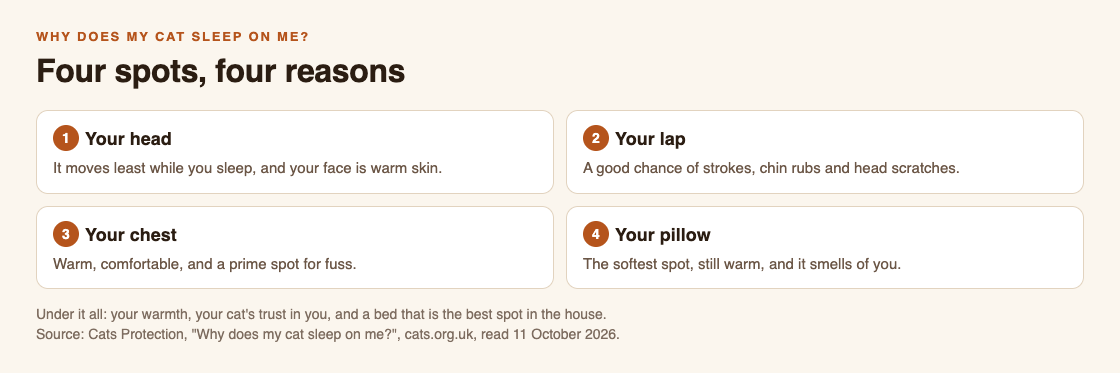
Where your cat sleeps on you, and the reason Cats Protection gives for each spot.
How much do cats sleep?
A lot. Cats Protection says cats sleep for 12 to 18 hours a day, and they often like to switch their sleeping spots. One theory, the charity says, is that this habit comes from their African wildcat ancestors, as a way to keep the risk of parasites low. So if your cat sleeps on you for a week and then moves to the sofa, that is normal too.
Why does my cat sleep on my head, lap, chest or pillow?
The charity gives a reason for each favourite spot.
- Your head: when you are asleep, your head is likely the part of you that moves least, so it is a place your cat will not be disturbed. Your face may also be the only skin showing, and your cat may want to be close to it for the feel or the warmth. A cat that does not like stepping on the covers may find your head safer and easier to reach.
- Your lap: when you are sitting down, your lap is a great chance for strokes, chin rubs and head scratches.
- Your chest: warm and comfortable for a nap, and a prime spot for strokes and fuss.
- Your pillow: the softest part of the bed. If you are still in bed or have just got up, it is also still warm and carries your familiar, comforting scent.
If your cat follows you from room to room as well, our guide to why your cat follows you around covers that.
Is it safe for my cat to sleep on my bed?
Cats Protection says it is safe for your cat to sleep on the bed with you. It adds two exceptions. If you are allergic to cats, you may find it more comfortable to keep your cat out of the bedroom. And the charity recommends keeping cats out of babies' and young children's bedrooms, for the children's safety.
How to get your cat to sleep in its own bed: a one-week plan
The charity says the easiest way to stop your cat sleeping on you at night is to shut it out of the bedroom. But a persistent cat may then keep you awake by meowing or scratching at the door. Its advice is to give your cat lots of other good places to sleep instead. Here is that advice as a simple plan for one week.
- Day 1, pick the spots: choose two or three places around your home for cat beds. Cats Protection says the perfect cat bed is comfortable, warm, private and off the ground, with a good view of the room. That is exactly why your bed wins, so match it.
- Day 1, add the smell: put something with your cat's own scent in each bed, such as a blanket or pillowcase it has slept on before, so the bed smells familiar.
- Days 2 to 4, keep the options: leave all the beds out. The charity says cats like to change their sleeping spots often, so several choices work better than one.
- Days 5 to 7, notice the winner: see which bed your cat uses most, and think about why: is it the warmest, the highest, or the most hidden?
- Night time: if you decide to close the bedroom door, expect some meowing or scratching at first, as the charity warns.
Our guide to why cats like sitting on things has more on what makes a spot appealing to a cat.
Why does my cat twitch in its sleep?
Cats Protection says cats like to stay alert even while they snooze. You may see the odd ear or tail twitch as your cat listens out for danger. In deep sleep, twitching paws or a twitching mouth is likely a sign your cat is dreaming.
Sleeping cats outside, and Cat Go
The cats you meet on a walk choose their spots for the same reasons: a warm wall in the sun, somewhere raised with a good view, or somewhere hidden. A cat asleep in the sun is best left where it is. Our guide on how to approach a cat you don't know sets out what cat charities advise.
Cat Go is a game that plays in your web browser, built around those outdoor cats: "Walk anywhere, photograph a real cat, lure it with food and catch it." You catch a cat by taking its photo, and the treats are in the game, so there is no need to wake a sleeping cat or go closer.

Cat Go's map, where each catch is recorded with the place you found the cat.
The camera screen says "Fit the whole cat in the frame", which is easy with a cat curled up asleep. When you toss in-game treats, the game warns that "Cats you've startled leave quickly. Stay calm with your tosses."
Frequently asked questions
Does my cat sleep on me because it loves me?
Cats Protection says a cat that is happy to cuddle up to you shows it trusts you and sees you as a friend. Warmth and comfort are big reasons too.
Why does my cat sleep on my head?
Your head moves least while you sleep, your face may be the only skin showing, and a cat that dislikes stepping on covers may find it easier to reach, the charity says.
Is it OK to let my cat sleep in my bed?
Cats Protection says it is safe. If you have a cat allergy you may prefer to keep your cat out of the bedroom, and it recommends keeping cats out of babies' and young children's rooms.
Why does my cat twitch while it sleeps?
The charity says ear and tail twitches show a cat staying alert to danger, while twitching paws or mouth in deep sleep is likely a sign of dreaming.
Get started
Tonight, notice where your cat settles on you, and match it to a reason above. If you want your pillow back, set out two warm, raised beds with your cat's own blanket in them.
Play Cat Go in your browser: walk anywhere, photograph a real cat, lure it with food and catch it.
Comments
No comments yet.
Sign in or make an account to comment.