Why does my cat spray indoors? Causes, vet check, fixes
Why does my cat spray indoors? Cats Protection, a UK cat charity, says spraying is a normal territory-marking behaviour, but that spraying inside "is usually a sign that something is wrong". This post sticks to what its spraying guide and a few linked pages say. It is not a diagnosis, and your vet is the first call.
Spraying is a scent message, not a toilet visit. Cats Protection says cats spray pee on upright surfaces outdoors to mark their territory and to leave information that they and other cats can "read".
Any cat can do it: male or female, neutered or not. Because it is normal outside, the question is why a cat is doing it in your hall.
Spraying or ordinary toileting: how to tell
The two look different when they happen. According to Cats Protection, a cat that is toileting usually pees from a squatting position and leaves a large puddle in a secluded spot. A cat that is spraying backs up to an upright surface in an open spot and squirts a little pee from a standing position. It may paddle its back legs and quiver its tail while it does it.
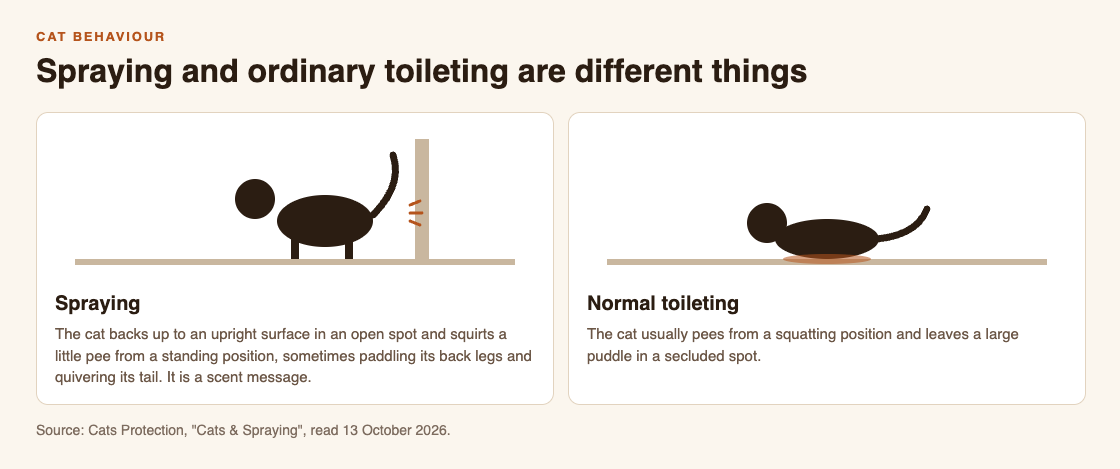
Spraying and toileting, as Cats Protection describes them.
That matters because the advice differs. If your cat squats and puddles on the floor, you are probably dealing with a toileting problem, covered further down. If it stands and marks an upright surface, you are looking at spraying.
Why does my cat spray indoors? The scent map
Cats Protection says cats use different scents to build a scent map of their surroundings. They rub their cheeks on things in the core of their territory, where they feel safe and relaxed. They use pee spray to mark the parts of their territory where they feel threatened, as a reminder to themselves to be wary there. When the smell fades, the cat sprays again to top it up.
So spraying inside can mean the cat does not feel secure at home. The guide says it is often linked to a change in the cat's surroundings, such as a new cat.
Where the cat sprays can give a clue:
- Internal doorways and hallways: these may be where the cat meets other cats in the house.
- The cat flap, outside doors or windows: the cat may be threatened by something outside, such as another cat.
Start with the vet
The guide's first step is a visit to your vet, to make sure there are no medical causes for the behaviour. It is the same when a cat toilets in the wrong place. Cats Protection's toileting page says to rule out medical reasons first and suggests taking a urine sample to the vet, who can supply sample pots and explain how to collect one.
Cats Protection also says never to punish a cat for spraying. Punishing it never helps, and it may lead to more spraying.
What may help, by where the cat sprays
After the vet visit, the aim is to work out what makes your cat feel threatened and remove the threat. The guide says this can be complicated because many factors may be involved, so it suggests asking your vet to refer you to a qualified cat behaviourist.
For spraying on internal doors and in hallways, it suggests reducing conflict with extra litter trays, bowls and places to sleep, play and scratch, so the cats compete less.
For spraying on the cat flap, outside doors or windows, it suggests making the home feel more secure:
- Cover windows with a semi-transparent material, which may restrict the cat's view of other cats.
- Fit a microchip-activated cat flap that only admits your own cats.
- Try to discourage neighbouring cats from coming into your garden.
The guide adds that pheromone therapy may also help reduce your cat's anxiety.
Pheromones are the scents cats make to communicate. Cats Protection's pheromone page lists facial pheromones, which mark things as safe and help a cat feel secure, and pheromones in pee, which mark territory. Artificial versions in sprays, diffusers and wipes copy the facial kind.
The page is careful about what they can do. There is no set timeline: some owners see a change in a few days, others not for a week or so. It says not to rely on them alone, because you will likely need to find the cause and make other changes too.
Worked example: a week of notes for your vet
A short record makes the vet and behaviourist visits more useful. This is a simple routine built on the questions in Cats Protection's guide, not a method it sets out. Here is how it could go for a cat that has started marking near the front door:
- Day 1: Note where the spray is. Is it on an upright surface, and is it by a door, a window or the hallway?
- Days 1 to 3: Note anything new: a new cat in the house or garden, a change to the home.
- Day 3: Book the vet visit. Ask about a urine sample and tell the vet what you have noted.
- Days 4 to 7: Add the changes the guide suggests for that location, such as extra trays and bowls for a hallway, or a covered window for a window.
- Day 7: Write down whether the marks changed, and take the notes to the vet or behaviourist.
If the problem is toileting, not spraying
If the cat squats and puddles instead, Cats Protection's toileting page has its own checklist. Cats feel vulnerable when they toilet, so they may avoid a tray that does not feel safe or clean. The page suggests:
- A quiet spot for the tray, away from washing machines, doorways, corridors and cat flaps, and away from food, water and sleeping areas.
- One tray per cat, plus an extra one, in different places and not in a row.
- Removing pee and poo twice a day, and washing the whole tray in hot, soapy water at least once a week.
- No scented litter and no liners.
It also says to clean up any mess straight away: blot or absorb the pee, then clean thoroughly with a cat-safe cleaner made for cat pee, which helps deter a repeat. The page says to keep an indoor tray even for a cat that usually goes outside, because something outdoors, such as a neighbouring cat, may have spooked it.
When to ask for a behaviourist
Cats Protection says behaviourists work on referral from a vet and can help with toileting in the house, among other behaviours. It warns that anyone can use the title, and recommends one who is a member of the Animal Behaviour and Training Council and uses positive, non-punitive methods.
If your cat is stressed in other ways too, our post on how to tell if your cat is stressed covers the signs. Scent is also part of scratching, as our post on why your cat scratches the furniture explains.
Frequently asked questions
Is spraying the same as peeing outside the litter tray?
No. Cats Protection says a cat toileting usually squats and leaves a large puddle in a secluded spot, while a cat spraying stands, backs up to an upright surface and squirts a little pee.
Do only male or unneutered cats spray?
No. Cats Protection says any cat can spray, male or female, neutered or not.
Should I punish my cat for spraying?
No. Cats Protection says punishment never helps and may lead to more spraying.
What is the first thing to do if my cat sprays indoors?
See your vet, to rule out a medical cause. Then work out what is making the cat feel threatened.
Get started
If watching cats and learning how they behave is your thing, Cat Go is a game that plays in your web browser. You walk, collect kibble and tuna at treat stops on a map, and photograph a cat you meet. Then it asks "Which breed is it?" and you pick from a list; the screen says "Mixed breed is always a safe pick". Each catch is kept in your Catdex with where you found it.

Cat Go's map. The game needs your location to record where each cat was caught.
Cat Go needs the camera and location allowed in your browser. Play Cat Go in your browser: walk anywhere, photograph a real cat, lure it with food and catch it.
Comments
No comments yet.
Sign in or make an account to comment.