Why does my cat wiggle before pouncing? Three theories
Why does my cat wiggle before pouncing? Cats Protection, the UK cat charity, says nobody knows for sure. The quick shuffle of the bottom just before a leap, sometimes called the "death wiggle", is not entirely understood, but the charity sets out three theories: checking balance, testing the ground, and warming up. This guide walks through each one, why some cats never wiggle, and how to give your cat the chance to do it at home.
Everything about cats here comes from Cats Protection's guide "Why does my cat wiggle before pouncing?" and its advice on cats and play, both opened for this article.
Why does my cat wiggle before pouncing? Three theories
You have probably seen it. Your cat fixes on a toy or a moving leaf, sinks low, and its back end starts to sway. Then it leaps. Cats Protection says the wiggle shows up in the moments before a cat pounces on prey or on a favourite toy, and that there are many theories about what it means. It names three.
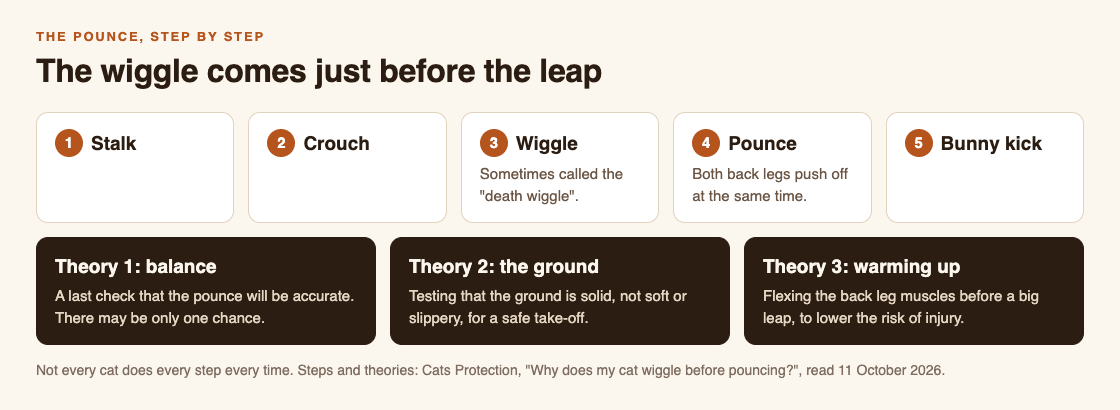
The steps of a hunt and the three theories, from Cats Protection's guide.
Theory one: checking balance
When a cat pounces, it pushes off with both back legs at the same time. The charity suggests the wiggle may give the cat a chance to check its balance, so that the pounce is accurate and effective.
The stakes are high for a hunting cat. It may only have one chance to catch its prey, so, in the charity's words, preparation is key to getting it right first time.
Theory two: testing the ground
As a cat wiggles, its back legs move up and down. Cats Protection says this may help it check that the ground beneath is solid and stable enough to jump from.
Ground that is uneven, soft or slippery could cause an injury on take-off. A quick wiggle lets the cat adjust its footing and get better grip for a safe launch.
Theory three: warming up
The third theory compares the wiggle to a person warming up before exercise. A pounce is a big, energy-intensive movement for a cat, and the charity says a wiggle could help flex the back leg muscles and lower the risk of injury.
The three theories do not rule each other out. A single wiggle could check balance, test the ground and loosen the muscles all at once, and the charity does not pick a winner. Treat each as a likely reason rather than a proven one.
Why some cats never wiggle
Cats Protection lists the steps a cat's hunting behaviour can include:
- stalking
- crouching
- wiggling
- pouncing
- bunny kicking
These behaviours are built in, but not every cat performs every step every time. If your cat attacks without a wiggle, the charity says there is no need to worry.
The urge behind all of this is not hunger. Cats Protection's play advice says hunting activity, the stalk, the pounce, the play and the kill, releases feel-good hormones called endorphins. An outdoor cat with no prey around will often play with fallen leaves or grass blowing in the wind instead. When a cat seems to toy with a mouse, catching it and letting it go, the charity's guide on why cats bring you dead animals says that is a hunting technique that tires the animal out, not a game.
Big cats wiggle too
The habit is not only for pet cats. Cats Protection says big cats such as lions, tigers, leopards and jaguars sometimes wiggle while hunting, most likely for the same three reasons: to adjust their balance, to check the ground is stable, and to warm up their muscles.
The lifted paw
Some cats lift one front paw before they pounce. The charity says this could be another way of getting ready, especially when the cat expects to swat or catch something with its front paws as it leaps. There may be a few more steps between the lifted paw and the pounce, but it is probably another warm-up for a big leap.
A short play session that lets your cat wiggle: a worked example
Cats Protection says it is good to give your cat lots of different options for play, so it has the chance to wiggle if it wants to. Here is one short session built from the charity's advice.
- Pick the toy. The charity suggests a fishing rod toy you can drag along the floor for your cat to stalk and pounce on, ping pong balls it can swat around, and kicker toys for bunny kicking.
- Drag it along the floor. Pull the fishing rod toy along the floor for your cat to stalk. The best games, the charity says, encourage a cat to stalk, pounce, chase and bat with a paw in a safe way.
- Watch for the crouch. If your cat sinks low and its back end starts to sway before it leaps, that is the wiggle this guide is about.
- Let it win. Allow your cat to catch and "kill" the toy now and then, so it does not get frustrated.
- Stop while it is still fun. Very short games of one to two minutes are fine. Then put away any toy it could shred and eat or get tangled in.
How often? Cats Protection says older cats will love playing three or four times a day, and younger cats ten times a day or more. Swap toys around regularly to keep them interesting, and check them for wear. A toy also gives the pounce a proper target: the charity says the right cat toys help stop a cat hunting and attacking things it should not, such as your feet.
Spotting the crouch on a walk, and Cat Go
Out on a walk you may see a cat crouched low at the edge of a hedge. Leave it be. If your own cat chatters at birds from the window, you have seen the same hunting focus from indoors.
Cat Go is a game that plays in your web browser, made for walks where you meet cats. In the site's own words: "Walk anywhere, photograph a real cat, lure it with food and catch it. Every catch keeps its breed and where you found it." A catch starts with a photo, and the camera screen asks you to "Fit the whole cat in the frame". The kibble and tuna are food inside the game, never real food. One of the game's own tips fits too: "Cats you've startled leave quickly. Stay calm with your tosses, and bring tuna for wary ones."
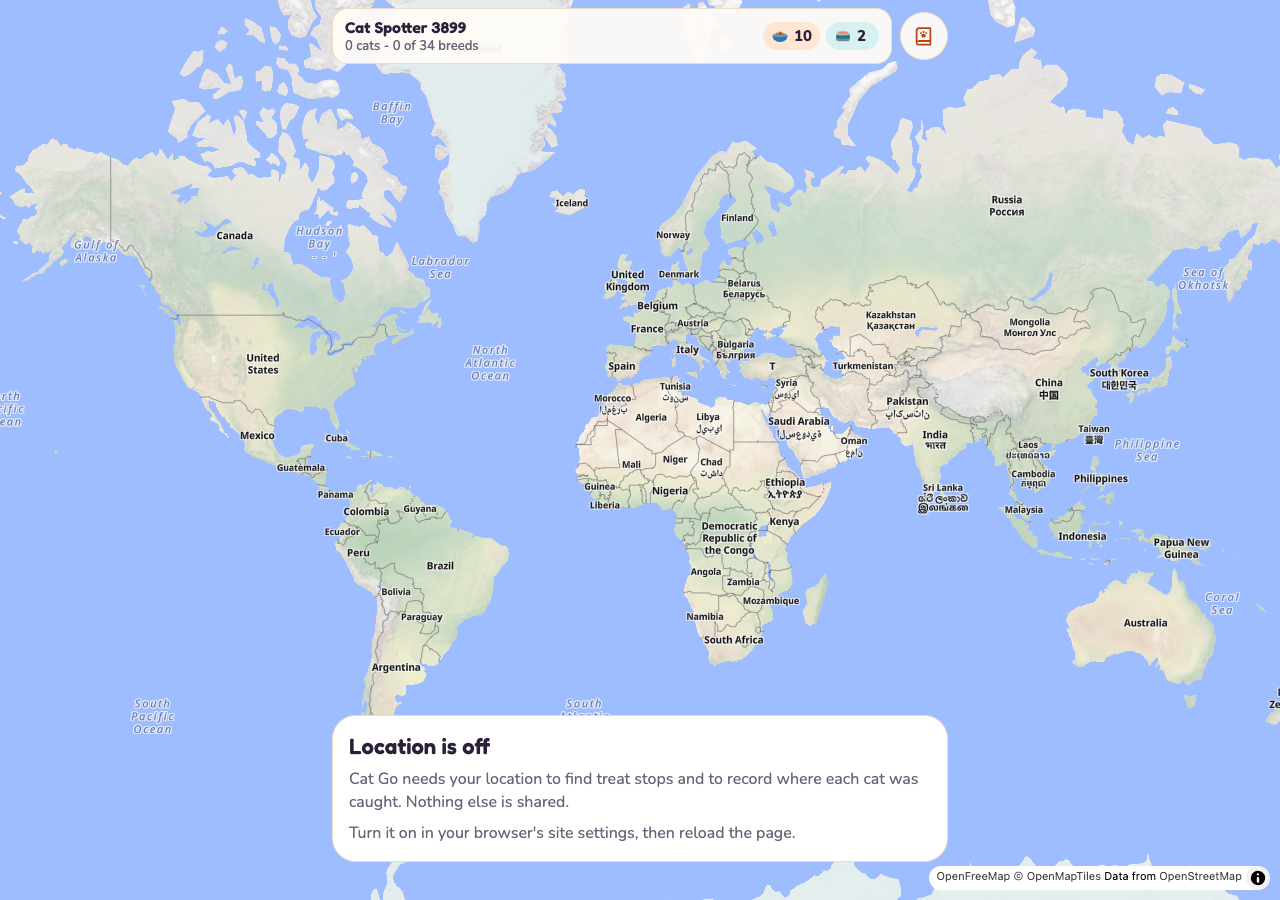
Cat Go's map, where each catch is recorded with the place you found the cat.
Frequently asked questions
What is the "death wiggle"?
It is a common name for the shuffle of a cat's bottom just before it pounces on prey or a toy. Cats Protection says the move is not entirely understood.
Is it a problem if my cat doesn't wiggle before pouncing?
No. The charity says hunting steps are built in, but not every cat does every step every time, so there is no need to worry.
Do lions and tigers wiggle before they pounce?
Yes, sometimes. Cats Protection says lions, tigers, leopards and jaguars can wiggle while hunting, most likely for the same reasons as pet cats.
Why does my cat pounce on my feet?
Cats Protection says giving your cat suitable toys helps stop it hunting and attacking inappropriate things, such as your feet.
Get started
Next time you meet a cat on a walk, let it finish its stalk and take a photo when it is calm. Open Cat Go in your browser, allow location and the camera, and start your Catdex with the cats you meet.
Comments
No comments yet.
Sign in or make an account to comment.