Why was Ashoka the Great important? Five reasons
Why was Ashoka the Great important? He ruled one of the largest empires of the ancient world, then, after a war that killed huge numbers of people, he said he regretted it, turned to Buddhism and carved his new ideas into stone across his empire. This guide gives five reasons he matters, all from World History Encyclopedia, sets out the doubts modern scholars raise, and shows you how to read his most famous inscription as a primary source.
According to World History Encyclopedia's article on Ashoka the Great, he reigned from 268 to 232 BCE as the third king of the Mauryan Empire, which his grandfather Chandragupta founded. At its height, under Ashoka, the empire "stretched from modern-day Iran through almost the entirety of the Indian subcontinent".
A warning before the details: most of what we know about his early life comes from Buddhist texts, which the article says "are considered, in many respects, more legendary than historical". His own inscriptions, the edicts, are the firmer ground. In them he calls himself Devanampiya Piyadassi, which the article on the edicts translates as "Beloved of the Gods" and "Gracious of Mien".
Reason 1: he renounced war after Kalinga
In about 260 BCE Ashoka invaded Kalinga, a wealthy coastal kingdom. The article gives the toll as 100,000 inhabitants killed and 150,000 deported, with thousands more left to die of disease and famine. What prompted the campaign "is unknown".
Afterwards, Ashoka recorded his regret in his 13th Major Rock Edict, quoted in the article: "On conquering Kalinga, the Beloved of the Gods [Ashoka] felt remorse for, when an independent country is conquered, the slaughter, death, and deportation of the people is extremely grievous to the Beloved of the Gods and weighs heavily on his mind." The article ends by describing him as the only empire-builder of the ancient world who, at the height of his power, renounced warfare and conquest.
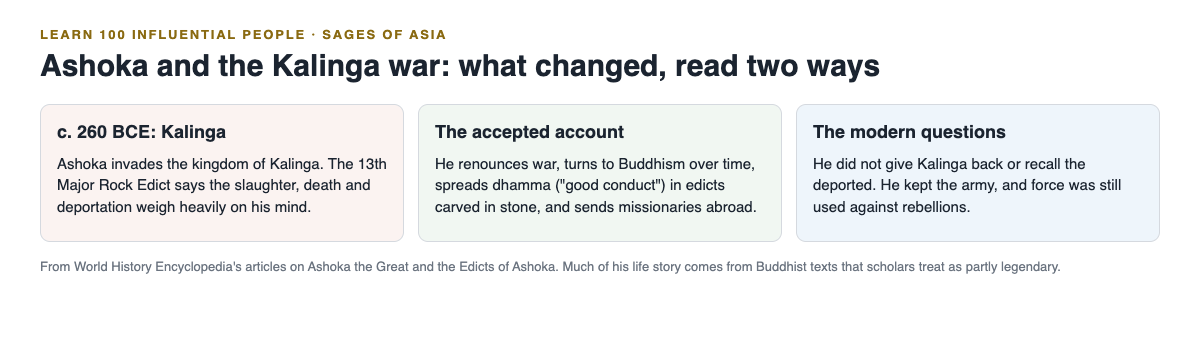
The change after Kalinga, read two ways, from World History Encyclopedia.
Reason 2: he made dhamma a policy
Ashoka's answer to Kalinga was dhamma. The article says it grows out of the Hindu idea of dharma (duty) and the Buddha's use of it, and Ashoka expanded it "to mean general goodwill and beneficence to all as 'right behavior'". The historian John Keay, quoted there, equates it with "mercy, charity, truthfulness, and purity"; it is also understood as "good conduct".
In practice, the accepted account says, he swapped the hunt for pilgrimage, brought in vegetarianism at the royal kitchen, and made himself available to his subjects at all times.
Reason 3: he wrote to his people in stone
Ashoka had his edicts engraved on rocks and pillars throughout the empire. The edicts article says they were inscribed across what is now Afghanistan, Bangladesh, India, Nepal and Pakistan, mostly in Brahmi script, with one in Afghanistan also given in Aramaic and Greek.
That makes him one of the rare ancient rulers you can read in his own words, which is why he matters to anyone learning to work with sources.
Reason 4: he helped make Buddhism a world religion
Buddhism was a minor sect in India at the time, the article says. Ashoka sent Buddhist missionaries to other regions, including modern-day Sri Lanka, China, Thailand and Greece, and "in so doing, he established Buddhism as a major world religion". He also ordered stupas, mounds holding relics of the Buddha, such as the famous one at Sanchi. Tradition says 84,000; the article calls that number an exaggeration.
Reason 5: he preached tolerance
The missionaries were to spread the Buddha's teaching peacefully because, as the article puts it, Ashoka had decreed that "no one should elevate their own religion over anyone else's". Since his rediscovery, it says, he has come to be recognised for "his insistence on religious tolerance".
And rediscovery is the right word. The empire did not last even 50 years after his death, and his name was lost until the British scholar James Prinsep deciphered the Brahmi script and identified him, publishing his work in 1837.
Why was Ashoka the Great important? The doubts
Give the critics their case. The article says modern scholars note that Ashoka "did not return the kingdom to the survivors", that there is no evidence he called back the 150,000 deported, that he did not disband the army, and that force was still used against rebellions. It also quotes Keay's point that Buddhist writers had a reason to paint the young Ashoka as cruel, because a monster turned saint makes a better conversion story.
The article's own author answers that Ashoka was trained in the Arthashastra, a manual of statecraft, and could have regretted Kalinga sincerely while still needing to look strong. That is one writer's reading, and you can weigh it against the evidence.
A worked example: read the 13th Rock Edict as a source
- Who wrote it, and for whom? The king himself, carved in public for his subjects to read.
- What does it say? That the slaughter and deportation in Kalinga weigh heavily on his mind.
- Why might he say it? Genuine remorse, a new policy to announce, or both.
- What does it leave out? Whether the deported came home, which the article says there is no evidence for.
These are the questions in how to analyze a primary source in history. For two other sages from the same course, read Confucius vs Laozi.
Frequently asked questions
What is Ashoka best known for?
For renouncing war after the Kalinga campaign, his idea of dhamma, and promoting Buddhism across and beyond his empire.
What happened at Kalinga?
In about 260 BCE Ashoka invaded the kingdom; World History Encyclopedia gives 100,000 killed and 150,000 deported. His 13th Major Rock Edict records his remorse.
Did Ashoka really give up violence?
Scholars disagree. He renounced conquest, but he kept the army, did not return Kalinga and force was still used against rebellions.
Why was Ashoka forgotten?
His empire did not last 50 years after his death and the Brahmi script of his edicts could no longer be read, until James Prinsep deciphered it in the 19th century.
Get started
Ashoka is in Sages of Asia, an Intermediate course on Learn 100 Influential People, with the Buddha, Mahavira, Confucius, Laozi and Sun Tzu. Intermediate means "How ideas, faiths, inventions and markets spread and changed the world." Lessons take about 9 minutes, 38 cards set out where researchers disagree, and every lesson lists its sources, as the about page says. Sign in with your email and an emailed code, and questions from finished lessons come back for review, up to 5 a day.
Comments
No comments yet.
Sign in or make an account to comment.