Why was Julius Caesar important? Five reasons
Why was Julius Caesar important? In short, he conquered Gaul, crossed the Rubicon to make war on his own government, ruled Rome as dictator for life, and his murder set off the wars that ended the Roman Republic and began the Roman Empire. This guide gives five reasons he matters, all from World History Encyclopedia, sets out both readings of his rule, and ends with a method for answering "why was this person important" in an exam.
According to World History Encyclopedia's article on Julius Caesar, he was born on 12 July 100 BCE, "though some cite 102 as his birth year". His family held to the Populare ideology, which favoured more rights for the lower class, against the Optimates, who favoured the nobility. The article stresses that these "were not political parties" but outlooks people moved between.
One early story shows his character. In 75 BCE pirates kidnapped him and said they would ransom him for twenty talents; "Caesar claimed he was worth at least fifty." He told them he would hunt them down and have them crucified, they took it as a joke, and after his release he did exactly that. The article calls this determination "one of his defining characteristics".
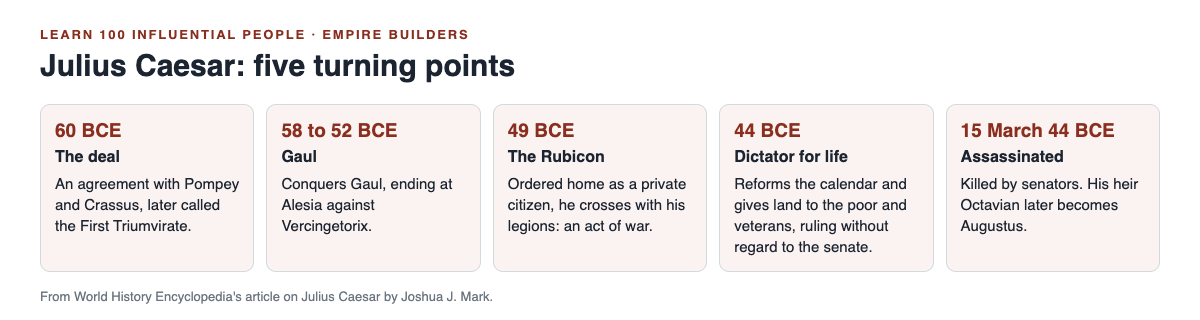
Five turning points in Caesar's life, from World History Encyclopedia.
Reason 1: he made a deal that ran Rome
In 60 BCE Caesar made a business and political agreement with the general Pompey and Marcus Crassus, the wealthiest man in Rome. Modern historians call it the First Triumvirate, "though no one in ancient Rome used that term". The three "effectively ruled Rome", with Caesar as consul pushing through measures in the senate.
He used the office for Populare goals: reform of government and "a redistribution of land to the poor". It is an early example of a theme that runs through his life: going to the people for support rather than to the senate.
Reason 2: he conquered Gaul
Caesar went to Gaul in 58 BCE. The article describes him bridging the Rhine as a show of force and then taking the bridge down, and twice invading Britain, "Rome's first incursion into the British isles". At the Battle of Alesia in 52 BCE he defeated the Gallic leader Vercingetorix "and completed the conquest of Gaul".
Gaul made him rich and gave him loyal, battle-hardened legions. That is what made the next step possible.
Reason 3: he crossed the Rubicon
By then the deal had fallen apart. Crassus was killed fighting the Parthians in 54 BCE, and Caesar's daughter Julia, who had married Pompey, died the same year. Pompey turned to the Optimates, and the senate ended Caesar's governorship and ordered him home as a private citizen, where he could be prosecuted.
Instead, in 49 BCE, he crossed the Rubicon with his legions and marched on Rome. "This was considered an act of war," the article says, because the river was the border between his province and Rome. He then defeated Pompey's forces at Pharsalus in 48 BCE with a much smaller army.
Reason 4: he ruled as dictator and changed Rome
In 44 BCE Caesar was granted the title Dictator Perpetuus, dictator for life. "Contrary to popular belief, he never held the title 'emperor'."
His reforms were wide. The article lists land for the poor and for veterans, a reformed calendar, a police force, the rebuilding of Carthage, among many other laws. It says his time as dictator "is generally regarded as a prosperous one for Rome". It also says he "ruled without regard to the senate", usually just telling senators which laws he wanted and how quickly.
Reason 5: his death opened the way to the Roman Empire
On 15 March 44 BCE, senators including Brutus and Cassius killed Caesar; he was stabbed twenty three times. They had not planned what came next. Mark Antony and Caesar's heir Octavian defeated them at Philippi in 42 BCE, then turned on each other; Octavian beat Antony and Cleopatra at Actium in 31 BCE.
Octavian had Caesar deified, took the name Augustus and, the article says, "initiated the end of the Roman Republic and the beginning of the Roman Empire". So Caesar's most lasting effect came after his death, through the man he chose as heir.
Why was Julius Caesar important? Two readings
Give both sides. One reading sees a reformer who gave land to the poor and veterans and brought Rome a prosperous time. The other, the fear the article gives to the senators, sees a man who took power by force, ignored the senate and, as the article puts it, "could soon abolish the senate entirely to rule absolutely as a king".
Both readings fit the same facts, which is why he is still argued about. For a later thinker who wrote about exactly this kind of ruler, see Machiavelli vs Hobbes.
A worked example: turning points
- Pick five turning points. For Caesar: the deal, Gaul, the Rubicon, the dictatorship, the assassination.
- Give each a date and one fact from your source. The picture above does this.
- Ask "what did this make possible?" Gaul made the Rubicon possible; the Rubicon made the dictatorship possible.
- End with the debate. Reformer or tyrant, with one piece of evidence for each.
This chain of cause and effect turns a list of events into an argument. To judge Caesar against other names, try how to judge any list of the most influential people in history.
Frequently asked questions
Was Julius Caesar an emperor?
No. He was granted the title dictator for life in 44 BCE but, as World History Encyclopedia notes, never held the title emperor. His heir Octavian, as Augustus, became the first emperor.
Why did Caesar cross the Rubicon?
The senate had ended his command and ordered him home as a private citizen, where he could be prosecuted. Crossing with his army in 49 BCE was an act of war.
Why was Julius Caesar killed?
Senators, especially of the Optimate faction, feared he was becoming too powerful and might abolish the senate to rule as a king.
What reforms did Julius Caesar make?
Land for the poor and for veterans, a reformed calendar, a police force, and the rebuilding of Carthage, among many other laws.
Get started
Caesar is in Empire Builders, a Basic course on Learn 100 Influential People, with Cyrus, Alexander, Augustus, Constantine, Qin Shi Huang and Genghis Khan. Basic means "The best-known names, no background needed." Lessons take about 9 minutes, 38 cards set out where researchers disagree, and every lesson lists its sources, as the about page says. Sign in with your email and an emailed code, and questions from finished lessons come back for review, up to 5 a day.
Comments
No comments yet.
Sign in or make an account to comment.