Why was Nelson Mandela important? Five reasons, explained
Why was Nelson Mandela important? In short, he became the symbol of the fight against apartheid, South Africa's system of racial segregation, spent 27 years in prison, and then helped negotiate its peaceful end and led the country that came after it. This guide gives five reasons, each from the Nobel Prize's own pages on him, sets out where people still disagree, and ends with a timeline method you can reuse for any "why was this person important" question.
The Nobel Prize biography gives the outline. Nelson Rolihlahla Mandela was born in Transkei, South Africa, on 18 July 1918. He studied law at the University College of Fort Hare and the University of the Witwatersrand. He joined the African National Congress (ANC) in 1944 and resisted the ruling National Party's apartheid policies after 1948.
The Nobel facts page adds that the son of a chief became "one of South Africa's first black lawyers". He went on trial for treason from 1956 to 1961 and was acquitted. In 1993 he shared the Nobel Peace Prize with F. W. de Klerk, the president who had released him. He died on 5 December 2013.
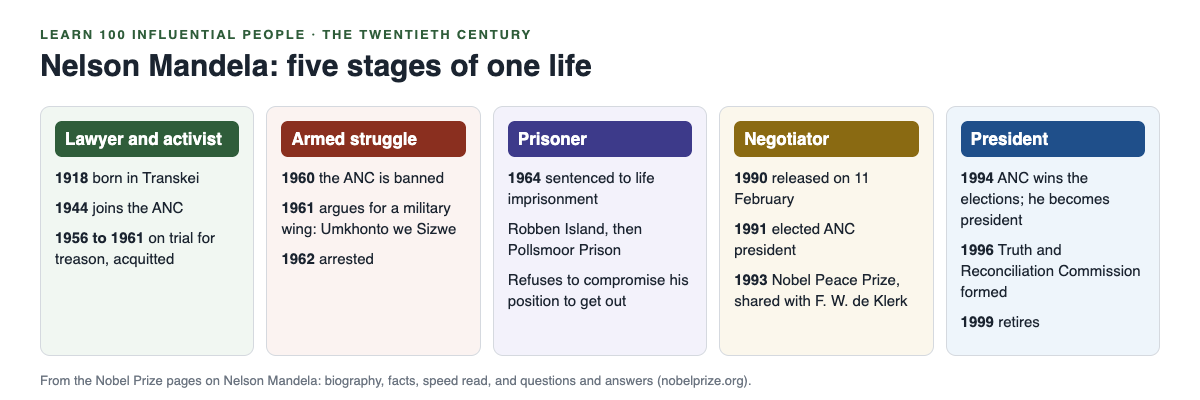
Five stages of Mandela's life, from the Nobel Prize pages.
Reason 1: he turned to armed struggle when protest was banned
This is the part of his story that is most often left out, and it matters. The Nobel speed read says that in 1960 police killed 69 black demonstrators at an anti-apartheid protest in Sharpeville. The government banned the ANC the same year.
After the ban, the biography says, Mandela argued for a military wing inside the ANC. In June 1961 the ANC executive agreed that members who wished to join his campaign would not be stopped, and this led to Umkhonto we Sizwe, "Spear of the Nation". According to the facts page, "Inspired by the guerrilla wars in Algeria and Cuba, he organized a military underground movement that engaged in sabotage." The speed read says power lines and railways were bombed.
Why does this make him important? Because it shows that the man later honoured for peace did not start as a pacifist. Compare him with the leaders in Gandhi vs Martin Luther King, who held to nonviolence; Mandela's path raises the question of when, if ever, force is justified.
Reason 2: prison made him the symbol of the struggle
Mandela was arrested in 1962 and sentenced to five years with hard labour. In 1963, when many other ANC and Umkhonto we Sizwe leaders were arrested, he was brought to trial with them for plotting to overthrow the government by violence, and on 12 June 1964 he was one of eight sentenced to life imprisonment. The biography notes that his "statement from the dock received considerable international publicity".
He was held on Robben Island, off Cape Town, and later at Pollsmoor Prison on the mainland. In those years, the biography says, "Nelson Mandela's reputation grew steadily", and he "became a potent symbol of resistance as the anti-apartheid movement gathered strength". The facts page calls him "the world's most famous political prisoner".
Reason 3: he would not trade his position for his freedom
A prisoner who is offered a way out has a choice. The biography is plain about Mandela's: "He consistently refused to compromise his political position to obtain his freedom."
That refusal is part of why his release, when it came on 11 February 1990, meant so much. He left prison as the leader the movement had kept, not as a man who had bargained his cause away. In 1991, at the first ANC national conference held inside South Africa since the ban, he was elected the ANC's president.
Reason 4: he negotiated with the people who jailed him
The speed read says that after Mandela was moved to the mainland in 1982 he "entered into negotiations with the white minority government on the future of South Africa", and that these talks went on until his release in 1990.
The Nobel Committee's 1993 press release explains the shared prize. Mandela and de Klerk, "From their different points of departure", agreed on a transition to a new political order "based on the tenet of one man-one vote". The committee praised them for "looking ahead to South African reconciliation instead of back at the deep wounds of the past". The facts page says the two shared the prize "because they had agreed on a peaceful transition to majority rule".
Reason 5: as president he chose reconciliation, then stepped down
The ANC won the 1994 elections, and Mandela became the first democratically elected President of South Africa. The speed read says the country adopted a new constitution "granting equal rights for all", and a Truth and Reconciliation Commission was formed in 1996; through public hearings it exposed abuses committed by the apartheid regime.
Then he left. "Mandela did not cling to power, but retired with honour in 1999," says the speed read. For a leader with his standing, giving up power after one term is a lesson in itself.
Why was Nelson Mandela important? Where people disagree
Give every side its case. The apartheid government convicted him of plotting to overthrow it by violence, and the sabotage campaign he led was real. Supporters answer that the ANC turned to arms only after peaceful protest was banned and protesters were shot at Sharpeville.
There is also the question of what changed after 1994. The same Nobel speed read that praises him lists "serious problems" that remain: high unemployment and crime, HIV, the gap between rich and poor, and land reform demands that "have not been met". Some readers weigh Mandela by the peaceful transition; others by how much daily life changed. A fair answer names both.
A worked example: the five-stage timeline
Here is a method for any "why was this person important" question, for an exam answer or your own notes.
- Split the life into stages. For Mandela: lawyer and activist, armed struggle, prisoner, negotiator, president.
- Give each stage two or three dated facts, from one source. The diagram above uses only the Nobel Prize pages.
- Write one "so what" line per stage. For example: prisoner, so what? He became the symbol the movement rallied around.
- Add one quotation. In his Nobel lecture Mandela said the reward of the new South Africa must be measured "by the happiness and welfare of the children".
- Close with the debate. Name the strongest criticism and the strongest defence.
To make the dates stick, try the steps in how to remember historical figures.
Frequently asked questions
Why was Nelson Mandela sent to prison?
He was arrested in 1962 and, in June 1964, sentenced to life imprisonment with other ANC leaders for plotting to overthrow the government by violence, after leading the ANC's armed wing.
How long was Nelson Mandela in prison?
The Nobel Prize speed read says he spent 27 years in prison before his release on 11 February 1990.
Why did Mandela win the Nobel Peace Prize?
He shared the 1993 prize with F. W. de Klerk "for their work for the peaceful termination of the apartheid regime, and for laying the foundations for a new democratic South Africa".
When was Nelson Mandela president of South Africa?
From 1994, after the ANC won that year's elections, until he retired in 1999.
Get started
Mandela is in The Twentieth Century, an Advanced course on Learn 100 Influential People, alongside Lenin, Stalin, Hitler, Churchill, Roosevelt, Mao, Deng, Gandhi and King. Advanced means "Modern power, modern physics and the debates still running today." Lessons take about 9 minutes, 38 cards set out where researchers disagree, and every lesson lists its sources, as the about page says. Sign in with your email and an emailed code, and questions from finished lessons come back for review, up to 5 a day.
Comments
No comments yet.
Sign in or make an account to comment.