Wide moves on a cube: what Rw and r mean
If you have seen a lowercase letter or a "w" in cube notation and paused, this guide is for you. Wide moves on a cube come down to one idea: an outer face turned together with the layer next to it, as one block. Below are every wide move, how each splits into a face turn and a slice, how to read them in a sequence, and the same two-layer turn tested in 3D 2048.
Wide moves on a cube: turning two layers at once
A normal face turn like R moves only the outer right layer. A wide move moves the outer right layer and the middle layer beside it, in the same direction, at the same time. On a 3 by 3 cube that is two of the three layers.
Hold the cube with the right face toward your right hand. Grip the left layer still with your left hand. Now turn everything else the way you would turn R. That is a wide right turn.
The left layer does not move. The two layers to its right turn a quarter together. The centres in the middle layer move too, which is why a wide move changes which colour is on top.
Rw and r: two names for the same move
On a 3 by 3 cube, Rw and r mean the same thing: a wide right turn. Wikipedia's notation section defines the lowercase letters as a face plus its middle layer, and notes that the common standard today writes them with a w for wide, so Rw is r. You will meet both; on a 3 by 3, treat them as equal.
Every wide move: Rw, Lw, Uw, Dw, Fw and Bw with primes and doubles
There is one wide move for each face. Each turns that face plus the layer behind it, in the direction of that face.
- Rw (r): right face plus the middle layer, turned like R.
- Lw (l): left face plus the middle layer, turned like L.
- Uw (u): top face plus the layer under it, turned like U.
- Dw (d): bottom face plus the layer above it, turned like D.
- Fw (f): front face plus the layer behind it, turned like F.
- Bw (b): back face plus the layer in front of it, turned like B.
The usual suffixes work the same as on face turns. A prime, as in Rw' or r', is a quarter turn the other way. A 2, as in Rw2 or r2, is a half turn. Direction for a half turn does not matter.
To check a direction, look straight at the face named in the move. A plain move turns that face clockwise from where you are looking. A prime turns it counterclockwise. The second layer always follows the face.
How wide moves relate to R, M and the x rotation
A wide move is just a face turn and a slice turn done together. If you know the slice moves from our guide to M, E and S moves, you can write each wide move as a pair:
r=R M'l=L Mu=U E'd=D Ef=F Sb=B S'
The primes appear because M follows the direction of L, E follows D and S follows F. So the middle layer has to turn "against" its own letter to match R, U or B.
There is a second way to see it. If you turn the whole cube with an x rotation, all three layers move like R. Now undo the left layer with L, which turns it the other way. What is left is the right two layers moved like R. So r leaves the pieces exactly where L x does.
This link matters in practice. A wide move is a single layer turn plus a change of grip.
Reading wide moves in a sequence, step by step
Here is a worked example. Read r U R' U r U2 r' one token at a time.
r: turn the right two layers like R.U: turn the top face clockwise.R': turn only the outer right layer back.U: top face clockwise again.r: right two layers like R.U2: top face a half turn.r': right two layers back.
Notice how capital and lowercase sit side by side: step 3 is R', one layer, while step 7 is r', two layers. That one letter's case is the whole difference.
A good habit: before you run a new algorithm, say each move aloud as "wide right" or "right" so your hands do not guess.
Common mistakes when doing wide turns
- Turning only one layer. Your grip slips and the middle layer stays behind. Hold the face and the slice together, like one thick block.
- Turning all three layers. If the far layer moves too, you did a rotation, not a wide move. Keep the opposite face pinned.
- Reading r as R. Small letters are easy to miss in a long line.
- Getting the direction of Lw or Dw wrong. Look at the left or bottom face itself and turn it clockwise from that view.
- Losing track of the centres. After a wide move the centre colours shift. That is expected, not a mistake.
A wide turn in 3D 2048, tested
3D 2048 is the 2048 puzzle on a cube you turn like a Rubik's cube, with six faces of nine squares. You twist one layer at a time: drag a row on the right face sideways, or a column on the top face, and that layer turns a quarter and carries its tiles to the next face. The middle row and column twist too, like the slice moves in our M, E and S guide.
So can you make a wide turn? A script set up the front's left column as 2, 4 and 8 from top to bottom, and the right face's nearest column as 16, 32 and 64.
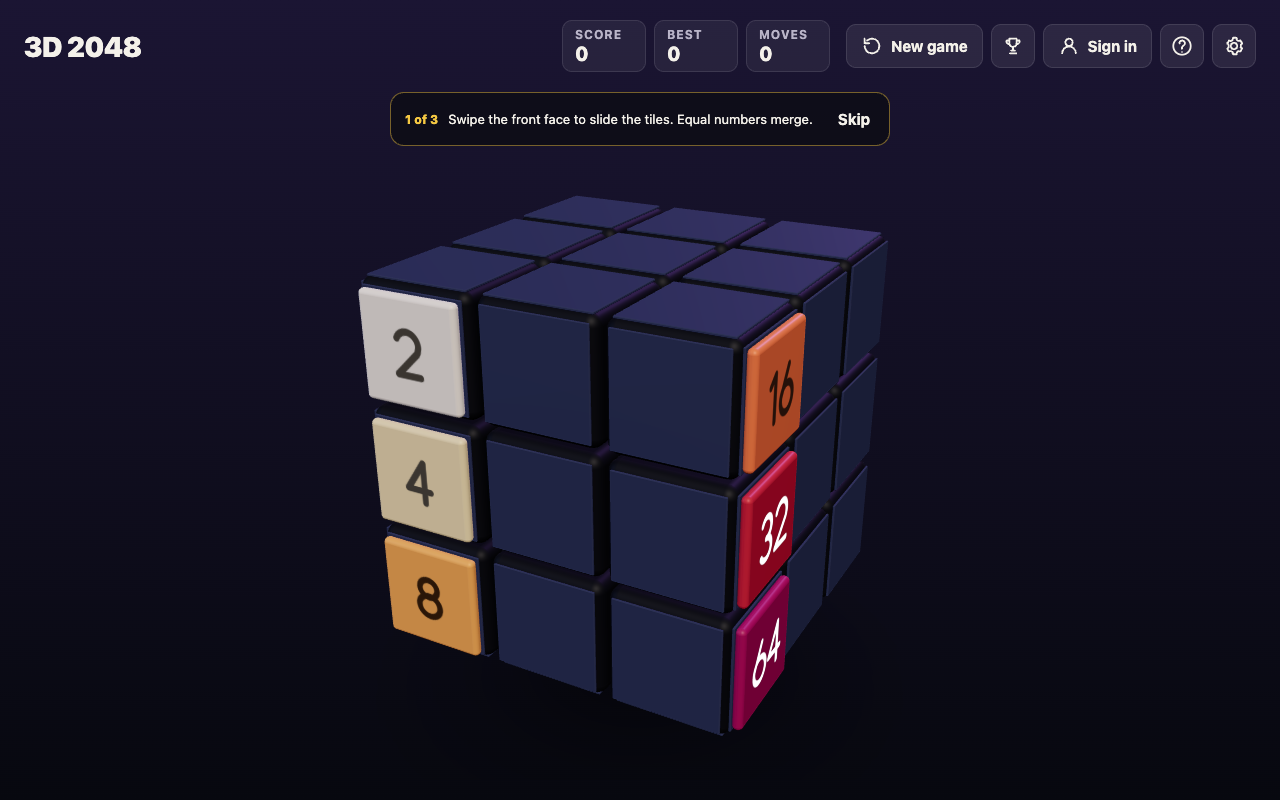
- Drag the right face's top row to the left. The 16 comes onto the front's top row and the front's 2 goes to the left face. Moves reads 1.
- Drag the right face's middle row to the left. The 32 comes onto the front's middle row and the 4 goes to the left face. Moves reads 2.
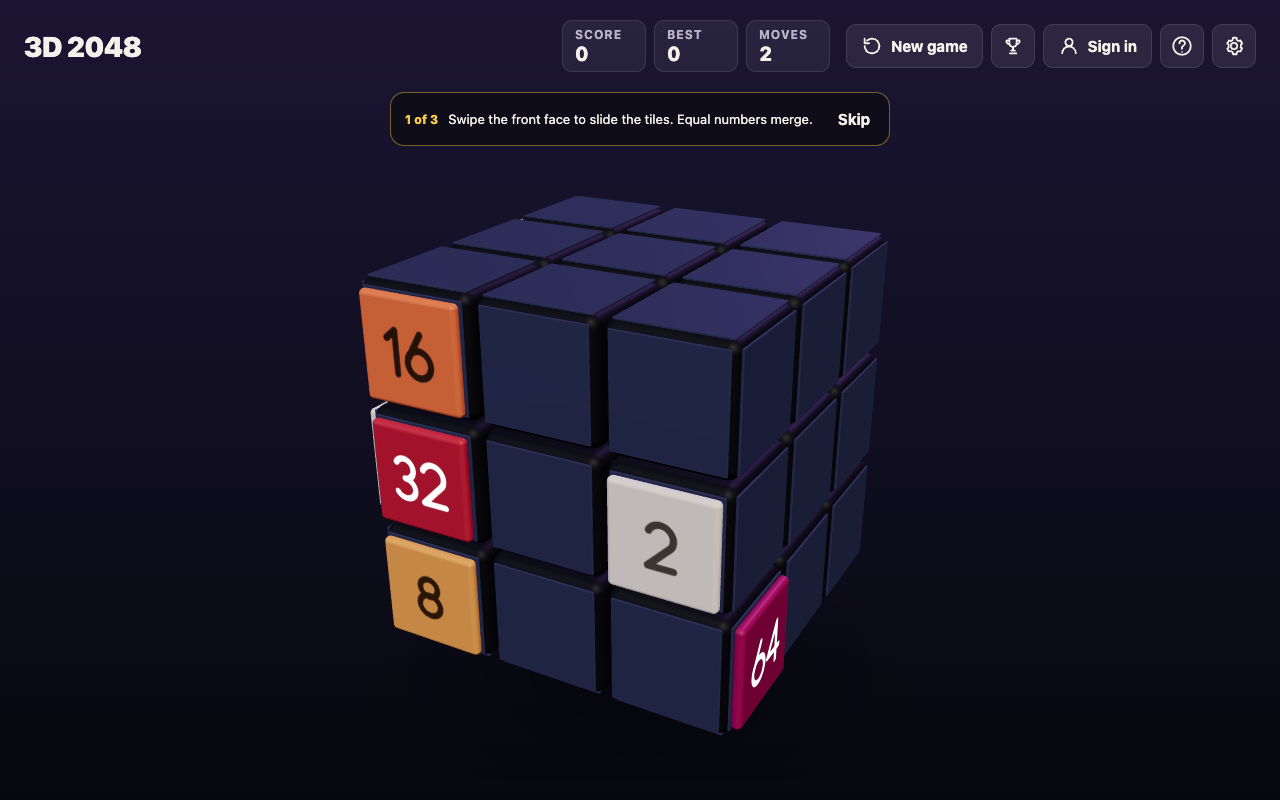
After two twists: the top two layers turned together, and the bottom layer (the 8 and the 64) stayed put.
That is the top two layers turned together, while the bottom layer stays: the shape of a wide turn. In notation the right face coming to the front is the U direction, so this pair of twists is a u, built as U plus E'. In the game it is still two moves, each scoring nothing and adding a new tile, and each twist needs an empty square. Whole-cube turns are different: Shift and Left is a y and Shift and Up is an x, and turning is free, as our guide to cube rotations shows.
Frequently asked questions
Is Rw the same as r?
On a 3 by 3 cube, yes. Both turn the right face and the middle layer together.
What does Rw2 mean?
It is a half turn of the right two layers. Turning it either way gives the same result.
Is r the same as R and M' together?
Yes. M turns the same way as L, so to match R the middle layer turns M'. That is also what L x gives: x turns all three layers like R, and L takes the left one back.
Can you do a wide move in 3D 2048?
Not in one move. Each drag turns one layer, an outer row or column or the middle one. In the test, two twists turned the top two layers together, for 2 moves and 2 new tiles.
Get started
Open the game, fill the front a little, then drag the right face's top row and middle row in turn and watch two layers ride round together. Your game, best score and settings are saved on your device, and you can play without an account.
Play 3D 2048 in your browser on a computer or a phone.
Comments
No comments yet.
Sign in or make an account to comment.