Yoshua Bengio: what he argues about AI risk
Yoshua Bengio helped build the deep learning methods behind much of today's AI. Now he is one of the best-known scientists warning about its risks. This post explains who he is, what he has done, and what he argues and proposes about AI risk, using Wikipedia's Yoshua Bengio article as its only source.
Who is Yoshua Bengio?
The article calls him a Canadian computer scientist and a pioneer of artificial neural networks and deep learning. He is a professor at the Université de Montréal. He is also co-president and scientific director of LawZero, a nonprofit. He founded Mila, the Quebec Artificial Intelligence Institute, and was its scientific director until 2025.
He earned his engineering degree, master's and PhD at McGill University. After a postdoctoral post at MIT, he joined the faculty in Montréal in 1993. He is also co-director of the Learning in Machines & Brains program at the Canadian Institute for Advanced Research.
In October 2016 he co-founded a Montreal-based AI company. It sold its operations to another company in 2020, and he stayed on there as an advisor. He also advises two other companies.
His research, briefly
With Geoffrey Hinton and a third researcher, he received the 2018 Turing Award for foundational work on deep learning. The three are sometimes called the "Godfathers of AI".
One early idea of his team was the neural probabilistic language model. It learned distributed representations of words, called word embeddings, to overcome the "curse of dimensionality" in natural language processing. In 2016 he co-wrote the book Deep Learning with Ian Goodfellow and Aaron Courville.
The article says he is the most-cited computer scientist in the world, and the most-cited living scientist in any field by total citations. He has also trained other well-known researchers, including David Krueger, Ian Goodfellow and Hugo Larochelle.
Awards and honours
- 2017: Officer of the Order of Canada, Fellow of the Royal Society of Canada, and the Marie-Victorin Quebec Prize.
- 2020: Fellow of the Royal Society.
- 2023: Knight of the Legion of Honour, and ACM Fellow.
- 2025: an honorary doctorate from McGill University, and Officer of the National Order of Quebec.
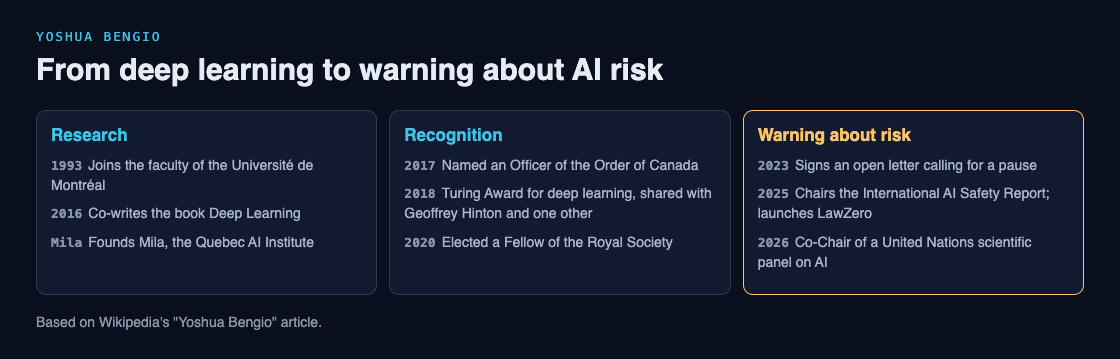
Bengio's path, as Wikipedia's article on him sets it out.
What Yoshua Bengio argues about AI risk
The article records his warnings from 2023 on. They grew from one letter into reports, a nonprofit and a role at the United Nations.
2023: a pause, and "lost" over his work
In March 2023, after AI experts raised concerns about existential risk from artificial general intelligence, he signed an open letter from the Future of Life Institute. It called on all AI labs to pause, for at least six months, the training of AI systems more powerful than a named leading model. Over 30,000 people signed it, including the researchers Stuart Russell and Gary Marcus. Our post on calls to pause AI covers what such letters ask and who disagrees.
In May 2023 he said in an interview that he felt "lost" over his life's work. He worried about "bad actors" getting hold of AI as it grows more powerful. He called for better regulation, product registration, ethical training, and more work by governments to track and audit AI products. He also backed monitoring access to AI systems, so that illegal or dangerous uses could be tracked. In July 2023 he wrote that "the risk of catastrophe is real enough that action is needed now."
Reports and a state bill
At the first AI Safety Summit in November 2023, a head of government announced that Bengio would lead an international scientific report on the safety of advanced AI. An interim version, in May 2024, covered cyber attacks and "loss of control" scenarios. The full International AI Safety Report came out in January 2025, and he still chairs it.
With Geoffrey Hinton and others, he co-wrote a letter backing SB 1047, a California AI safety bill. It would require companies training models that cost more than $100 million to assess risks before release. The letter called it the "bare minimum for effective regulation of this technology."
2025: warning signs and an AI race
In June 2025 he said some advanced AI systems were starting to show deception, reward hacking and situational awareness. He described these as signs of goal misalignment and potentially dangerous behavior. He also said an AI arms race was pushing companies to put capability ahead of safety research. Our post on the AI race explains why that worries researchers.
In December 2025 he said giving rights to AI systems would be a "huge mistake", because being able to shut them down is essential for safety.
LawZero and what he proposes
In June 2025 he launched LawZero, a nonprofit that aims to build "honest" AI systems that can detect and block harmful behavior by autonomous agents. It is building a system called Scientist AI, meant to act as a guardrail by judging whether an agent's actions could cause harm. He said the first goal is to show the method works, then scale it up. Its funders include the Future of Life Institute and the Canadian government.
In early 2026, through LawZero's research, he said he felt more optimistic that guardrails can be designed for existing AI systems. He calls for both technical and societal guardrails, including policy, governance and new laws. He supports strong regulation and international collaboration.
In February 2026 he joined the United Nations' Independent International Scientific Panel on AI, a group of 40 experts, and later became its Co-Chair. In September 2026 he compared the state of AI safety to the start of the COVID-19 pandemic, when governments saw they had to act fast.
Where people disagree
The Wikipedia article records his views but does not set out named critics of him. Whether advanced AI poses a risk of catastrophe is a debated question, and serious people stand on each side. Our post on existential risk from AI sets out the main arguments on each side. This post takes no side.
Note one shift in his own view: by early 2026 he sounded more hopeful that guardrails can work, while still calling for action.
A worked example: sort his proposals
Bengio says safety needs technical guardrails and societal guardrails. You can test that idea yourself in five minutes.
- List his proposals. From this post: regulation, product registration, ethical training, government tracking and auditing, monitoring access, risk checks before release, international collaboration, and a guardrail system like Scientist AI.
- Sort them. Put each under "technical" (built into the software) or "societal" (rules, laws, oversight).
- Name who acts. For each one, write who would have to do it: a lab, a government, or many governments together.
- Find the gap. Ask which items stop working if just one builder refuses.
Then compare your sorted list with his call for both kinds of guardrail together, and decide for yourself what each kind adds.
Exploring the idea in Contain ASI
Contain ASI is a story strategy game for 1 to 4 players that runs in your browser and needs WebGL 2. Chapter 1, Before ASI, starts in January 2024 with four fictional AI labs in one race. As a researcher, research manager, CEO or government, you try for three years to keep every lab from crossing into recursive self-improvement before 2027.
The page says it is inspired by the AI 2027 scenario and that all its labs, people and events are fictional. It does not mention Bengio. It is a game, not a forecast.
Frequently asked questions
Who is Yoshua Bengio?
He is a Canadian computer scientist and deep learning pioneer, a professor at the Université de Montréal, the founder of Mila, and co-president and scientific director of LawZero.
What does Yoshua Bengio say about AI risk?
He has said "the risk of catastrophe is real enough that action is needed now." He calls for strong regulation, international collaboration, and technical and societal guardrails.
What is LawZero?
A nonprofit he launched in June 2025 to build "honest" AI systems that can detect and block harmful behavior by autonomous agents.
Did Bengio sign the letter calling for a pause?
Yes. In March 2023 he signed the Future of Life Institute's open letter calling for a pause of at least six months on training more powerful AI systems.
Get started
Want to see how hard it is to keep a race safe from the inside? Open Contain ASI in your browser and start a campaign as a researcher, research manager, CEO or government.
Comments
No comments yet.
Sign in or make an account to comment.