2048 Merge Chain: Can One Slide Merge Twice?
No. A tile merges at most once per slide, so the question "2048 merge chain: can one slide merge twice?" has a short answer. A tile made by a merge cannot merge again in the same slide. A chain like 2, 2, 4 never collapses into a single 8 in one move. It takes two slides.
If you want to see this on a cube, Evolved 2048 is the 2048 puzzle on a cube you turn like a Rubik's cube, free to play in your browser. Its slides follow the one-merge rule, and you can test every example below yourself.
2048 merge chain: can one slide merge twice? The short answer
The rule is this: two equal tiles merge into their sum, and the new tile is finished for that slide. It sits where it landed. If another tile of the same value is next to it, they stay apart until your next move.
This is what stops chain reactions. Without the rule, a row of 2, 2, 4 would go 4, 4, then 8 in one swipe. With it, you get 4, 4 and have to slide again. In Evolved 2048 a face row is three squares, so the rule shows up constantly.
How 2048 resolves a slide, step by step
Think of a slide as a short procedure. Here it is for a slide toward one wall.
- Start with the tile nearest the wall you are sliding toward.
- Look at the next tile along the line. If it equals the first, and neither one was made by a merge during this slide, merge them into one tile at the wall side.
- Move on to the next unmerged tile and repeat.
- Close the gaps so everything rests against the wall.
- Add a new 2 or 4 to the board.
In Evolved 2048 the new tile goes on the front face when it has room. It is a 2 most of the time and sometimes a 4.
The score works from the same procedure; how 2048 scoring works has the full count. A slide adds the value of every tile its merges make, and the slide counts as one move. In the 10 October test, three rows slid in one go (2 2 2, 2 2 4 and 2 _ 2) made three 4s, so the slide scored 12 and Moves went up by 1.
The original 2048 code does the same thing. Its game_manager.js merges only with a tile that has not already been merged this move, and it works from the far wall first.
Merge chain examples: 2-2-2, 2-2-4 and 4-2-2
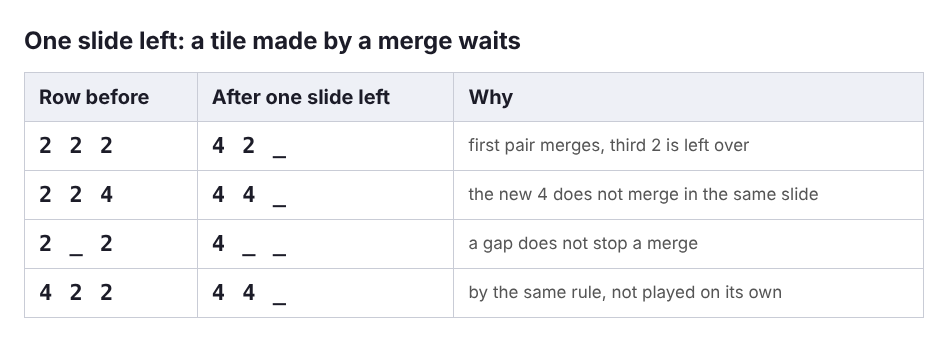
These are the cases people ask about. The first three were played on a set-up front face in Evolved 2048 on 10 October 2026, one slide each, and the fourth follows from the same rule. Here _ means an empty square.
2 2 2, slide left
The result is 4 2 _. The first two 2s merge at the wall. The third 2 has nothing left to pair with, so it sits next to the new 4.
2 2 4, slide left
The result is 4 4 _. The two 2s merge into a 4. That new 4 now sits beside the old 4, and they do not merge, because one of them was just made. This is the chain the rule cuts short. By the same rule, a second slide left would then give 8 _ _.
2 _ 2, slide left
The result is 4 _ _. A gap between equal tiles does not stop a merge. Tiles only need to be neighbours once the empty squares are ignored.
4 2 2, slide left
The result is 4 4 _. This is the mirror of the 2 2 4 case slid right, which gave _ 4 4 in the same test. The 2s merge into a 4, and that 4 does not join the 4 beside it. This exact row was not played on its own.
Why 2-2-2-2 becomes 4-4 and not 8
Take a longer line of four 2s. Slide it toward a wall. The two 2s nearest the wall merge into a 4. The next two 2s merge into a second 4. Those two 4s are both newly made, so they stay separate. You get 4 4, never 8.
That follows straight from the rule above. A face row here is only three squares, so four 2s cannot sit in one row on a single face. Treat the four-tile case as the rule applied, not as a result played out in the game.
The same rule held across a face edge. In a test played on 15 October 2026 in Edge mode, a 16 sat on the front's top left, an 8 on the top right and an 8 just over the right edge on the right face. One slide right turned the two 8s into a 16 on the front's top right, and the old 16 slid next to it. The top row read empty, 16, 16, and the two 16s did not merge in that slide.
Does merge direction change the result?
Yes. Direction decides which pair merges first, and so where the leftover tile ends up. The pair nearest the wall you slide toward merges first.
Take 2 2 2. Slide left and you get 4 2 _. Slide right and you get _ 2 4. The tiles are the same, but the layout differs. In the same way, 2 2 4 slid right gave _ 4 4.
The leftover 2 always ends up on the side away from the wall you slid toward. Sometimes you want it there. Sometimes it blocks the tile you were saving.
How to plan moves around the one-merge rule
Once you know a slide merges each tile at most once, you can plan chains across several slides. Here is a worked example from a test played on 11 October 2026, when edge merges were still a setting that was on (they are now the Edge mode).
The front face started like this. The top row was 64 32 16, the middle row was 4 8 16, and the bottom row was empty.
- Up merged the two 16s into a 32 at the top right. Score 32, Moves 1.
- Left merged the 32 and the 32 into a 64 beside the other 64. Score 96, Moves 2.
- Left again merged the two 64s into a 128 in the top left corner, and two 2s on the bottom row into a 4. Score 228, Moves 3.
Each slide did one merge on that line, and each merge set up the next. You line up tiles in a row so that every slide produces the match for the following one.
Use twists to start a chain
On the cube you can also bring a match to the tile you want. Twisting a row or column carries tiles round from the other faces. In one test, dragging the right face's top row to the left carried a 16 onto the front's top left. A new 2 appeared on the front. One slide down then merged the 16 with the 16 below it into a 32.
A twist adds no points but counts as one move, and it adds a new tile. Turning the whole cube is free: no points, no move, no new tile. Use turns to look for a match, and twists to deliver it.
Common mistakes that cost you a chain
- Expecting a full collapse. If you set up
2 2 4hoping for an 8, one slide will not do it. You need two slides, and a bad spawn can land in between. - Sliding toward the wrong wall. The nearest pair merges first. Check which side the leftover tile will land on before you swipe.
- Counting on an undo. I found none. Control+Z, Backspace and other keys did nothing. Undoing a twist with Shift and its key counts as a second move and adds a second new tile.
- Filling the cube. A twist needs one empty square for its new tile. The game says "The cube is full. Merge two tiles on a face to make room before you twist."
- Forgetting where the new tile goes. Every slide or twist adds a 2 or a 4. If it lands in your row, it can break the pattern you built.
Frequently asked questions
Can a tile merge twice in one slide in 2048?
No. A tile made by a merge cannot merge again in the same slide. 2 2 4 slid left becomes 4 4, and you need a second slide to make the 8.
Why does 2 2 2 give 4 2 and not 4 4?
Only two of the three 2s have a partner. The pair nearest the wall merges, and the third 2 is left over. It slides next to the new 4 but has nothing to merge with.
Does it matter which direction I slide?
Yes. The pair nearest the wall you slide toward merges first. 2 2 2 becomes 4 2 _ sliding left and _ 2 4 sliding right.
Does the one-merge rule apply across a cube edge?
In my Edge mode test it did. Two 8s across the edge made a 16, and that 16 did not merge with the 16 beside it in the same slide.
Get started with Evolved 2048
The quickest way to feel the one-merge rule is to play it. Open Evolved 2048, pick a mode, and slide the front face. Try a row of three equal tiles in both directions and watch where the leftover lands. It is free to play in your browser on a computer or a phone.
The 2048 puzzle on a Rubik's cube, and past 2048.
Visit evolved2048.vlvd.net↗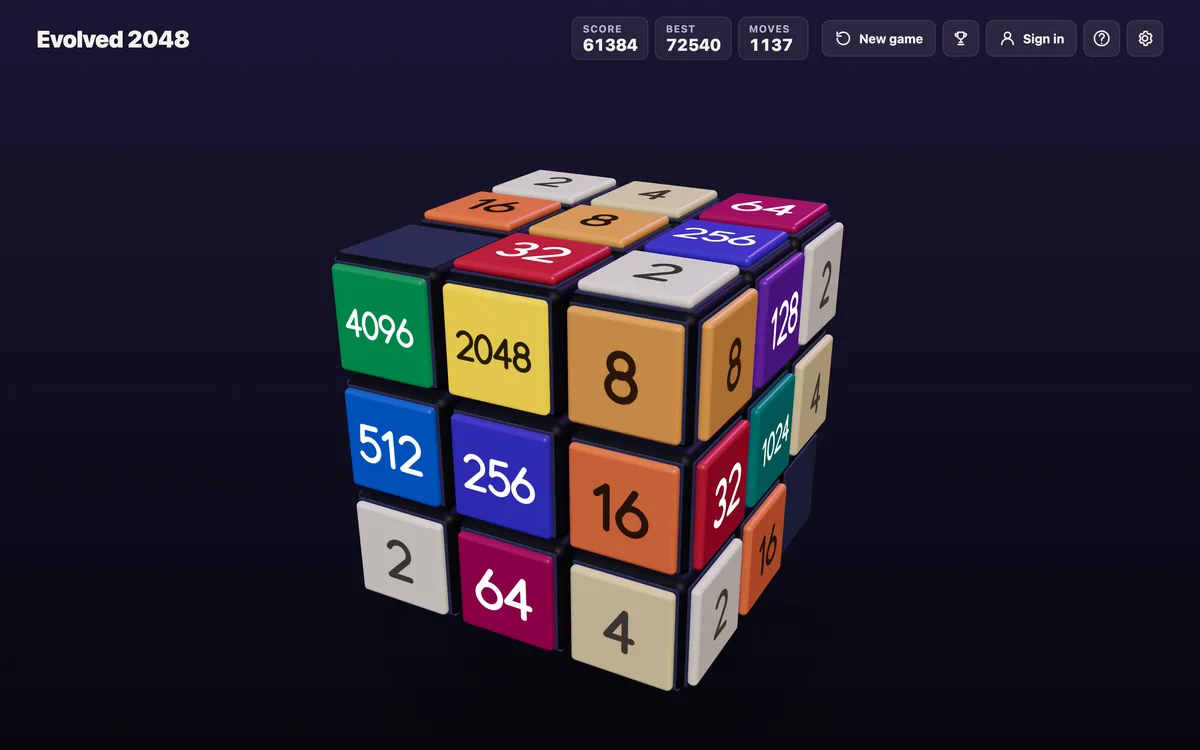
Comments
No comments yet.
Sign in or make an account to comment.