How does 2048 scoring work? Points, merges and best score
How does 2048 scoring work? The short answer: every time two tiles merge, you get the value of the new tile as points, and nothing else scores. That one rule explains why your score jumps late in a game, why two players with the same top tile can have different scores, and how you can check a score just by looking at the board. This guide walks through the rule, the sums behind it, and a real game where we did the check.
How does 2048 scoring work? A merge adds the new tile's value
Wikipedia's 2048 article) puts it in one line: your score starts at zero and goes up whenever two tiles combine, by the value of the new tile. Merge two 2s and you get 4 points. Merge two 64s and you get 128 points.
The original game's code says the same thing. In its game manager on GitHub, a merge makes a tile worth twice the old value, and the very next step adds that new value to the score. A tile made in a merge cannot merge again in the same move, so one slide can never chain 2, 2, 4 into an 8.
That leaves a short list of things that score nothing:
- Sliding without a merge. Tiles move, the score stays the same.
- New tiles. The 2 or 4 that drops in after each move is free.
- Making 2048. There is no bonus. You get the 2048 points from the merge, like any other merge.
When one slide makes several merges, their points add together. Our post on who made 2048 and how it works shows four sample rows and the points each slide earns.
What one tile is worth in points
Because every merge pays the new tile's value, a big tile carries the points of every merge that built it. Take a 16 built only from 2s. You need eight 2s. They merge into four 4s (4 points each, 16 in all), then two 8s (8 each, 16 in all), then one 16 (16 points). The total is 48.
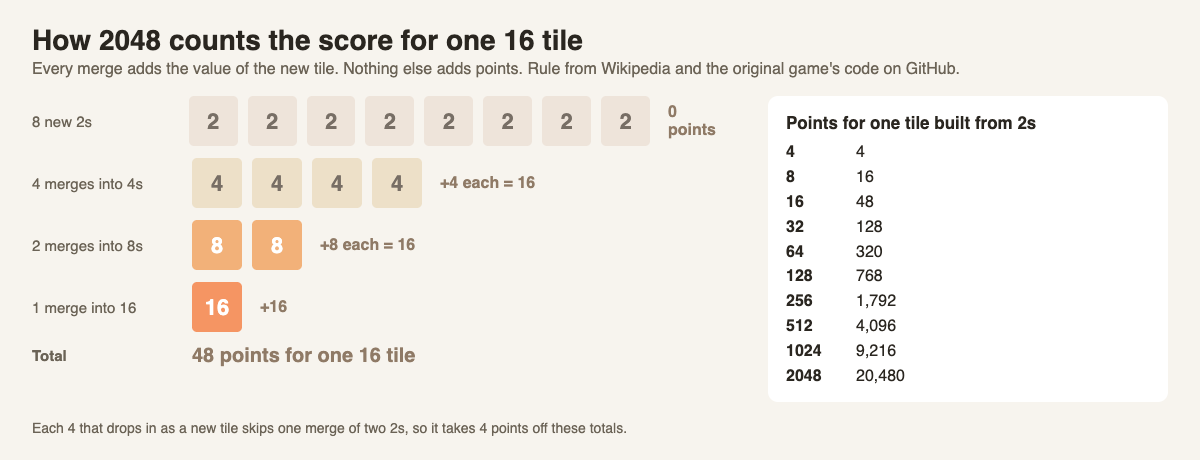
Each level of merges pays the same amount: 16 points per level for a 16 tile.
The pattern holds all the way up. Each level of merging pays the tile's own value once. A 16 takes three levels of merges (into 4s, into 8s, into the 16), and a 32 takes four, so a 32 is worth 4 times 32, which is 128. In the same way, a 128 is worth 768, a 1024 is worth 9,216, and a 2048 built only from 2s is worth 20,480 points. That last number is the score the 2048 tile alone brings, before you count the other tiles on the board.
Why every new 4 costs you 4 points
New tiles are not always 2s. The original code makes a new tile a 2 when a random number is under 0.9 and a 4 otherwise, and Wikipedia gives the same split: 2s 90% of the time, 4s 10%. A 4 that drops in for free is a 4 you did not have to make by merging two 2s, so you miss those 4 points.
That gives a simple way to read any 2048 score:
- Add up the points each tile on the board is worth, as if each was built from 2s.
- Take off 4 points for every 4 that appeared as a new tile during the game.
This is why two games with the same biggest tile can end with different scores. The one with more 4s dropped in, or fewer smaller tiles left over, ends lower. It is also why your score climbs slowly at first and fast later: a merge of two 512s pays 1,024 points in one move.
How the best score is kept
The original game saves your best score in your browser's own storage, under a name its code calls bestScore, and replaces it whenever your score goes higher (you can read this in its storage file on GitHub). So a best score lives in one browser on one device.
3D 2048 works the same way. Its top bar shows Score, Best and Moves, and its settings say: "Your game, best score and settings are saved on this device." When you press New game in the middle of a game, it asks first: "This game ends and its score is kept only if it is your best."
How 3D 2048 scoring works on a cube
3D 2048 puts the puzzle on a cube like a Rubik's cube, with six faces of nine squares. You slide the front face as in 2048, twist a row or column to carry tiles to the next face, and turn the whole cube to use its other sides. We read the scoring part of the game's own script file. It follows the same rule as the original, with three details worth knowing:
- Only slides score. A slide adds the value of every tile its merges make, and counts as a move.
- Twists score nothing. A twist counts as a move and adds a new tile, but it adds no points. Its job is to bring a tile next to its match, so the next slide can merge them.
- Turns are free. Turning the whole cube changes neither Score nor Moves. The game's own help says: "Turning is free."
So on the cube a twist is an investment: no points now, a merge later.
A worked example: check a score from the board
We played one short game of 3D 2048 in a browser, signed out, with a simple script that only slid the front face. It tried Down first, then Left, then Right, and Up only when nothing else moved. It is one game played by fixed rules, not a skilled player. The front face filled up and stopped sliding at move 31, with a Score of 148.
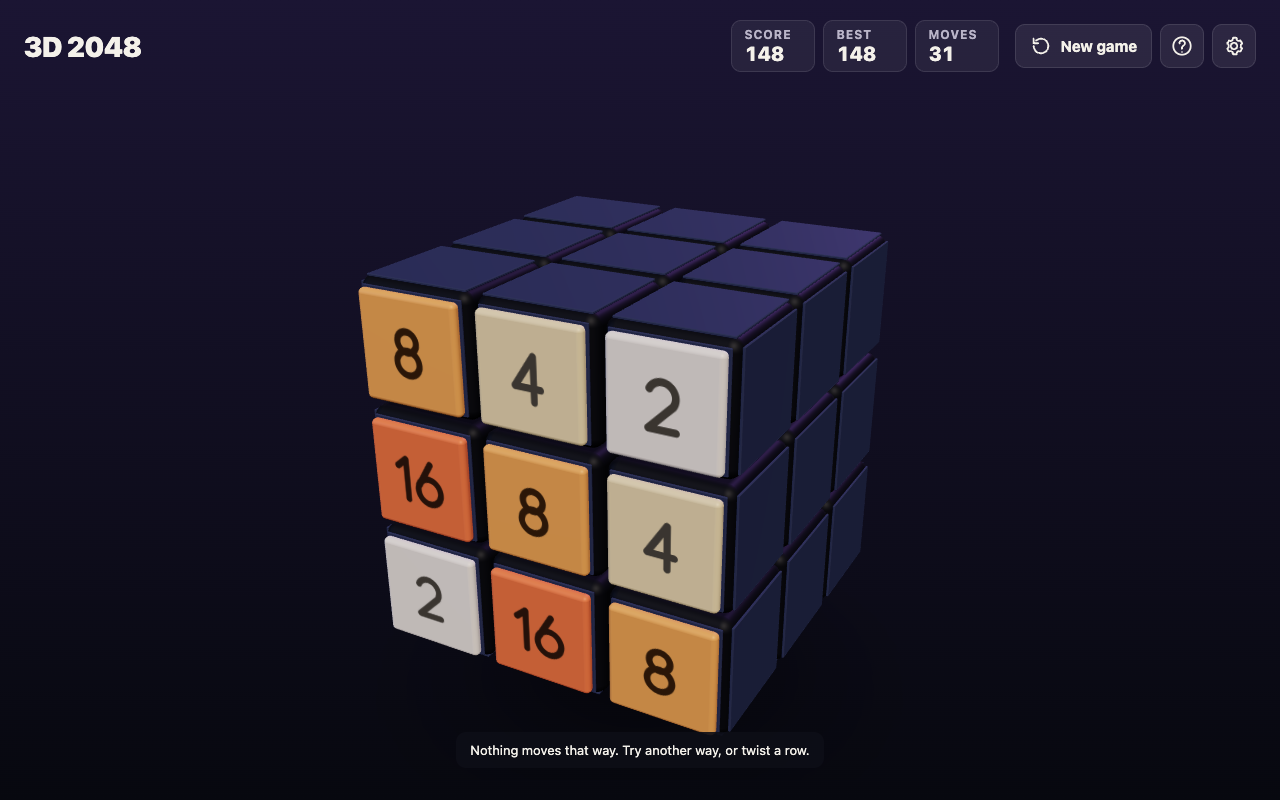
Move 31: the front face is full, Score 148.
Now read the board and add it up, using the points per tile from above:
- Two 16s: 48 points each, 96.
- Three 8s: 16 points each, 48.
- Two 4s: 4 points each, 8.
- Two 2s: 0 points.
That comes to 152. Our script also watched every new tile, and exactly one of them was a 4. Take off 4 points, and you get 148, the same number the Score box shows. The biggest gain from a single slide in the whole game was 16 points.
Then the script held Shift and pressed Left, which turned the whole cube to an empty face. Score stayed at 148 and Moves stayed at 31, just as the script file says.
Frequently asked questions
Do you get points for new tiles in 2048?
No. Points come only from merges, and each merge adds the value of the tile it makes.
How many points is the 2048 tile worth?
A 2048 built only from 2s brings 20,480 points through all the merges that make it. Each new 4 that went into it takes 4 points off.
Why is my score different from a friend's with the same top tile?
The other tiles on the board count too, and every new 4 lowers the total. More leftover tiles mean more points, and more 4s mean fewer.
How high can 2048 scores go?
Much higher than 2048 itself, because you can keep playing. Wikipedia reports a 2025 computer program with a median score of about 820,000 per game.
Get started
Next time you play, stop at any move and add up your board. It shows where your points came from. To raise your score, keep merging: the 2048 strategy for beginners post explains the corner plan, and is 2048 a game of luck or skill shows how much the new tiles matter.
Play 3D 2048: it is free and plays in your browser on a computer or a phone.
Comments
No comments yet.
Sign in or make an account to comment.