AI Hallucination Examples: Real Cases and What They Teach
Looking for AI hallucination examples you can learn from? Here are four patterns: fake court citations, a support bot that invents policy, made-up sources and quotes, and confident wrong answers in math and code. Each one shows a different way a fluent answer can be false. If you want the explanation of why models do this and four fixes, read Why AI makes things up, and what builders can do about it. It is written for people shipping AI features, and it uses a support bot as its worked example. One thing worth knowing from it: the model is built to produce likely text, not to check whether the text is true.
The How Modern AI Actually Works course in Age of AI Entrepreneur has a lesson called "What AI Gets Wrong", which covers the ground this post walks through; you sign in with your email and an emailed code to open it.
An AI hallucination is an answer that sounds right and is not. The model states a made-up fact in the same calm tone it uses for a true one. There is no warning label, no hesitation, and often a neat citation attached.
That is what makes it dangerous. A wrong answer that looks wrong gets caught. A wrong answer that looks polished gets pasted into a filing, sent to a customer, or shipped in your product.
The four examples below are ordered from most public to most everyday. The first two ended up in front of a court or tribunal. The last two happen to builders every week.
AI hallucination examples, part 1: fake legal citations in a court filing
In 2023, lawyers in a New York federal case (Mata v. Avianca) filed a legal motion that cited court cases. Many of those cases were fake. The lawyers had used ChatGPT to write the motion, and it produced fictitious cases with fabricated quotations. In June 2023 the court dismissed the case against the airline and fined the lawyers $5,000.
The part to notice is what happened when the court could not find the cases. The lawyers handed over copies of the supposed cases, after ChatGPT assured them the cases "indeed exist" and could be found in legal databases. Asking the same model to verify its own output is not verification. It is the same guesser answering a second time.
The pattern: a request that demands a specific, checkable item (a case, a number, a page) pushes the model to produce something with the right shape, even when it has no such item to give.
AI hallucination examples, part 2: a support bot that invents a refund policy
In 2024, a British Columbia tribunal ruled on a dispute with an airline (Moffatt v. Air Canada). A customer asked the airline's website chatbot about bereavement fares. The bot said he could buy a full-price ticket and claim the difference back within 90 days. Another page on the airline's site said bereavement fares could not be applied after the flight. The airline argued the chatbot was a separate legal entity responsible for its own actions, and the tribunal rejected that. The company was held responsible for what its bot said.
Here is a made-up version of the same failure for a small software product. Say your bot has only a pricing page in its prompt:
Customer: Can I get a refund if I cancel after 60 days? Bot: Yes. We offer a full refund within 90 days of purchase.
Your real policy might be 14 days. The bot never saw a policy, so it filled the gap with something common and plausible. The customer now has a screenshot.
The pattern: when the model lacks the fact, it does not say "I don't know" by default. It writes the most likely sounding policy. Your customer will treat it as yours.
AI hallucination examples, part 3: made-up sources, links and quotes
This is the most common one you will meet. You ask for sources and get a tidy list: an author, a title, a year, a link. Some entries are real. Some are blends of real authors with invented titles. Some links lead nowhere.
Quotes work the same way. Ask for "a quote from a famous founder about pricing" and you may get a sentence that sounds exactly like them and was never said.
A simple habit helps. Treat every citation as a lead, not a fact, until you have opened it yourself. Check three things:
- The page exists at that address.
- The author and title on the page match what the model said.
- The quote or number appears in the text, word for word.
If you publish content, this matters twice. A fabricated source in a post is a public error with your name on it.
AI hallucination examples, part 4: confident wrong answers in math and code
Models write step by step reasoning that reads well and still lands on a wrong number. A long multiplication, a unit conversion, a tax calculation: the working looks tidy and one step is off. Because the steps look careful, you trust the total.
Code has its own version. A model may call a function that does not exist in the library you use, or invent an option name that looks like the real one. It may also suggest a package name that sounds right and is not real. Code at least fails loudly when you run it. A wrong figure in a spreadsheet does not.
A practical rule: let software do the arithmetic and let the model do the language. If a number matters, calculate it in code or a spreadsheet and have the model explain the result.
The pattern: fluent reasoning is not the same as correct reasoning. Check the output, not the tone.
Why these mistakes happen: a plain-words explanation
A language model is trained to predict the next piece of text given the text so far. That is the core of how it works, and the lesson on next-token prediction in the How Modern AI Actually Works course goes through it step by step. (Sign in to open a course.)
Predicting likely text is a different job from stating verified facts. When the training data covers a topic well, the likely text is usually true. When it does not, or when your question asks for something very specific, the model still has to write something. It writes what looks most plausible.
That explains all four examples. A case name has the shape of a case name. A refund window has the shape of a refund window. A citation has the shape of a citation. A calculation has the shape of a calculation. The shape is right, and the content is a guess.
How to spot the pattern before your customers do
You do not need a research lab. You need a short habit of testing the places where the model is most likely to guess.
- Ask things the bot cannot know. Ask your support bot about a plan you do not sell, or a feature that does not exist. A safe bot says it does not know. A risky one invents an answer.
- Ask for specifics. Dates, prices, limits, names and links are where made-up details show up first.
- Check against the source. Put the bot's answer next to your real policy, docs or data. Do not ask the model to grade itself.
- Save the failures. Every wrong answer you find becomes a test case you can run again after you change your prompt or your model.
- Read real conversations. Sample what users actually asked and what the bot said. The surprising questions are the ones you did not test.
Step 4 is the start of an eval set. The post on testing LLM prompts before release shows how to run one, and the course lesson "Why Your AI Product Needs Evals" in Evals: Shipping AI That Works covers it. Retrieval, which means handing the model your own documents to answer from, is taught in "Giving Models Your Data: Retrieval" in The AI Product Stack.
What each example teaches a builder
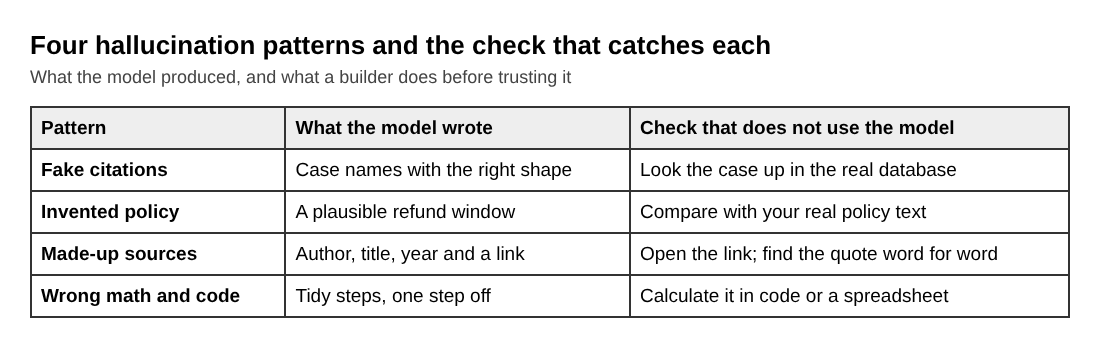
- Fake citations: never let the model be the only checker of its own facts. Add a check that does not depend on the model.
- The invented refund policy: if your bot speaks for your company, you own what it says. Give it your real policy to answer from, and tell it what to do when the answer is not there.
- Made-up sources: verify before you publish. A link you did not open is a claim you did not check.
- Wrong math and code: use tools for exact work. Use the model for drafting and explaining.
One more lesson sits under all four. Hallucinations are one of the ways a model's fluent output can mislead you, and the founder's guide to AI, machine learning and deep learning sets out where language models sit among the other kinds of AI.
Frequently asked questions
What is a simple example of an AI hallucination?
You ask a chatbot for three sources on a topic and it gives you titles, authors and links, and one of them does not exist. The entry looks right, but nothing real stands behind it.
Do AI hallucinations ever go away completely?
You should not count on it. You can make them rarer and catch them sooner by giving the model your own documents, keeping its task narrow, testing it, and having a person review high stakes answers.
Why does the AI sound so sure when it is wrong?
It writes fluent text whether or not it has the facts. Confidence in the tone comes from how the text is generated, not from a check that the content is true.
Can I ask the AI whether its own answer is true?
That is weak evidence at best. The same model can repeat the same mistake, as the court filing case shows. Check against a real source instead.
Get started
Start with the post on why AI makes things up and what builders can do about it. It turns the patterns above into fixes you can apply to your own product.
Then open Age of AI Entrepreneur and take the lessons in order. You sign in with your email and an emailed code.
Building a business in the age of AI, from a first project to a company.
Visit aientrepreneur.vlvd.net↗
Comments
No comments yet.
Sign in or make an account to comment.