AI vs Machine Learning vs Deep Learning: A Founder's Guide
The short answer to AI vs machine learning: artificial intelligence is the broad goal, machine learning is one way to reach it, and deep learning is one kind of machine learning. Each term sits inside the one before it. If you want the longer, step-by-step version, the How Modern AI Actually Works course covers next-token prediction, how a raw model becomes a helpful assistant, and what AI gets wrong. Sign in with your email and an emailed code to open it.
Age of AI Entrepreneur gives you short, hands-on lessons on how modern AI works and how to build a business with it, so you can make product decisions without a technical background.
AI vs machine learning vs deep learning in one picture
Picture three circles, one inside another.
- The outer circle is artificial intelligence. Any system that does something we would call intelligent when a person does it.
- The middle circle is machine learning. Systems that learn patterns from examples instead of following rules a person wrote by hand.
- The inner circle is deep learning. Machine learning that uses neural networks with many layers.
Generative AI and large language models sit inside the inner circle. They are deep learning systems built to produce text, images, code or audio.
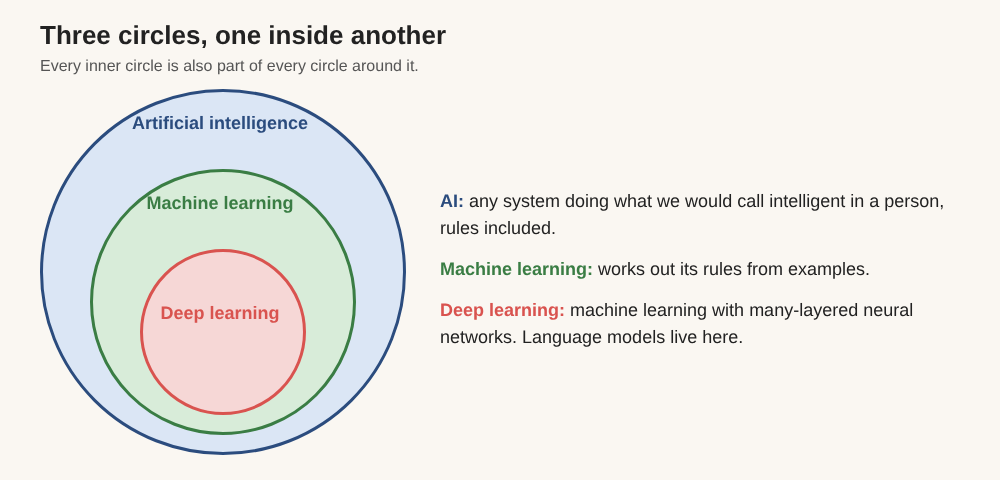
Deep learning sits inside machine learning, which sits inside AI.
The nesting matters because people use the words as if they were interchangeable. They are not. Every deep learning system is machine learning, and every machine learning system is AI. The reverse is not true.
What artificial intelligence means (and what it does not)
Artificial intelligence is a goal and a field of research, not a single technology. The term goes back to the 1950s, when a 1955 proposal for a summer workshop at Dartmouth used it, and John McCarthy was one of the people who helped name it. If you want the longer story of how the field got from early thinking machines to today, the Road to the Age of AI course walks through it.
Because the goal is so broad, a lot of different things have been called AI over the years. A program that plays chess using hand-written rules counts. So does a system that reads handwriting by learning from thousands of examples. So does a chatbot.
What AI does not mean is "a thinking machine that understands your business." It does not mean one specific product or one specific method. When a vendor says "we use AI," the useful follow-up question is: which kind, and doing what?
Machine learning: software that learns from examples
In ordinary software, you write the rules. If an email contains certain words, move it to spam. In machine learning, you show the system many examples and it works out the rules itself.
The ingredients are simple:
- Data. Examples of the thing you care about, such as emails already marked spam or not spam.
- A model. The thing that adjusts itself as it sees those examples.
- A prediction. What the trained model says about a new example it has never seen.
Machine learning is the right fit when the rules are too fiddly to write by hand but you have plenty of examples. It is the wrong fit when you have no data, or when a short list of clear rules already does the job. A tax calculation does not need to be learned. It needs to be correct.
Deep learning: neural networks with many layers
Deep learning is machine learning built on neural networks. A neural network passes numbers through layers of simple calculations. "Deep" just means there are many layers. Each layer can pick up more abstract patterns than the one before it. In an image, early layers might respond to edges, and later layers to shapes and objects.
Deep learning became the dominant approach once two things were available at scale: huge amounts of data and fast chips to train on. If you want a plain explanation of the network itself, this post on what a neural network is is a good companion read.
For a founder, the practical point is this. Deep learning handles messy inputs like images, speech and free text far better than older methods. The trade-off is that it usually needs more data and more computing power, and its decisions are harder to explain.
Where generative AI and large language models fit
Most of the AI you hear about now is generative. A large language model is a deep learning system trained to predict the next piece of text, called a token. Repeat that prediction many times and you get sentences, answers and code. The first lesson in the How Modern AI Actually Works course, Next-Token Prediction, is about exactly this.
A raw model that only predicts text is not yet a helpful assistant. It gets shaped into one afterward, which is the second lesson in that course. The third lesson, What AI Gets Wrong, matters most if you plan to sell something built on these models, because they produce confident text that can be false.
So when someone says "AI" in 2026, they usually mean a generative model, which is deep learning, which is machine learning, which is AI. All four labels are true at once. They just describe the thing at different levels of detail.
Which of the three matters for your product decision
Here is a worked example. You run a small business and want to sort incoming support emails into billing, bug reports and everything else. You have three realistic options.
- Rules. If the email contains "invoice" or "refund," tag it billing. This is AI in the loosest sense, but it is not machine learning. It is cheap and predictable, and it breaks when customers phrase things differently.
- Classic machine learning. Collect a few thousand emails you have already labeled, train a classifier, and let it label new ones. This works well if you have the labeled data and the categories stay stable.
- A language model through an API. You send each email to a model with an instruction and get a label back. You need no training data to start.
For option three, a first prompt might look like this:
You sort support emails. Read the email below and reply with exactly one word: billing, bug, or other. If you are unsure, reply other.
For a small team with no labeled data, option three is often the fastest way to test whether the idea is worth building at all. Then your questions become practical ones. What does each request cost? How do you know the labels are right? The AI Product Stack course covers model APIs, tokens and what a request costs. The Evals: Shipping AI That Works course covers how to check quality with an eval set.
You do not need to choose between the three circles on principle. You choose by looking at what data you have, how messy the inputs are, how costly a wrong answer is, and how fast you need to ship.
Common mix-ups founders should avoid
Treating "AI" as a feature
"Add AI" is not a product decision. "Sort support emails into three labels and flag the uncertain ones" is. Name the task first, then pick the method.
Assuming you need to train a model
Many founders hear "machine learning" and assume they need a research team. For many early products, you call an existing model and spend your effort on the problem, the prompt and the checks. Training your own model is a later question, if it is a question at all.
Assuming more complex means better
A rule that catches 90 percent of cases and never surprises you can beat a model that is clever and sometimes wrong. Start with the simplest thing that works, and measure it.
Trusting fluent output
A language model writes in a confident tone whether it is right or wrong. Build a way to check outputs before you let customers rely on them.
Mixing up the labels in a pitch
If you say "our deep learning AI" when you mean "we call a language model through an API," a technical reader will notice. Use the plain version. It is usually more convincing anyway.
For a gentler overview aimed at the same reader, see AI explained for non-technical founders.
Frequently asked questions
Is machine learning the same as AI?
No. Machine learning is a subset of AI. AI also includes approaches that follow hand-written rules and never learn from data.
Is deep learning the same as machine learning?
No. Deep learning is a type of machine learning that uses neural networks with many layers. Other machine learning methods exist that do not use neural networks.
Is ChatGPT machine learning or deep learning?
Both. It is a large language model, which is a deep learning system, and deep learning is a form of machine learning. It is also generative AI and AI.
Do I need to know how to code to understand the difference?
No. You need the nesting idea and a few examples, and that is enough to ask good questions of a vendor or a developer.
Get started
The fastest way to make these terms stick is to see them used. Open the How Modern AI Actually Works course. It has three short lessons, each about nine minutes, with questions and sources. You sign in with your email and an emailed code. The terms page says what an account includes.
Start Age of AI Entrepreneur: short hands-on lessons on how to build a business in the age of AI, with every side of the debate and the sources to read next.
Building a business in the age of AI, from a first project to a company.
Visit aientrepreneur.vlvd.net↗
Comments
No comments yet.
Sign in or make an account to comment.