John McCarthy: the computer scientist who helped name AI
John McCarthy was an American computer scientist who, with three colleagues, wrote the 1955 proposal that gave the field its name: artificial intelligence. Wikipedia's article on him) calls him one of the founders of AI and says he also led the creation of the Lisp programming language and created garbage collection. This post explains who John McCarthy was, what he built, what he believed about machines, and who disagreed with him.
Contain ASI is a story strategy game for 1 to 4 players that runs in your browser: as a researcher, research manager, CEO or government, you try to keep four AI labs from crossing into recursive self-improvement before 2027. Its labs, people and events are all fictional.
John McCarthy in short
McCarthy lived from 4 September 1927 to 24 October 2011. The article describes him as a computer scientist and cognitive scientist, and as "part of just a small group of artificial intelligence researchers in the 1950s and 1960s". It lists him with Alan Turing, Marvin Minsky, Allen Newell and Herbert A. Simon as one of the "founding fathers" of AI.
He spent most of his career at Stanford University. His honors include the 1971 Turing Award, given for his contributions to AI, the United States National Medal of Science and the Kyoto Prize. The article also notes he advised 30 PhD graduates.
From a Boston childhood to Stanford
McCarthy was born in Boston. The article says his parents encouraged learning and critical thinking, and that before high school he got interested in science through a translation of a Russian popular science book for children, 100,000 Whys. He taught himself college mathematics from the textbooks used at nearby Caltech, which let him skip two years of math there. He received a BS in mathematics in 1948. At Caltech he attended a lecture by John von Neumann that, the article says, inspired his future endeavors.
He moved to Princeton University and received a PhD in mathematics in 1951. After short appointments at Princeton and Stanford, he became an assistant professor at Dartmouth College in 1955, moved to MIT as a research fellow in autumn 1956, and became a full professor at Stanford in 1962. He stayed there until he retired in 2000.
Naming the field: the Dartmouth proposal
The article says McCarthy, Minsky, Nathaniel Rochester and Claude E. Shannon coined the term "artificial intelligence" in the proposal they wrote for the Dartmouth conference of summer 1956, and that the conference started AI as a field. We cover that summer in our post on the Dartmouth workshop. Note the wording: four people wrote it. McCarthy is one of the names behind the term, not the only one.
Lisp, garbage collection and ALGOL
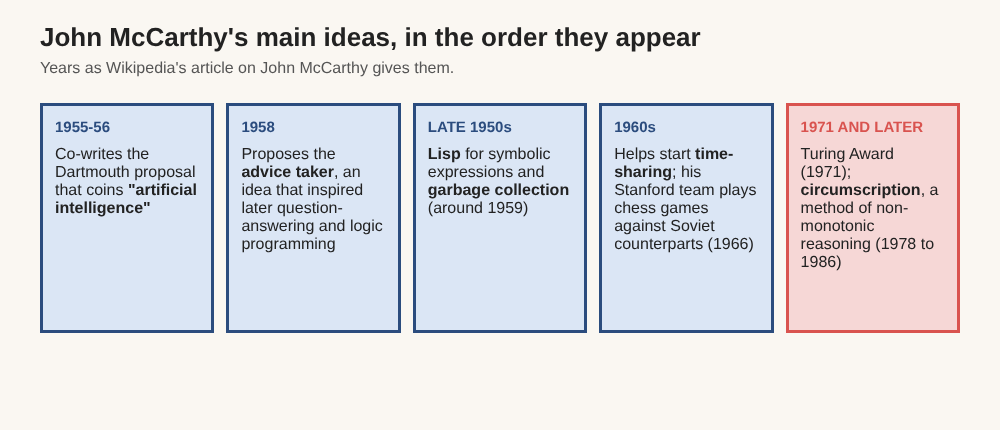
In the late 1950s McCarthy found that primitive recursive functions could be extended to compute with symbolic expressions. The result was the Lisp programming language, which became the language of choice for AI applications after its 1960 publication. The same paper introduced a notation borrowed from lambda calculus, and the article says later dialects such as Scheme based their meaning on it.
Around 1959 he invented what the article calls "garbage collection", a kind of automatic memory management, to solve problems in Lisp. He also served on a 1958 committee that became part of the group that designed ALGOL 60, and in August 1959 he proposed recursion and conditional expressions, which became part of ALGOL.
Lisp matters here because, as the article says, it became the language of choice for AI applications. For that story, see our posts on symbolic AI and the history of AI.
Time-sharing and the advice taker
McCarthy was instrumental in creating three of the earliest time-sharing systems. The article quotes his colleague Lester Earnest telling the Los Angeles Times that the Internet would not have happened nearly as soon as it did without this work, and that "we keep inventing new names for time-sharing... Now we call it cloud computing". In 1961, in a speech for MIT's centennial, McCarthy was perhaps the first to suggest publicly that selling computing power like water or electricity could become a business model. The article says the idea faded by the mid-1990s and has returned in new forms since 2000.
In 1958 he proposed the advice taker. The article says it inspired later work on question-answering and logic programming. From 1978 to 1986 he developed circumscription, a method of non-monotonic reasoning, and the article says he invented logics for achieving common sense in AI. If you want one small taste of why common sense is hard for machines, read our post on the frame problem.
What John McCarthy believed about machines
The article calls McCarthy "an artificial intelligence optimist", specifically confident in logic-based AI. His philosophy was that every aspect of human intelligence could be formalized precisely enough to be programmed into a machine.
In 1979 he wrote "Ascribing Mental Qualities to Machines". In it he said that machines as simple as thermostats can be said to have beliefs. In 1980 the philosopher John Searle replied with his Chinese Room Argument, saying machines cannot have beliefs because they are not conscious and lack intentionality. You can read that argument in our post on the Chinese room.
In a 1989 television interview, the article says, McCarthy was asked whether intuition separates humans from computers. He answered that some people believe humans have a spiritual or transcendent intuition that is not physically accessible, but that this view has been in steady decline for a few centuries. He thought realizing human consciousness in machines raised many difficult challenges, but he expected to overcome them.
McCarthy and Hubert Dreyfus
The article names Hubert Dreyfus, a philosophy professor at Berkeley, as perhaps the most famous skeptic of early AI. It says Dreyfus viewed human reasoning as more than just logic, and that the two men debated throughout their professional careers, with McCarthy staying outwardly optimistic about logic-based AI. Our post on Hubert Dreyfus on AI gives his side in full.
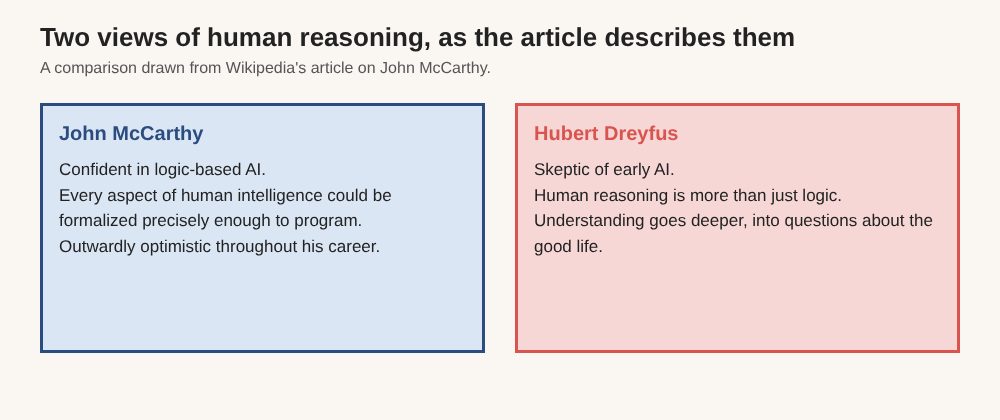
Neither side wins in the article. It simply sets the two views next to each other, and that is the useful way to read them.
A worked example: test a bold claim the way this story suggests
McCarthy's philosophy is a bold claim: every aspect of human intelligence can be formalized well enough to program. Here is a short exercise you can use on that claim, or on any big claim about AI.
- Write it as one sentence. "Every aspect of human intelligence can be formalized precisely enough to be programmed."
- Mark the words doing the work. "Every aspect" is the scope, and "precisely enough" is the standard. A claim about every aspect is hard to confirm and easy to challenge with one counterexample.
- Write the rival claim. Dreyfus's view, as the article gives it, is that human reasoning is more than just logic. Put it next to the first claim.
- Ask what would settle it. Name one result that would move you toward each side. If neither side can name one, the disagreement is partly about words.
- Check the speaker's record. McCarthy stayed optimistic for his whole career and said realizing machine consciousness raised difficult challenges. Both facts belong in your summary of his view.
Try it again with a claim you read this week about what AI will soon do. Who is claiming it, what is the scope, and what would count against it?
John McCarthy and Contain ASI
McCarthy's era was about making machines able to reason. Contain ASI looks at a later question as fiction. Its page reads "January 2024. Four AI labs. One race." and gives you three years to keep every lab from crossing into recursive self-improvement before 2027. You play as a researcher, research manager, CEO or government. The page says it is inspired by the AI 2027 scenario, and that all its labs, people and events are fictional. It is a story, not a forecast, and it does not claim to show what real organizations will do.
Frequently asked questions
Who was John McCarthy?
An American computer scientist and cognitive scientist (1927 to 2011), described by Wikipedia as one of the founders of artificial intelligence. He spent most of his career at Stanford University.
Did John McCarthy invent the term artificial intelligence?
He co-authored the proposal that coined it. The article says McCarthy, Minsky, Rochester and Shannon coined the term in their proposal for the 1956 Dartmouth conference.
What is John McCarthy known for?
Helping start AI as a field, leading the development of Lisp, creating garbage collection, helping popularize time-sharing, and winning the 1971 Turing Award.
What is the advice taker?
A proposal McCarthy made in 1958. The article says it inspired later work on question-answering and logic programming.
Why did Hubert Dreyfus disagree with John McCarthy?
The article says Dreyfus saw human reasoning as more than just logic, while McCarthy was confident that every aspect of human intelligence could be formalized and programmed. They debated their entire professional careers.
Get started
McCarthy bet that intelligence could be written down precisely enough to build. If you would rather explore where such bets might lead as a story, play Contain ASI: a story strategy game for 1 to 4 players that runs in your browser. Its labs, people and events are all fictional. You will need a recent browser, because it runs on WebGL 2.
January 2024. Four AI labs. One race.
Visit containasi.vlvd.net↗


Comments
No comments yet.
Sign in or make an account to comment.