AI Workflow vs AI Agent: How to Choose for Your Product
The choice of AI workflow vs AI agent is the first design decision in most AI products, and it is easy to get backwards. A workflow is a fixed path you design: step one, step two, step three, with a model doing the fuzzy work inside some steps. An agent is a model that chooses its own next step, using tools, in a loop, until it decides the job is done.
The first lesson of the Agents and Automation course on Age of AI Entrepreneur is called "Workflows Versus Agents", and a reader signs in with an email and an emailed code to open it. This post gives you a way to choose.
What each one is, in plain words
In a workflow, your code decides what happens next. Take a support ticket: classify it, look up the order, draft a reply, send it for approval. The same steps run in the same order every time. A model may write the draft or read the ticket, but it never decides to skip a step or add one.
In an agent, the model decides. You give it a goal and a few tools, such as "search orders" or "search the help pages". It picks a tool, reads the result, and picks again, until it thinks the goal is met or a limit stops it.
Most real products sit between the two: a mostly fixed path with one step where a model has some freedom. That middle ground is usually where a first product should start.
AI workflow vs AI agent at a glance
The picture sums up how they differ on the points that matter when you build and pay for them.
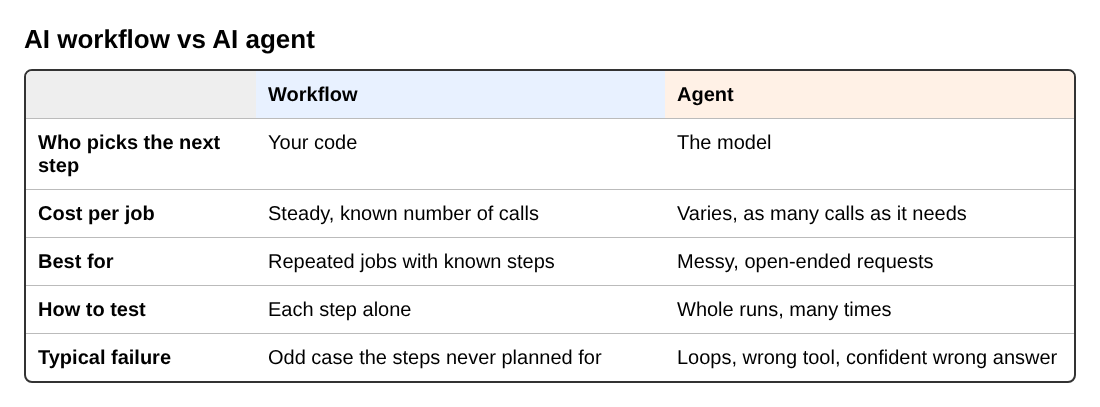
Read the table as tendencies, not laws. A tightly limited agent can be predictable, and a sprawling workflow can be hard to follow. Still, the direction holds: more freedom for the model means more range and less control for you.
Five questions that tell you which to build
- Can you write the steps down? If you can list them on a page and they rarely change, build a workflow. If every case needs a different path, an agent starts to earn its place.
- What does a wrong step cost? If a mistake is cheap and visible, an agent can try things. If it sends money, deletes data or messages a customer, fix the path and put a person before the risky step.
- How much variety is in the inputs? A narrow, repeated job suits a workflow. Messy, open-ended requests suit an agent, because no fixed list of steps covers them.
- Do you need a steady cost per job? A workflow makes a known number of model calls. An agent makes as many as it needs, and each call carries the whole conversation so far. The "Model APIs, Tokens and What a Request Costs" lesson in The AI Product Stack course shows how that adds up.
- How will you test it? A workflow can be tested step by step. An agent has to be tested on whole runs, which is slower and noisier. If you cannot say what a good run looks like, build the simpler thing first.
If three or more answers point to a fixed path, build a workflow. If most point to variety and low cost of error, try an agent, and limit it.
A worked example: a support ticket
Say you run a small online shop and want AI to handle refund questions. Here are both designs, side by side.
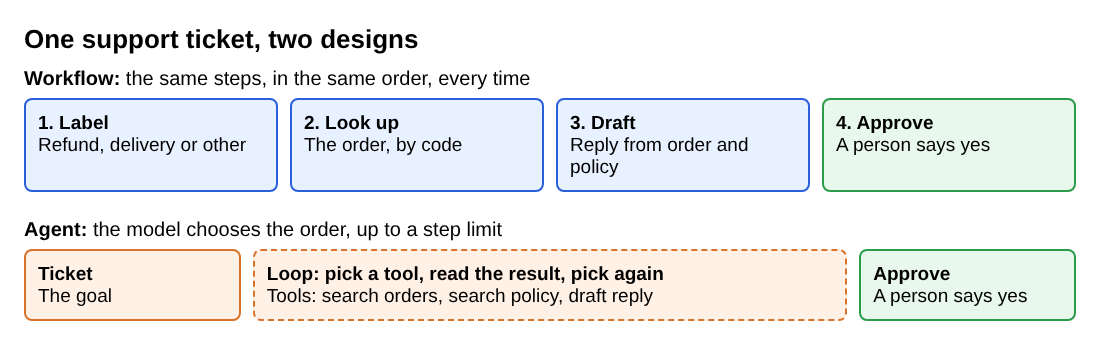
The workflow version. Step 1: a model labels the ticket as refund, delivery or other. Step 2: your code looks up the order. Step 3: a model drafts a reply using the order and your refund policy. Step 4: a person approves it. Every ticket takes the same path, costs about the same, and each step can be tested alone.
The agent version. The model gets the ticket and three tools: search orders, search policy pages and draft a reply. It decides the order of use. For an odd ticket, such as a refund on a bundle bought in two parts, it may look up both orders and compare them to a policy page, which a fixed path would miss. It may also loop, call a tool it does not need, or reach a confident wrong conclusion.
The sensible start. Build the workflow. Then find the one step that fails on odd cases, and give only that step agent-like freedom with a step limit and an approval before anything is sent. You get the range where you need it and the control everywhere else.
Where builders disagree
Builders do not agree on how fast to move toward agents. One camp says models keep getting better at choosing steps, so a fixed path will look dated soon and you should build agents now. Another camp says reliability is the product, so keep paths fixed and let the model fill in blanks until agents prove they are steady on your own tests. Both can be right for different jobs. The course lists sources in every lesson, and the app sets out 17 cards on questions where researchers disagree, so you can read the arguments yourself.
How to test either one before you ship
Whichever you pick, collect real cases with known good outcomes, run your design on them, and read the results. For a workflow, check each step. For an agent, check the whole run, the number of tool calls and where it stopped. The Evals course at its course page has a lesson on building an eval set and judging outputs.
When you are ready to go further, our posts on building an AI agent step by step and picking the first task to automate cover the next moves.
Frequently asked questions
Is a workflow with an AI step an agent?
No. If your code fixes the order of steps, it is a workflow, even when a model does work inside some of them. It becomes an agent when the model chooses the next step and the tool.
Should a first AI product be an agent?
Usually a workflow is the safer start, because it is cheaper to predict and to test. Add agent-like freedom to a single step once you see where fixed steps fail.
Are agents more expensive than workflows?
They often cost more and vary more, because an agent may make many model calls, each carrying the conversation so far. A step limit keeps the worst case in view.
Do agents need tools?
Yes. Tools are how a model reads data or acts, such as searching a database or drafting a message. Keep the list short and say plainly when to use each one.
Get started
Open the Agents and Automation course for its three short lessons: Workflows Versus Agents; Tools, Loops and Why Agents Fail; and Project: An Agent That Does a Real Job. You sign in with your email and an emailed code.
Start Age of AI Entrepreneur: short hands-on lessons on how to build a business in the age of AI, with every side of the debate and the sources to read next.
Building a business in the age of AI, from a first project to a company.
Visit aientrepreneur.vlvd.net↗
Comments
No comments yet.
Sign in or make an account to comment.