Allen Newell and AI: unified theories of cognition
Allen Newell was an American researcher in computer science and cognitive psychology who helped write some of the first AI programs and spent the rest of his career chasing one big goal: a single theory that explains the whole human mind. His last answer to that goal, a system called Soar, is still in use. This post covers his path into AI, the methods he left the field, and how his idea of a unified mind works in practice.
If you want to explore the long road from early AI programs to a mind that could improve itself, as a story, Contain ASI is a browser story strategy game for 1 to 4 players in which you try to keep four fictional AI labs from crossing into recursive self-improvement before 2027.
Who Allen Newell was
Wikipedia's article on Allen Newell says he was born in San Francisco on March 19, 1927, and died on July 19, 1992. He worked at the RAND Corporation and then at Carnegie Mellon University, across its computer science school, its business school and its psychology department.
With Herbert A. Simon and Cliff Shaw, he worked on the Information Processing Language in 1956 and on two of the earliest AI programs, the Logic Theorist and the General Problem Solver. In 1975 he and Simon shared the ACM Turing Award for their contributions to artificial intelligence and to the psychology of human cognition.
From physics and the Air Force to thinking machines
Newell did not start in computing. He earned a bachelor's degree in physics at Stanford in 1949 and spent a year studying mathematics at Princeton. There he met game theory and decided he preferred research that mixed experiments with theory over pure mathematics.
In 1950 he joined RAND in Santa Monica, in a group studying logistics problems for the Air Force. With colleagues he won Air Force funding in 1952 to build a simulator for studying how flight crews made decisions and handled information. That work convinced him that information processing is the central activity in organizations.
The turn to AI came at a seminar in September 1954, where Oliver Selfridge described a running computer program that learned to recognize letters and other patterns. Newell came away believing that systems could be built that contain intelligence and adapt. Within months he wrote The Chess Machine, a 1955 design for a program that would play chess in a humanlike way.
The Logic Theorist and the tools AI still uses
That work caught the attention of the economist Herbert A. Simon, who became his advisor and longtime partner. With the programmer J. C. Shaw they built the Logic Theorist, which the article calls the first true AI program. They showed it at the 1956 Dartmouth conference, now widely seen as the birth of AI, and its attendees led the field for the next two decades.
The article credits Newell with three ideas that outlived the program:
- List processing, which it calls the most important programming paradigm AI has used ever since.
- Means-ends analysis applied to general reasoning, or reasoning as search: compare where you are with where you want to be, and pick a step that shrinks the gap.
- Heuristics, rules of thumb that cut down how many options a search has to try.
At Carnegie Mellon, Newell and Simon founded an AI laboratory and produced the General Problem Solver and the physical symbol system hypothesis, the controversial claim that all intelligent behavior can be reduced to the kind of symbol handling their programs did. Simon's side of the story is in our post on Herbert A. Simon.
Unified theories of cognition: one mind, one theory
In 1990 Newell published Unified Theories of Cognition. Its argument is that the mind works as a single system, and that a theory of it should cover all of cognition at once: problem solving and decisions, memory and learning, perception and movement, language, motivation and emotion, even imagining and dreaming. He also argued that the models of his day were badly underdetermined by the experimental data: many different models fit the same results.
He then listed what a unified theory has to explain. A mind must behave flexibly and pursue goals, act in real time in a rich and changing world, use symbols and language, learn from experience, act on its own inside a social group, have a sense of self, and be something a brain could actually build and evolution could produce.
This is where he and Simon parted ways. The researcher Antonio Lieto has pointed out that Simon focused on single programs that each model one ability, expecting a general theory to emerge from many of them. Newell did not think that was enough, and set out to build integrated systems that do many tasks at once, called cognitive architectures.
Soar: Newell's architecture for general intelligence
Wikipedia's article on Soar) says it was created by John Laird, Allen Newell and Paul Rosenbloom at Carnegie Mellon, starting in 1983 as Laird's thesis. Its goal is the fixed building blocks for general intelligent agents: agents that can do a wide range of tasks and learn all kinds of knowledge, from planning to understanding language.
Soar rests on Newell's Problem Space Hypothesis: all goal-oriented behavior can be cast as a search through a space of possible states. At each step the system picks one operator and applies it to the current state. The name comes from this cycle of State, Operator, And Result.
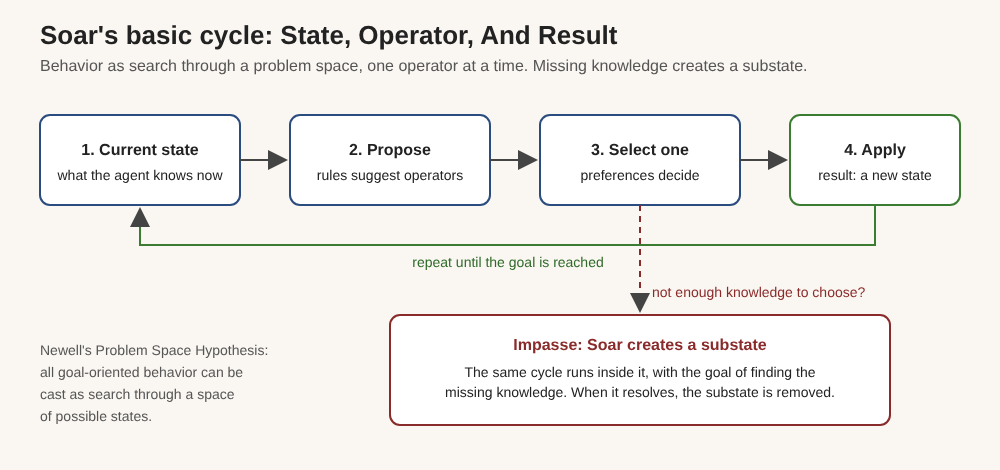
The clever part is what happens when the system gets stuck. If it lacks the knowledge to choose or apply an operator, it hits an impasse and creates a substate, where the same cycle runs with a new goal: find the missing knowledge. A mechanism called chunking then turns that work into new rules, so the next time the system does not get stuck in the same place.
Try it: solve a puzzle the Soar way
Soar has been used on classic puzzles, including the Water Jug puzzle. Here is a version you can solve on paper with Newell's method. You have a 4 litre jug and a 3 litre jug, both empty, and a tap. Your goal is exactly 2 litres in the 3 litre jug.
- Write the state. Use a pair: litres in the big jug, then the small one. You start at (0, 0). The goal is any state ending in 2.
- List the operators. Fill a jug, empty a jug, or pour one into the other until the source is empty or the target is full.
- Pick one, apply it, write the result. Fill the small jug: (0, 3). Pour it into the big one: (3, 0). Fill the small jug again: (3, 3). Pour into the big one until it is full: (4, 2). Goal reached.
- Notice your impasses. At (3, 0), you may have paused, unsure which move helps. That pause is Soar's impasse. Whatever you worked out to get past it, such as "top up the big jug from the small one to leave a remainder", is the kind of new rule chunking would store.
Try it again for 1 litre. You will be faster, and that speed-up is what Soar models.
His honors, legacy and the debate he left
Newell collected many honors. He was elected to the National Academy of Sciences in 1972, served as the first president of the American Association for Artificial Intelligence in 1980, and received the National Medal of Science in 1992. The ACM AAAI Allen Newell Award is named for him, and the field of cognitive architectures he started is still active in both AI and computational cognitive science.
His central bet is still argued over. The physical symbol system hypothesis is called controversial in his own article: supporters see symbols as necessary for general intelligence, while critics doubt that symbol handling alone can make a mind. Today, the Soar article notes, Soar's own emphasis has moved toward general AI, while a rival architecture, ACT-R, stays focused on modeling human cognition in detail.
Frequently asked questions
What is Allen Newell known for?
Co-creating the Logic Theorist and the General Problem Solver with Herbert A. Simon and Cliff Shaw, the physical symbol system hypothesis, his 1990 book Unified Theories of Cognition, and the Soar cognitive architecture.
What is a unified theory of cognition?
A single set of assumptions meant to explain all of cognition, from perception and memory to language and emotion, instead of a separate model for each ability. Newell called such a theory a cognitive architecture.
What does Soar stand for?
It came from State, Operator, And Result, the basic cycle of the system, though it is no longer treated as an acronym.
Did Allen Newell win the Turing Award?
Yes. He and Herbert A. Simon shared the ACM Turing Award in 1975 for their contributions to AI and the psychology of human cognition.
Get started with Contain ASI
Newell spent his life asking what it would take to build one general mind. Contain ASI lets you explore what might follow if minds like that arrived fast, as fiction: as a researcher, research manager, CEO or government, you try for three years to keep four fictional AI labs from reaching recursive self-improvement before 2027. Its Chapter 1, Before ASI, starts in January 2024, and the game says it is inspired by the AI 2027 scenario by Daniel Kokotajlo, Scott Alexander, Thomas Larsen, Eli Lifland and Romeo Dean. It needs a browser with WebGL 2.
Play Contain ASI: a story strategy game for 1 to 4 players that runs in your browser. Its labs, people and events are all fictional.
January 2024. Four AI labs. One race.
Visit containasi.vlvd.net↗

Comments
No comments yet.