Physical symbol system hypothesis: can symbols make a mind?
The physical symbol system hypothesis is a claim about what intelligence is made of. Wikipedia's article on physical symbol systems describes it as a position in the philosophy of artificial intelligence, formulated by Allen Newell and Herbert A. Simon. This post explains the claim, the evidence for it and the main attacks on it.
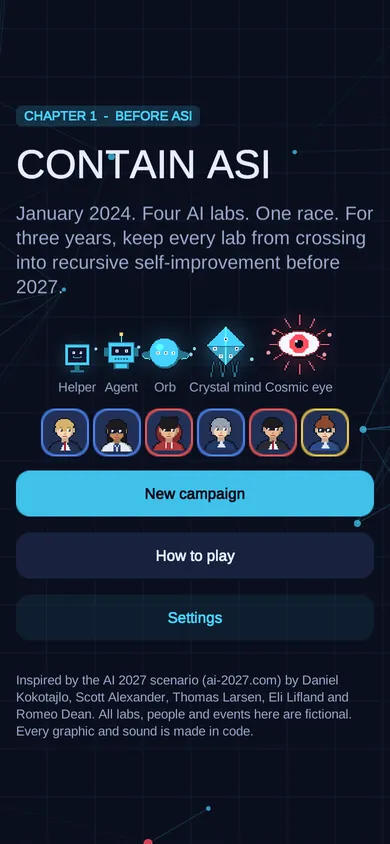
Contain ASI is a story strategy game for 1 to 4 players that runs in your browser: as a researcher, research manager, CEO or government, you try to keep four AI labs from crossing into recursive self-improvement before 2027. Its labs, people and events are all fictional.
What the physical symbol system hypothesis says
The article defines a physical symbol system as something that takes physical patterns (symbols), combines them into structures (expressions) and manipulates them (using processes) to produce new expressions. It is also called a formal system.
Newell and Simon wrote that "a physical symbol system has the necessary and sufficient means for general intelligent action." Two ideas hide in that sentence:
- Necessary: human thinking is a kind of symbol manipulation, because you cannot have intelligence without a symbol system.
- Sufficient: machines can be intelligent, because a symbol system is enough.
The article traces the idea back to Thomas Hobbes, who said reasoning is "nothing more than reckoning", and to Gottfried Wilhelm Leibniz, who tried to build a logical calculus of all human ideas. It also names David Hume and Immanuel Kant. Its latest form, the article says, is the computational theory of mind, linked to the philosophers Hilary Putnam and Jerry Fodor.
Symbols, expressions and processes
The easiest way to grasp it is through examples. The article lists four ordinary physical symbol systems: formal logic, algebra, chess, and a computer running a program. In each, you can point to the symbols, the expressions built from them and the processes that change one expression into another.
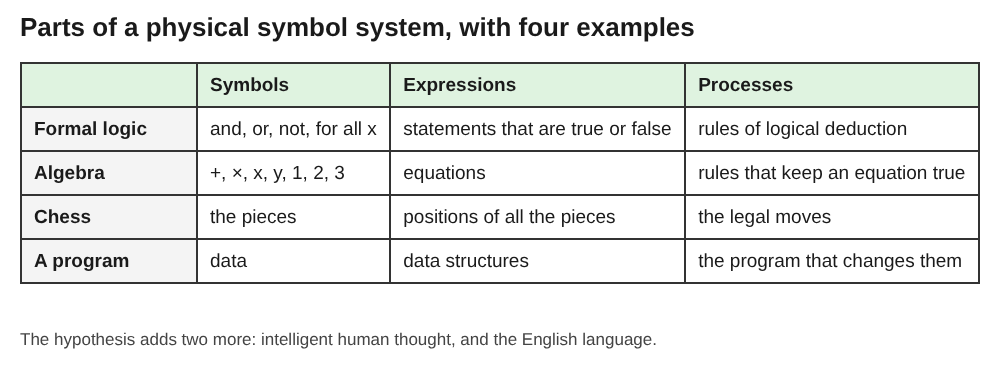
Then comes the bold part. The hypothesis claims two more things are physical symbol systems too:
- Intelligent human thought: the symbols are encoded in our brains, the expressions are thoughts and the processes are the mental operations of thinking.
- The English language: the symbols are words, the expressions are sentences and the processes are the mental operations of speaking, writing and reading.
If you accept that, a machine running the right program is not imitating thought. It is doing the same kind of thing.
Why Newell and Simon believed it
The article names two lines of evidence. The first is psychology. Newell and Simon ran experiments in which people worked through hard problems in logic, planning and puzzle solving. The people went step by step, weighed several ways forward, picked the most promising one and backed up at dead ends. Each option was held in symbols such as words, numbers or diagrams. Newell and Simon then wrote programs that used the same algorithms and solved the same problems. Hubert Dreyfus called this approach "cognitive simulation", and the article says it fed the cognitive revolution of the 1960s and the founding of cognitive science.
The second line is the programs themselves. In the 1950s and 1960s many AI programs worked by processing symbols, and they did things people had assumed machines could not do:
- STUDENT solved algebra word problems.
- The Logic Theorist proved theorems in logic. See the Logic Theorist post.
- Arthur Samuel's program learned to play competitive checkers.
- ELIZA and SHRDLU communicated in natural language. See our post on the ELIZA chatbot.
Their success, the article says, suggested symbol processing systems could simulate any intelligent action. For the wider story of that era, read our post on symbolic AI.
Three clarifications that keep it from being trivial
The article warns that the hypothesis becomes "trivial, incoherent or irrelevant" unless you keep three distinctions in mind.
Symbols are not just signals
The hypothesis is only interesting if the symbols have a recognizable meaning and can be combined into bigger symbols, like <dog> and <tail>. It does not apply to the 0s and 1s in a computer's memory, or to matrices of unidentified numbers such as those in neural networks. David Touretzky and Dean Pomerleau note that if symbols and signals are the same thing, sufficiency is a given, "because physical symbol systems are Turing-universal". Nils Nilsson adds that describing a process in symbols instead of signals can be "unmanageably cumbersome".
General intelligence, not narrow tools
The claim is about "general intelligent action", so it says artificial general intelligence can be reached with symbolic methods alone. It says nothing about narrow programs built to solve one problem. The article also says whether large language models show general intelligent action is arguable.
Behavior, not consciousness
The hypothesis is about what a machine does, not what it experiences. A machine could in principle simulate consciousness without having it, so the hypothesis does not settle John Searle's strong AI claim. See our post on the Chinese room.
The case against the hypothesis
The article cites Nilsson's list of four themes critics use: that the hypothesis lacks symbol grounding, that AI needs non-symbolic processing such as connectionist designs, that the brain is not a computer, and that the brain is closer to an ant colony than a logic engine. It then goes through specific critics.
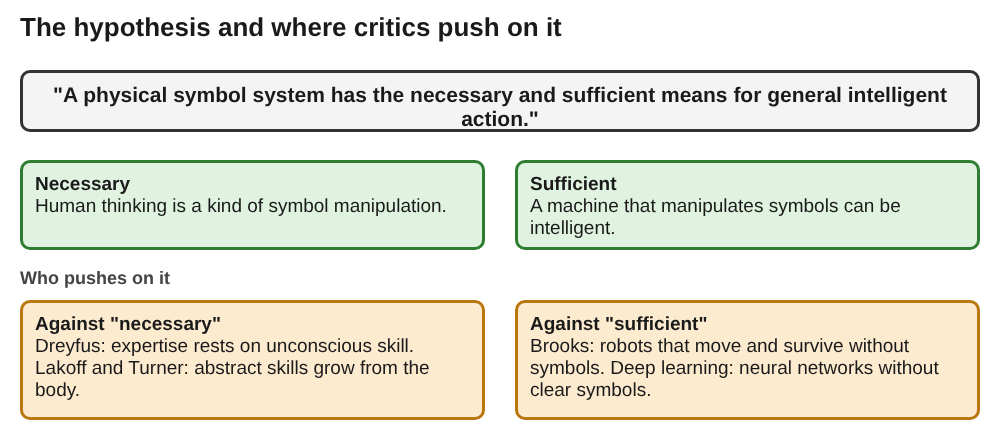
- Hubert Dreyfus attacked the "necessary" side. He called it "the psychological assumption", the idea that the mind is a device operating on bits of information by formal rules. He argued that expertise rests mainly on unconscious instinct and intuition, not step-by-step symbol searches. Our post on Hubert Dreyfus on AI gives his case in full.
- George Lakoff, Mark Turner and others argued that abstract skills in mathematics, ethics and philosophy depend on unconscious skills that come from the body, and that conscious symbol manipulation is a small part of intelligence..
- Rodney Brooks of MIT built robots that moved and survived without symbolic reasoning. He and Hans Moravec found that basic skills like motion, perception and balance did not seem to need high-level symbols. In his 1990 paper Elephants Don't Play Chess he wrote that "the world is its own best model."
- Deep learning: the article says that in 2012 a deep learning network called AlexNet beat all other programs at classifying images on ImageNet by a wide margin, and that deep learning has since beaten symbolic AI in many areas. The article marks that line as needing a citation.
The article also says it is impossible to prove symbolic AI will never produce general intelligence. But if symbolic methods cannot solve particular problems efficiently, that is evidence against the "sufficient" side. It lists intractable problems, common sense knowledge and Moravec's paradox, which we cover in a post on Moravec's paradox. Hybrid designs that combine symbols with other methods would count against sufficiency but for the necessary side, the article says.
A worked example: sort a system into symbols or signals
You can use the article's own clarifications as a test. Take any system someone calls "AI" and run it through these steps.
- Name the system. For example, a program that proves logic theorems, a robot that balances on two legs, or an image classifier.
- Look for symbols. Can you point at pieces that have a recognizable meaning and can be combined, like words, logical connectives or chess pieces? A theorem prover passes. A matrix of unidentified numbers does not.
- Look for processes. Are there rules that turn one expression into another? A logic prover has deduction rules.
- Ask whether the task is narrow or general. The hypothesis only speaks about general intelligent action, so proving one kind of theorem does not test it.
- Ask whether the claim is about behavior or experience. If someone says the system "feels", the hypothesis is not the right tool.
Try it on three systems you used this week. Many land in the "signals" pile.
The hypothesis and Contain ASI
Contain ASI asks a different question from the hypothesis, as fiction. Its page reads "January 2024. Four AI labs. One race." and gives you three years to keep every lab from crossing into recursive self-improvement before 2027. You play as a researcher, research manager, CEO or government. The page says it is inspired by the AI 2027 scenario, and that all its labs, people and events are fictional. It is a story, not a forecast.
Frequently asked questions
What is the physical symbol system hypothesis?
The claim by Allen Newell and Herbert A. Simon that a physical symbol system has the necessary and sufficient means for general intelligent action. In plain words, symbol manipulation is both required for intelligence and enough for it.
What counts as a physical symbol system?
Anything that turns symbols into expressions and changes them with processes. The article's examples are formal logic, algebra, chess and a computer running a program, and the hypothesis adds human thought and the English language.
Do neural networks count as physical symbol systems?
The article says the hypothesis does not apply to unidentified numbers in neural network matrices. Those are better described as dynamic systems, because the symbols are not recognizable.
Who criticized the hypothesis?
The article names Hubert Dreyfus, George Lakoff, Mark Turner and Rodney Brooks, and it points to deep learning. Nils Nilsson sorted the objections into four themes.
Get started
If you would rather see what happens when capable systems race ahead, as a story, play Contain ASI: a story strategy game for 1 to 4 players that runs in your browser. Its labs, people and events are all fictional. You will need a recent browser, because it runs on WebGL 2.
January 2024. Four AI labs. One race.
Visit containasi.vlvd.net↗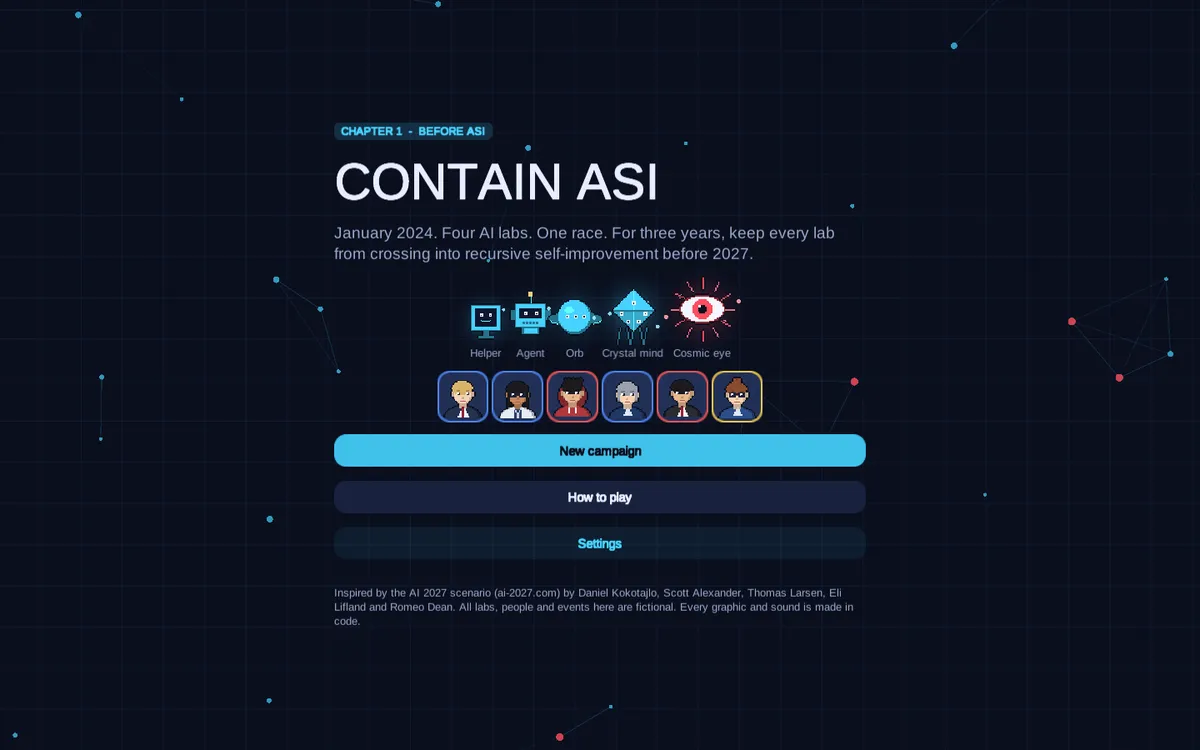
Comments
No comments yet.
Sign in or make an account to comment.