Are flashcards a good way to study? How to use them well
Flashcards are one of the oldest study tools there is: a term or question on the front, the answer on the back. So are flashcards a good way to study? Mostly yes, but only when you use them in a certain way, and the research shows many students skip the parts that matter. This post sets out what the studies say, where flashcards fall short, and a simple way to pair them with a practice quiz.
Are flashcards a good way to study? The short answer
Flashcards work because they make you pull an answer out of memory before you see it. That act, called retrieval practice, strengthens memory more than reading the answer again. Our post on retrieval practice covers the wider research.
But a flashcard is only as good as how you use it. Three things decide it: whether you really try to answer before you flip, how far apart you review each card, and whether you stop reviewing a card too early. And for exam questions that ask you to explain, compare or apply an idea, a stack of term cards covers only part of the job.
What the research says flashcards do well
In Kornell and Son (2009), people studied word pairs in a flashcard-like setup. On the second pass, they either saw the whole pair again or saw only the first word and tried to produce the second. People judged that seeing the whole pair taught them more, and the researchers report that judgement was wrong. Most still chose to test themselves, but mainly to check what they knew, not to learn it.
That second reason is worth fixing. Testing is not only a check. In Karpicke and Roediger (2008), students learned foreign language words. Once a student had recalled a word correctly, more studying of it did nothing for later recall, while more testing on it had a large positive effect. Students' guesses about how well they would do had no link with how they actually did.
A trial with 90 dental students in India points the same way (Santhosh and colleagues, 2024). One group had lectures only. The other had the same lectures followed by spaced review on a mobile flashcard app. Right after teaching, the groups scored about the same. One month and three months later, the flashcard group remembered significantly more.
Where flashcards go wrong
- Dropping cards too soon. Almost every student sets aside cards they think they know. Across four experiments, Kornell and Bjork (2008) found that being allowed to drop cards had small but consistently negative effects on learning.
- Gaps that are too short. A survey of 374 university students (Wissman, Rawson and Pyc, 2012) found they understood the value of getting a card right several times, but did not usually leave longer gaps between reviews, or see why that helps. The gaps are where the gain is; our post on spaced repetition for exams has a schedule.
- Flipping without answering. If you glance at the front and turn the card straight away, you are reading the card, not testing yourself. Say or write the answer first, even when you are unsure.
The other side: decks in real courses
Studies of flashcards in real courses are less clear. At Ulm University, staff made 1,007 electronic flashcards on 228 drugs and offered them to medical students over four semesters (Harder, Barth and Hafner, 2026). About 38 percent used them, more for exams on facts than for exams built on cases, and 83 percent of users found them helpful. Users scored lower than non-users, but the gap was no longer significant once the researchers allowed for how strong each student said they were in general; weaker students were more likely to use the cards. The authors concluded the decks showed no benefit and advised caution before making more.
In a smaller study of 53 first-year medical students (Haughey and colleagues, 2025), 80 percent used a spaced-repetition flashcard app. Across the module there was no clear benefit. Students who used it heavily did better than those who used it on and off, and use was linked with higher physiology scores.
Both are observational studies, so they cannot show cause in either direction. A fair reading: owning a deck is not enough, steady use seems to matter, and flashcards suit facts better than case questions.
Flashcards and practice quizzes do different jobs
A flashcard asks you to produce the answer from nothing. That is recall. A multiple-choice question shows you four options, so you can recognise the answer. Halamish and Bjork (2011) note that the benefit of testing tends to show most after a long delay or on a final test that asks for recall. If your exam asks you to write terms from memory, you need recall practice.
Multiple choice has its own strength. Little and colleagues (2012) found that well-built multiple-choice questions, with wrong options that sound right, made people really retrieve what they knew. They also helped people remember facts about the wrong options, which recall questions did not.
So use each for what it does best. Flashcards for terms, definitions, names and formulas. A quiz for ideas, comparisons and applying what a page says.
Worked example: a quiz finds the gaps, flashcards drill them
Making a full deck for a chapter takes a long time, and many cards end up covering things you already know. Here is a quicker way using Study Shot, which turns a photo of a page from your textbook, notes or worksheet into multiple-choice questions and explains every answer.
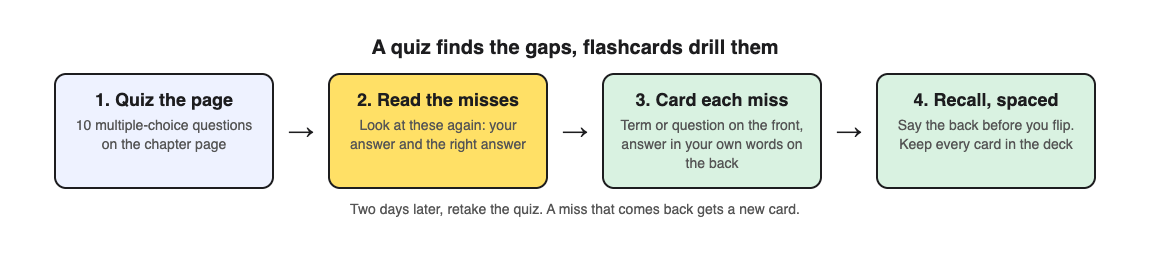
- Quiz the page first. Photograph the chapter page you are studying and make a quiz of 10 questions on the default ladder, which climbs from basic to advanced. Answer every question before you reread.
- Read the misses. After each answer, Check answer shows Correct! or Not quite., the correct answer and a short explanation. The results screen lists every miss under Look at these again, with your answer and the right one.
- Make one card per miss. On the front, write the term or a question in your own words. On the back, write the answer in your own words, plus one line on why your wrong pick was wrong.
- Review the cards with real recall. Say or write the answer before you flip. Keep every card in the pile, even the ones you get right.
- Retake the quiz in two days. Each quiz is saved in your library with its page photo and your best score. Press Retake quiz. Any miss that comes back gets a new card.
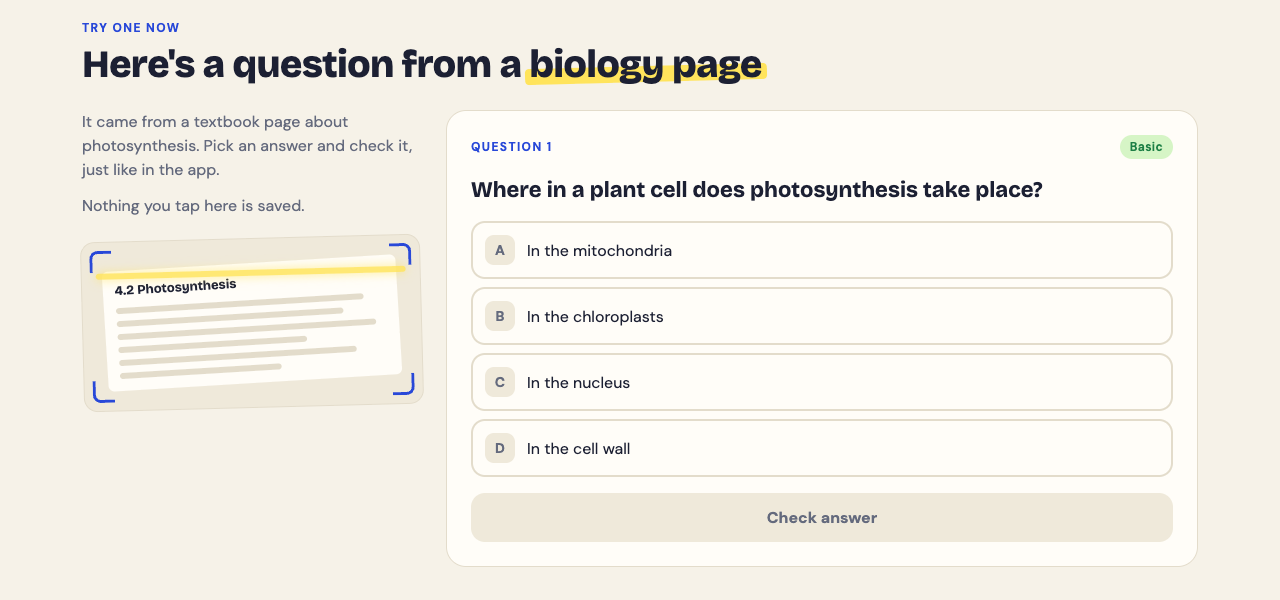
Your deck now holds only what you did not know, and the quiz keeps checking the ideas around those terms. For a page full of new words, our post on studying vocabulary from a textbook page goes further.
The questions are written by an AI model and can contain mistakes. If one does not match your textbook, trust the textbook and your teacher, and use Report a problem under the question.
Frequently asked questions
Should I stop reviewing a flashcard once I get it right?
No. Dropping cards you think you know had a small negative effect on learning, and more testing after a correct answer helped later recall a lot.
Are flashcards good for understanding, or only for memorising?
They are strongest for facts, terms and definitions. In the Ulm study, students used them more for exams on facts than for exams built on cases, so pair them with questions that ask you to explain or apply.
Are digital flashcards better than paper ones?
The studies here do not compare the two. What matters in them is that you answer before you flip and review on spaced days.
Is a multiple-choice quiz the same as flashcards?
No. A quiz asks you to pick from options and a flashcard asks you to recall, and each has its own benefit, so many students use both.
Get started
Try Study Shot: it is free to start and works on your phone and computer. Photograph the page you are studying, take a 10-question quiz, and turn every miss into a flashcard you review over the next few days.
Comments
No comments yet.
Sign in or make an account to comment.