Aristotle's contribution to science: biology, logic, causes
If you want to know Aristotle's contribution to science, start with animals. Most people remember Aristotle as a philosopher of ethics and politics. But the Stanford Encyclopedia of Philosophy calls him "the originator of the scientific study of life." He also gave science a method, a set of questions to ask about anything, and its first system of logic. This guide walks through all four, shows where scholars disagree, and ends with an exercise you can try on any animal near you.
Aristotle's contribution to science in one paragraph
Aristotle was born in Stagira, on the northern Aegean coast, in 384 BCE. At 17 he went to Athens and studied in Plato's Academy for 20 years, until Plato died in 347. Later he tutored the young Alexander, the future Alexander the Great, and then founded his own school in Athens, the Lyceum. Along the way he did four things that shaped science:
- He studied living things systematically. His animal studies are the first systematic and comprehensive record of their kind.
- He separated facts from reasons. First you collect what is true, then you look for why it is true.
- He asked four kinds of "why". What is it, what is it made of, what brought it about, and what is it for.
- He wrote the first logic. A theory of how one statement follows from others.
He made the study of life a science
Aristotle was not the first Greek to think about living things. Earlier natural philosophers speculated about where life came from. The Hippocratic medical writings show serious interest in human anatomy. Plato, his own teacher, had a character in the Timaeus talk at length about the human body.
What changed with Aristotle was the scale and the method. The Stanford entry on Aristotle's biology says he was the first to study life "both systematically and in a manner that is thoroughly empirical." Empirical means based on looking and checking, not only on reasoning. His writings on animals make up roughly a quarter of everything of his that survives. According to the entry, nothing of similar scope and sophistication appeared again until the 16th century.
He did not work alone. On the island of Lesbos he met Theophrastus, a younger man with the same interest. The entry says that between the two of them they originated the science of biology: Aristotle studied animals and Theophrastus did the same for plants.
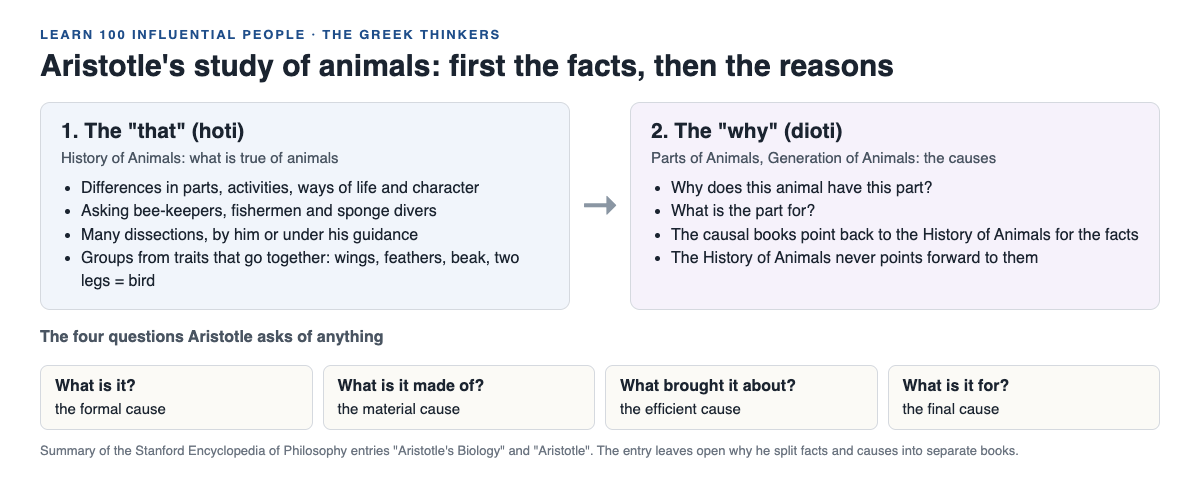
We have no notebooks or diaries from his research. But his writings show how he worked. He regularly asked people who knew animals first hand, such as bee-keepers, fishermen and sponge divers. He, or someone working under his guidance, dissected a great many animals of many kinds, and at least some diagrams were made from those dissections. He also had access to a large library of facts recorded by others.
First the facts, then the reasons
Aristotle split an investigation into two stages. The Greek words are hoti, "that", and dioti, "the reason why". First you establish that something is so. Only then do you ask why.
His History of Animals is the "that" stage. It sorts animals by four kinds of differences: in their parts, in their activities, in their ways of life and in their character. Groups come out of traits that go together. Many animals have wings, feathers, beaks and two fleshless legs, and that group has the name "bird". Where no name existed, he described a group by its traits, such as the four-legged animals that give birth to live young. The entry notes that this group corresponds to our land mammals, with one important exception.
His Parts of Animals and Generation of Animals are the "why" stage. They try to explain why animals have the parts and ways of developing that they do. These books keep pointing back to the History of Animals for the facts. The History of Animals never points forward to them.
Four questions to ask about anything
The general Stanford entry on Aristotle uses a statue to explain his four causes. Faced with a statue, you would want to know what it is, what it is made of, what brought it about and what it is for. Aristotle calls these the formal, material, efficient and final causes. In his view, once you have all four, you have explained the thing well enough.
The last question, "what is it for?", matters most for living things. In his biology, the form of an animal is its capacity to live: to feed, to sense, to move. The parts of the animal come to be and exist for the sake of that form. So explaining a part means asking what it is for.
The World History Encyclopedia draws the contrast with Plato. Both thought about final purposes. Plato held they could be known through a higher, invisible plane of truth. Aristotle believed they could be found by observing the world we know.
The first logic: a tool for every science
The Stanford entry lists among his great achievements "the first systematic treatment of the principles of correct reasoning, the first logic." People reasoned well and badly before him. What he added was a theory of it. His theory of deduction is now called syllogistic.
A classic syllogism has two premises and a conclusion. All birds have feathers. A sparrow is a bird. So a sparrow has feathers. The form works whatever words you put in, and Aristotle studied which forms are valid. His logical works came down from the Middle Ages under the name Organon, Greek for "tool". The name fits: logic was a tool for every other kind of inquiry.
His reach lasted. In the later Middle Ages he was called "The Master", most famously in Dante's Inferno, where he is recognized without being named.
Where scholars disagree
Three questions still divide people who study him.
- How much credit is his? The Stanford entry calls him the originator of the scientific study of life. It also lists the Greek thinkers and doctors before him who studied bodies, and it gives the founding of biology to Aristotle and Theophrastus together.
- What are the books? Some have called them lecture notes. The entry's authors think that is clearly wrong, because the texts are too carefully structured. They also warn that the collection we have was likely put together hundreds of years after his death, so we cannot be sure how close it is to what he wrote.
- Why two kinds of book? In no other subject, from weather to ethics, does Aristotle put the facts and their causes in separate books. The entry closes by leaving this as an open puzzle.
If you want to see why ranking someone like Aristotle is hard in the first place, read how to judge any list of the most influential people in history.
Worked example: study one animal the Aristotle way
You can try his method in about 20 minutes. Pick an animal you can watch or read about, such as a pigeon, a garden snail or a pet fish.
- Collect the "that". Write down ten facts about its parts, how it moves, what it eats and how it behaves. Do not explain anything yet.
- Ask someone who knows. Aristotle asked fishermen and bee-keepers. Ask a pet shop worker, a gardener, or read one trusted source, and add what you learn.
- Find traits that go together. Which other animals share three or more of your traits? That cluster is a group, the way wings, feathers, beaks and two legs make "bird".
- Ask the four questions. Pick one part, say a snail's shell. What is it? What is it made of? What brought it about? What is it for?
- Now ask "why". Only at the end, write one sentence explaining why the animal has that part.
Then check yourself. Did any step 1 fact sneak in an explanation? Aristotle's point was to keep the two stages apart. If you want a routine for doing this kind of study every day, see how to learn world history in 10 minutes a day.
Frequently asked questions
What was Aristotle's biggest contribution to science?
Many would point to biology. The Stanford Encyclopedia of Philosophy calls him the originator of the scientific study of life, and his animal studies are the first systematic and comprehensive record of their kind.
How did Aristotle study animals?
His writings show that he, or people working under him, dissected many kinds of animals and gathered reports from fishermen, bee-keepers and sponge divers. We have no notes or diaries of the research itself, only the finished books.
What are Aristotle's four causes?
The formal, material, efficient and final causes. In plain words: what a thing is, what it is made of, what brought it about and what it is for.
Did Aristotle invent logic?
People reasoned before him, but the Stanford entry credits him with the first systematic treatment of correct reasoning. His theory of deduction is now called syllogistic.
Get started
Aristotle is in The Greek Thinkers, one of the Basic courses on Learn 100 Influential People, alongside Socrates, Plato, Euclid, Archimedes and Hippocrates. The Basic level covers "The best-known names, no background needed." Each lesson takes about 9 minutes, with diagrams and a hands-on activity, and questions ask you to choose, put in order, match, sort or estimate a number. Questions from lessons you finish come back later, spaced out, up to 5 a day. Like this guide, the site sets out where researchers disagree, and every lesson lists its sources. Sign in with your email and an emailed code; accounts are for people aged 13 or older. Read about the project.
Start Learn 100 Influential People: short hands-on lessons on the people who shaped history, with every side of the debate and the sources to read next.
Comments
No comments yet.
Sign in or make an account to comment.