How to learn world history in 10 minutes a day
If you have ever wondered how to learn world history without drowning in dates, the answer is to change what you study and how you study it. Learn it through the people who shaped it. Study in short sessions, about 10 minutes a day. Test yourself with questions instead of rereading. Then come back to old material after a gap of a few days. This guide explains each part, shows what two well-known memory studies found, and gives you a 7-day plan you can start today.
How to learn world history: start with people, not dates
A list of dates is hard to hold on to. Each date stands alone, so there is nothing to hang it on. A person is different. A person had goals, rivals, ideas and results. When you learn about someone, you get a small story to hang the facts on.
People also connect. A ruler, a teacher, an inventor and a writer from the same age share one world. Once you know a few people well, the period around them starts to fill in. You remember the date because you remember the person, not the other way round.
This works for any starting point. You can begin with founders of empires, with thinkers, or with inventors. What matters is that each session gives you one or two people and one clear question about them.
Why short sessions and self-testing work
Two findings from memory research shape this method. Keep them in mind, but do not stretch them beyond what the studies say.
The first is about testing yourself. In a 2006 study, Roediger and Karpicke had students read prose passages. Some then took recall tests on them. Others studied the same passages again, the same number of times. On a final test 5 minutes later, the students who restudied did better. But on tests 2 days or 1 week later, the students who had been tested remembered substantially more. Rereading also made students more confident, even though they remembered less later. The authors conclude that testing is a powerful way to improve learning, not just a way to measure it.
The second is about timing. A 2006 review by Cepeda and colleagues pulled together 839 measurements from 317 experiments in 184 articles on spreading study out over time. One of its main results: the gap between study sessions that gave the best memory grew longer the longer people needed to remember the material.
So the practical lesson is simple. Answer questions from memory rather than rereading. And do not do all your review on one day. Come back after gaps, and the longer you want to remember something, the longer those gaps can be.
The method in five steps
- Pick one person or one pair. Pairs work well, because comparing two people gives you a natural question.
- Write one question before you read. For example: what was each one trying to change? A question gives your reading a target.
- Read for about 5 minutes. Use one good source, not five tabs. Note where the facts come from.
- Close the page and answer in three sentences. Then check your answer against the source and fix what you missed.
- Schedule the comeback. Ask yourself the same question again a few days later, then again a week after that, without looking first.
That is about 10 minutes. It is short enough to do every day, which matters more than doing a lot on one day.
A 7-day plan, about 10 minutes a day
Here is a worked example. Each day uses a pair of people from a course on Learn 100 Influential People. The questions are prompts for you to answer, not answers. Your job is to find the answer, write it down, and check it.
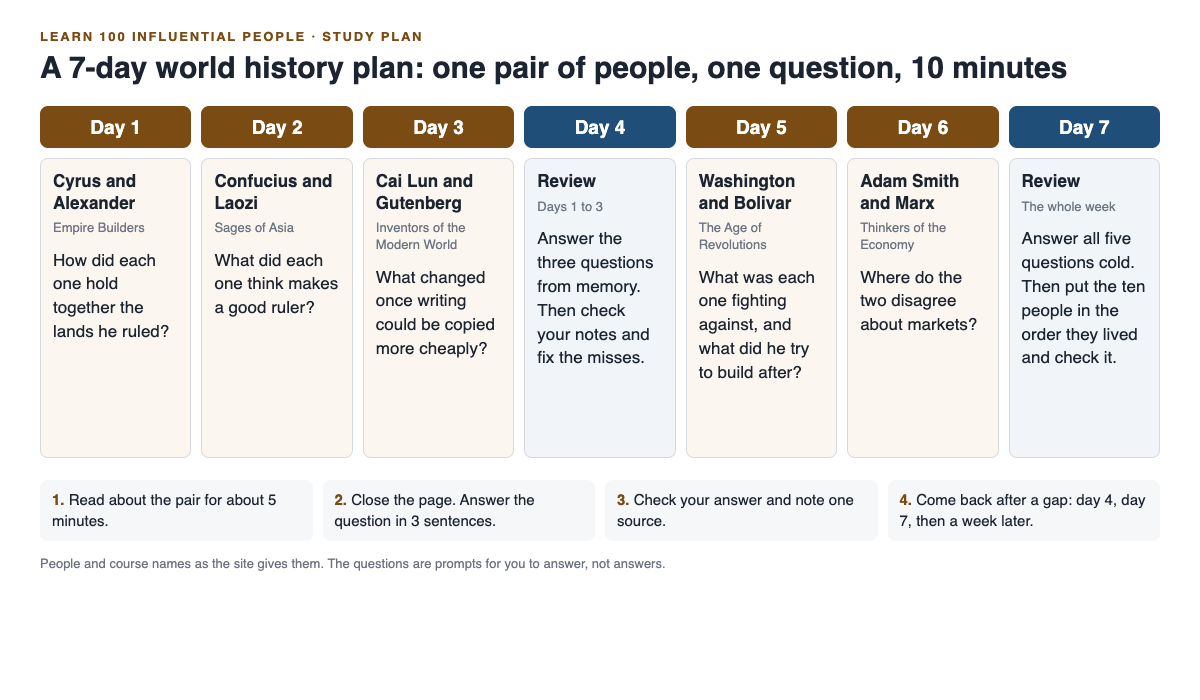
- Day 1: Cyrus and Alexander (Empire Builders). Question: how did each one hold together the lands he ruled?
- Day 2: Confucius and Laozi (Sages of Asia). Question: what did each one think makes a good ruler?
- Day 3: Cai Lun and Gutenberg (Inventors of the Modern World). Question: what changed once writing could be copied more cheaply?
- Day 4: Review. Answer the three questions from days 1 to 3 from memory, before you look at anything. Then check your notes and fix the misses. This is your first gap.
- Day 5: Washington and Bolivar (The Age of Revolutions). Question: what was each one fighting against, and what did he try to build after?
- Day 6: Adam Smith and Marx (Thinkers of the Economy). Question: where do the two disagree about markets?
- Day 7: Review the whole week. Answer all five questions cold. Then put the ten people in the order they lived, and check your order against your sources.
After day 7, do not stop reviewing. Ask yourself the five questions again a week later. Longer gaps suit things you want to keep for longer, which is what the review above found.
Notice what the plan does not ask for. It does not ask you to memorise a timeline first. The order of the ten people comes last, on day 7, after you know who they were. By then the order has something to hang on.
Read where historians disagree, and read the sources
History is not a fixed list of answers. Historians argue about causes, about motives, and about how much one person really changed. If you only learn one version, you learn less than half the story.
So add one more habit to your 10 minutes. When a question has more than one answer, write down both sides and who holds each. You do not have to pick a winner. Knowing that a debate exists, and what each side says, is part of knowing the history.
The second habit is to read the sources a lesson or book lists. A summary tells you what someone concluded. The source shows you what they were working from. Even a page of the original text will make the person feel real in a way a summary cannot.
Lists of influential people are a debate too. If you want to test any ranking you meet, our guide on how to judge any list of the most influential people in history walks through the questions to ask.
Common mistakes to avoid
- Rereading instead of answering. Rereading feels productive and builds confidence. The testing study above found the confidence was not matched by later memory.
- Long sessions once a week. One hour on Sunday is easier to plan than 10 minutes a day, but it packs all your practice into one sitting and gives you one chance a week to answer from memory.
- Too many people at once. One person or one pair per session is enough. Depth beats coverage at the start.
- Skipping the review days. Days 4 and 7 are where the plan does most of its work. Do not trade them for new material.
If you are studying for a class test rather than for yourself, two posts go further on scheduling: a simple spaced review schedule for an exam a few weeks away, and a one-week plan for studying for a history test from your notes.
Frequently asked questions
How long does it take to learn world history?
There is no finish line, but you can build a real base in short daily sessions. Ten minutes a day, with regular review, adds up faster than occasional long sessions.
Should I start with dates or people?
Start with people. Once you know who someone was and what they did, the dates around them are easier to place and to remember.
Is rereading my notes enough?
In Roediger and Karpicke's study, rereading helped on a test 5 minutes later, but testing did better on tests days later. Answer questions from memory first, then check.
Do I need a background in history?
No. Start with well-known names and build out from there. The plan above assumes you know nothing about the ten people before you start.
Get started
You can run this method on Learn 100 Influential People, where every pair in the 7-day plan comes from one of its courses. It has 46 lessons of about 9 minutes, close to the 10-minute session above, and the Basic level's 4 courses cover "the best-known names, no background needed." Each lesson checks you with questions where you choose, put in order, match, sort and estimate a number, and every attempt is graded, so you can retake a lesson any time. Questions from lessons you finish come back spaced out, up to 5 a day. And 38 cards set out where researchers disagree, while every lesson lists its sources so you can read the original work. Sign in with your email and an emailed code. Accounts are for people aged 13 or older.
Comments
No comments yet.
Sign in or make an account to comment.