Budget Leak Log: What You Tried to Cut Spending
A budget leak log is a short record of the small ways money slips out and the fixes you tried. If you want to cut spending and keep the cuts, a budget leak log: what you tried to cut spending is the habit that stops you repeating the same failed attempt every January. This post shows what to record, a template you can copy, and how to read the log after a few weeks.
Budget leak log: what you tried to cut spending, and why it works
Most people try to cut spending by willpower. They decide to eat out less, it works for nine days, and then it stops. Three months later they decide again, with no memory of what happened last time.
A log fixes the memory problem. You write down the leak, what you tried, and what happened. The next time the same leak shows up, you do not start from zero. You read your own history.
This is the same idea behind a plateau log for language learning or a sleep log. The subject changes. The method does not: name the problem, list the attempts, record the result honestly.
Budget leaks vs. big expenses: what to track
Rent, a car loan, and insurance are big expenses. You can change them, but you do that once, with a phone call or a move. They rarely need a log.
Leaks are different. They repeat, they are small, and you barely notice them:
- Delivery fees and "just this once" takeout
- Subscriptions you forgot you had
- Impulse buys late at night
- Coffee, snacks, and vending machines at work
- Bank fees and late fees
Track a leak when it has happened at least twice. One odd purchase is an event. A pattern is a leak.
What to record each time you try to cut spending
Keep each entry short. Four fields are enough.
- The leak, in one line. "Weekday lunch out costs about the same as a gym membership." Write it in plain words, not as a goal.
- What you tried. One action per attempt. "Packed lunch Monday to Wednesday."
- What happened. Use three outcomes only: worked, partly, or failed.
- Why, if you know. "Failed on Thursday because the team went out and I felt awkward."
The "why" field is where the value is. A failed attempt with a reason tells you what the next attempt must handle.
A simple budget leak log template you can copy
You can keep this in a notes file or a notebook. Write one block per attempt:
Leak: [one line] Tried: [one action] Date started: [date] Outcome: worked / partly / failed Why: [one line] Next: [the next thing to try, or "leave it"]
The "Next" line matters. It turns a record into a plan. If you write "leave it", that is a valid decision, and it saves you from feeling guilty about it later.
Example entries: what you tried and what happened
These are made-up examples to show the format, not real results.
Entry 1: lunch out
Leak: Weekday lunch out, about five times a week. Tried: Pack lunch every day. Outcome: failed. Why: Too much prep on Sunday night. I stopped by the second week. Next: Pack lunch only three days, using leftovers from dinner.
Entry 2: same leak, second attempt
Leak: Weekday lunch out. Tried: Leftover lunch three days a week, eat out on the other two. Outcome: worked. Why: No extra cooking, and the two outings kept it from feeling like a rule. Next: Keep it. Check again in a month.
Entry 3: subscriptions
Leak: Four streaming services, I watch one. Tried: Cancel two of them. Outcome: partly. Why: Cancelled one. The other was tied to a family plan and I could not cancel it alone. Next: Ask the plan owner whether we can drop it.
Notice that Entry 1 is not a defeat. It is information. Entry 2 only exists because Entry 1 was written down.
How to review your log and spot patterns
Set a review once a month. Ten minutes is enough. Read the entries and ask three questions.
- Which fixes worked? Do more of that kind. In the example above, small and flexible changes worked and strict rules failed.
- Which leaks keep coming back? A leak with three failed attempts needs a different approach, not more effort.
- Do the failures share a cause? If most "why" lines say "social plans" or "tired", the real problem is not the purchase. It is the situation around it.
Lists make this hard once you have thirty entries, because the connections are buried. Two leaks that look separate, like late-night snacks and late-night shopping, may both come from the same thing: you are tired and bored after 10 pm. A weekly habit helps here, and the guide to a weekly log you actually keep up covers how to make the review stick.
Seeing the links on a map
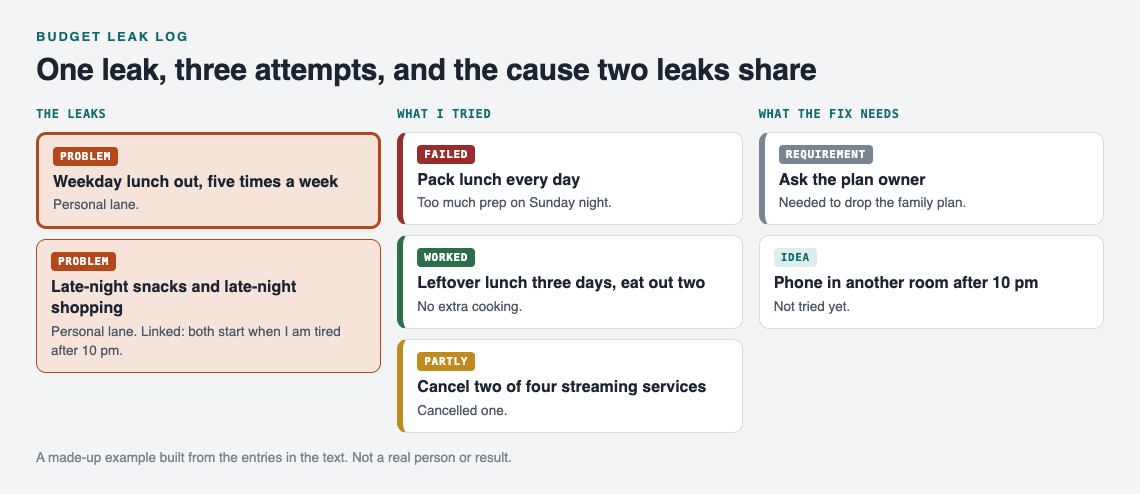
One leak, its attempts and their outcomes, and the cause two leaks share.
Problem Graph is built for this kind of linking. You write each leak as a one-line problem, attach the solutions you try, and mark each as worked, partly, or failed. You can then link problems that belong together, even across lanes, so a personal leak like "late-night shopping" can sit next to a work one like "stress after deadlines". The idea is that patterns show up on the map that never show up in a list.
Its AI can also propose new solutions based on what worked for others on similar problems. Treat those as ideas to test, not answers. Log them like any other attempt.
Common mistakes when trying to cut spending
- Trying to fix everything at once. Pick one leak, one fix, one month.
- Logging only wins. A log with no failures is not honest, and it is not useful. The failed attempts are what stop you from repeating them.
- Writing vague fixes. "Spend less on food" cannot be checked. "Cook dinner twice more a week" can.
- Skipping the reason. Without "why", you will retry the same plan and fail the same way.
- Never reviewing. A log you do not read is only a diary.
- Treating a failure as a verdict on you. It is a result about the method. Change the method.
If you want to share what you learn, writing it up as a clear list helps others. See how to write a list article that readers can use.
Frequently asked questions
How many leaks should I track at once?
Start with one to three. Each one needs its own attempts and a review, and more than that becomes a chore you drop.
Do I need to record every purchase?
No. A leak log is not a ledger. You record the pattern, what you tried to change it, and how it went.
What counts as "partly" worked?
The fix helped but did not fully solve the leak, or it worked only some of the time. Write down which part held and which part broke.
Can I keep the log private?
Yes. In Problem Graph, private is the default, so only you see your problems. You can later share a main node with a private network or make it public if you want to.
Get started
Pick one leak today and write it as a single line. Add the first thing you will try, then come back and mark it worked, partly, or failed.
Try Problem Graph: it is free, and you can look around the public network without an account. Write one problem down in a line and attach the first thing you will try.
Comments
No comments yet.
Sign in or make an account to comment.