Business Skills for Developers: What to Learn First
The business skills for developers worth learning first are four: finding a problem people will pay to fix, reading the numbers behind your product, knowing how customers find you, and talking to customers before you write more code. You do not need an MBA for any of them. The Business Basics for Builders course covers the problem and the numbers in three short lessons. You sign in to open it, and you will find lessons on problems worth paying for, revenue, costs and unit economics, and growth. The other two skills are taught in later courses, linked below.
Age of AI Entrepreneur is built for readers who can already make things, or want to, and need the business side in short, hands-on lessons with the sources listed. This post is the map. It tells you what to learn and in what order.
Why great builders still struggle with business
Building rewards a clear loop. You write code, run it, and see whether it works. Business gives slower and fuzzier feedback. A customer who does not reply tells you very little. A landing page with no signups could mean a dozen things.
So developers often fall back on what feels productive: one more feature, a cleaner architecture, a better model. The product gets better while the business stays where it was.
The fix is not to become a salesperson. It is to add a few habits that give you the same kind of feedback you already get from code: a number, a conversation, a test.
Skill 1: Find a problem worth solving
A problem worth solving is one where someone already spends money, time or patience to deal with it today. If nobody is working around it, nobody will pay for your fix.
A quick test: can you name a specific person who has this problem, what they do about it now, and what that costs them? If you cannot, you have an idea, not a problem.
Here is a worked example. Say you notice that small accounting firms spend hours renaming and filing scanned receipts. Write it down like this:
- Who: a bookkeeper at a firm with five to ten clients.
- What they do now: open each file, read the vendor and date, rename it by hand.
- What it costs: a few hours every week, plus mistakes at tax time.
That is concrete enough to check with a real person.
The first lesson in Business Basics, Problems Worth Paying For, goes through this idea. The Finding AI Opportunities course then asks the harder follow-up in its lesson Thin Wrapper or Real Product?
Skill 2: Learn to read the numbers behind your product
You do not need a spreadsheet full of metrics. You need to understand three things: revenue, costs, and what is left over per customer. That last one is unit economics.
Developers have an edge here, because AI products have a cost that behaves like a meter. Every request to a model has a cost. Here is a made-up example to show the shape of the math, not a benchmark:
- You charge a customer 20 a month.
- That customer triggers 400 model requests a month at an average cost of 0.02 each, so 8 in model costs.
- Hosting and support add another 3 per customer.
- What is left is 9 per customer per month, before your own time.
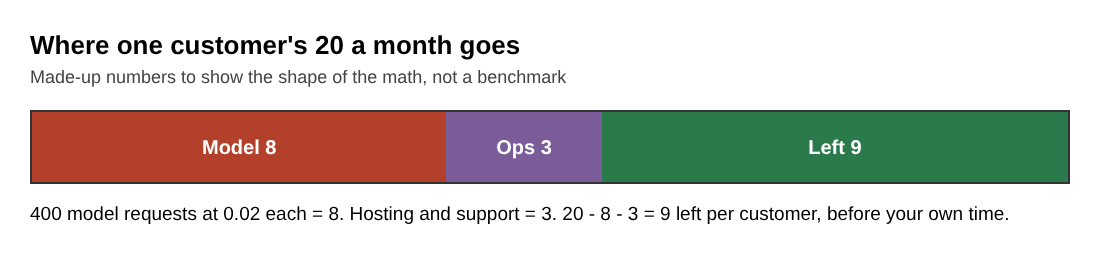
Now you can ask useful questions. What happens if a heavy user sends 2,000 requests? What if you switch to a cheaper model? What if you raise the price? Each question has an answer you can calculate. The Revenue, Costs and Unit Economics lesson works through this kind of reasoning, and the Launch, Price and Get Paid course picks up pricing for AI products later. For a longer walk through the same math, see how to calculate unit economics for an AI product.
The third lesson in Business Basics, Growth: The Number a Startup Lives By, covers the other number worth watching: how fast you are growing. Pick one growth measure, write it down weekly, and look at the trend instead of any single week.
Skill 3: Understand how customers actually find you
"Build it and they will come" fails often enough that it should not be your plan. Distribution means the specific route by which a stranger learns your product exists and decides to try it.
Make it concrete. For the receipt example, ask where bookkeepers already spend time online. Is it a forum, a newsletter, a software marketplace, a community group? Pick one place and test it for a few weeks before you add another.
The Distribution and Moats course has a lesson on getting in front of customers, plus one on what moats survive when AI is cheap. That second question matters for developers. If a competitor can copy your feature in a weekend, your edge has to come from somewhere else, such as a channel you own or data and trust you have built.
The site's blog also has longer reads on distribution channels and on testing demand with a landing page and a waitlist. Both are cheap ways to learn whether anyone cares before you build the full product.
Skill 4: Talk to customers before you write more code
This is the skill developers avoid most, and it pays back fastest. A customer conversation can save you weeks of building the wrong thing.
The trap is asking questions that invite a polite lie. "Would you use a tool that does this?" almost always gets a yes. Ask about the past instead:
- "Tell me about the last time you did this task."
- "What did you try to make it easier?"
- "What did that cost you, in time or money?"
- "What happened the last time it went wrong?"
Past behaviour is harder to fake than future promises. If someone has never tried to fix the problem, that is useful information too.
The lesson Talking to Customers Without Fooling Yourself in the Finding AI Opportunities course covers this in detail. For the next step, the post on getting your first 10 customers for an AI product picks up where the interviews end.
A simple order to learn business skills for developers
If you are starting from zero, this order keeps you from over-investing early:
- Problem first. Write down who has the problem and what it costs them. Do this before any code.
- Five conversations. Talk to five people who fit your description, using past-behaviour questions.
- Back-of-envelope numbers. Estimate price, cost per customer and what is left. If it does not work on paper, change the idea or the price.
- One channel. Choose one place to reach customers and test it.
- Build the smallest version. Only now, build the first thing a customer can try.
- Track one growth number. Check it weekly.
If you want the whole path laid out, see this 12 course path from zero to launch. The three levels there are Basic, Intermediate and Advanced. Business Basics sits in Basic and needs no background.
Common mistakes developers make when they start selling
- Building for weeks before talking to anyone. Even a rough conversation changes what you build.
- Treating compliments as demand. "That's cool" is not a purchase. Look for people who ask when they can use it or what it costs.
- Ignoring cost per request. With AI features, a popular product can lose money on each heavy user if you never did the math.
- Trying five channels at once. You learn nothing if you cannot tell which one worked.
- Underpricing out of fear. A price too low can signal low value and leave no room for support or improvement.
- Confusing a feature with a business. If the whole product is a thin layer over someone else's model, ask what a customer would miss if you disappeared.
Frequently asked questions
What business skills should a developer learn first?
Start with finding a problem people already pay to solve, then learn basic unit economics. After that, work on how customers find you and how to interview them honestly.
Do I need a business degree to start a product?
No. The core skills are a handful of habits: define the customer, check the numbers, test one channel, and listen. Business Basics for Builders is a Basic level course that assumes no background.
How long does it take to learn these skills?
Business Basics has three lessons of about 9 minutes each, so the reading is short. The real learning comes from applying each idea to your own project, such as holding customer conversations and writing out your numbers.
Should I build first or talk to customers first?
Talk first, even if only for a handful of conversations. Then build the smallest version that tests what you learned.
Is the course free to use?
The terms page says every lesson is free to everyone with an account. You sign in with your email and an emailed code.
Get started
Pick one project you have, or one you are thinking about. Write the problem, the person and the cost in three lines. Then sign in and open Business Basics for Builders to work through problems worth paying for, unit economics and growth, with questions and hands-on activities along the way.
Start Age of AI Entrepreneur: short hands-on lessons on how to build a business in the age of AI, with every side of the debate and the sources to read next.
Building a business in the age of AI, from a first project to a company.
Visit aientrepreneur.vlvd.net↗
Comments
No comments yet.
Sign in or make an account to comment.