Learn AI Entrepreneurship: A 12-Course Path From Zero to Launch
If you want to learn AI entrepreneurship, work through three layers in order: how we got here and how AI works, how to build a small product with it, and how to launch, price and grow a business around it. Skipping the first layer is the most common mistake, because it leaves you guessing about what these models can and cannot do.
Age of AI Entrepreneur lays those three layers out as 12 short courses with hands-on activities and sources for every lesson. The home page shows the whole path, and you sign in with your email and an emailed code to open a course.
What it means to learn AI entrepreneurship
It is not the same as learning to code, and it is not the same as learning general business. It sits between the two. You need enough understanding of AI to know what it does well, where it fails, and what a request costs. You also need enough business sense to find a problem people pay to solve, and to price a solution.
That gives you three skills to build:
- Understanding: where modern AI came from and how a language model produces its answers.
- Building: turning an idea into a working project, even a small one.
- Growing: getting customers, charging for the product, and keeping an edge when the underlying models are available to everyone.
The course path follows exactly this split. There are 12 courses with 3 lessons each, 36 lessons in all. Each lesson takes about 9 minutes, so the whole path is roughly 6 hours of lesson time, with 190 questions and 37 hands-on activities along the way.
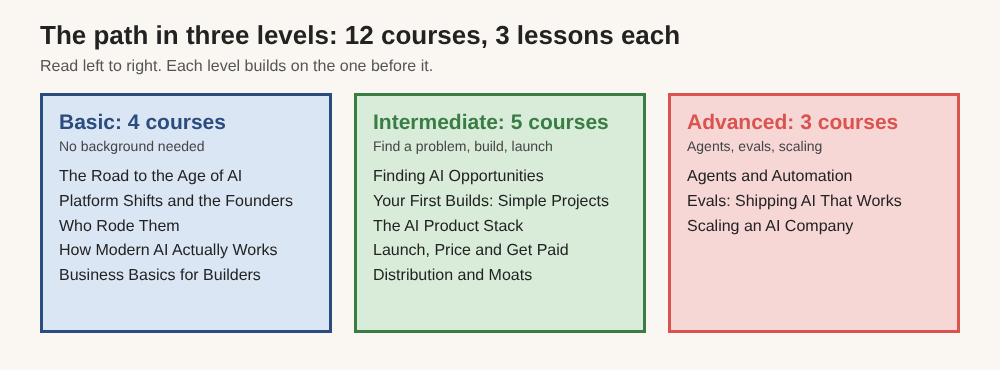
The 12 courses at their three levels.
Who needs a structured path and who can skip ahead
A structured path helps most if you are starting from zero. You may have read headlines about AI and watched a few videos, but you cannot yet say why a model sometimes states false things with confidence, or why a "wrapper" around someone else's model might not be a business.
You can skip ahead if you already have the skills of an earlier level. Here is a quick way to judge:
- If you can explain next-token prediction and work out a simple unit economics example, start at the Intermediate courses.
- If you have already shipped a small AI tool and spoken to real users, look at Launch, Price and Get Paid, then the Advanced courses.
- If you are unsure about either, take the first lesson of a course and see whether it feels like review. Every attempt is graded, and you can retake any lesson later to try for a better grade.
If a term trips you up, the glossary has 276 key terms. Like the courses, it needs a sign-in.
Level 1: Foundations, how AI works and how businesses work
The Basic level has four courses and needs no background. Two cover history, one covers how the technology works, and one covers how a business makes money.
- The Road to the Age of AI goes from Turing and the AI winters, through data, chips and the deep learning breakthrough, to transformers, scale and ChatGPT.
- Platform Shifts and the Founders Who Rode Them asks why AI counts as a platform shift, after looking at software eating the world and the fall in the cost of starting.
- How Modern AI Actually Works covers next-token prediction, how a raw model becomes a helpful assistant, and what AI gets wrong.
- Business Basics for Builders covers problems worth paying for, revenue, costs and unit economics, and growth.
If you want a quick primer on the vocabulary first, the founder's guide to AI vs machine learning vs deep learning sorts out three terms people often mix up.
A good test for this level: take a product idea you have and write one sentence on who pays, what they pay for, and what one customer costs you to serve. If you cannot write that sentence, the Business Basics course is where to go next.
Level 2: Building, from idea to a launched AI product
The Intermediate level has five courses. It is the longest stretch of the path, and it is the one where you make things.
Start with Finding AI Opportunities. Its three lessons cover where good AI ideas come from, how to talk to customers without fooling yourself, and how to tell a thin wrapper from a real product. Do this before you build anything, because a well-made project aimed at nobody is still a wasted project.
Then move to the builds:
- Your First Builds has three simple projects: a landing page and a waitlist, a prompt-powered micro tool, and an automation of one boring workflow.
- The AI Product Stack covers model APIs, tokens and what a request costs, giving models your data through retrieval, and choosing between big, small, open and closed models.
- Launch, Price and Get Paid covers the MVP and the build-measure-learn loop, pricing AI products, and landing your first ten customers.
- Distribution and Moats covers getting in front of customers, which moats survive when AI is cheap, and building on someone else's model.
A worked example: say you want to help local clinics answer routine questions. In the first-builds course you would put up a landing page and a waitlist to see whether anyone cares. You would then build a small prompt-powered tool for one narrow task. In the stack course you would check what a single request costs, so you know whether a price makes sense. The sequence matters. Test demand first, build second, price third.
When you reach the model choice lesson, the post on self-hosted LLM vs API adds a longer look at one of the trade-offs.
Level 3: Growing, agents, quality and a company that scales
The Advanced level has three courses. They suit you once you have something running and want it to hold up.
- Agents and Automation starts with workflows versus agents, then tools, loops and why agents fail, and ends with a project: an agent that does a real job.
- Evals: Shipping AI That Works explains why your product needs evals, how to build an eval set and judge outputs, and how to run AI in production.
- Scaling an AI Company covers the economics of AI companies, tiny teams with huge leverage, and a roadmap from first project to company.
Some of the topics here are contested, and researchers disagree about them. The app includes 17 cards that set out where researchers disagree, and it gives every side rather than pushing one. Each lesson also lists its sources, so you can read the originals yourself.
How to move through 12 courses without burning out
Six hours of lessons sounds small. The risk is not the hours. It is stopping after a week. A few habits help:
- Do one lesson at a time. A lesson takes about 9 minutes, so it fits into a coffee break. Finish it, answer the questions, do the activity, and stop.
- Use review. Questions from lessons you finish come back, spaced out, up to 5 a day. That is a small daily load, and it keeps earlier material from fading.
- Do the building lessons the same day you read them. The three projects in the first-builds course only teach you something if you make them.
- Use the leaderboards if they motivate you. There are weekly, monthly and all-time boards under a name you choose, and your email stays private. Ignore them if they do not.
- Expect a slow stretch. Most people hit one. When it comes, retake an earlier lesson rather than skipping ahead.
How to know you are ready to move up a level
Do not use the calendar. Use checks you can run yourself.
Ready to leave Level 1 when you can explain, in plain words and without notes, how a model predicts the next token, why it can be wrong, and how a business's revenue and costs fit together.
Ready to leave Level 2 when you have talked to real potential customers, built at least one small working project, and can say what a request costs and what you would charge. A written answer to "why would someone choose this over using a chatbot directly?" is a good test.
Ready to finish Level 3 when you can say how you would judge your product's outputs, where an agent might fail, and what keeps your business from being copied.
If a lesson grade is lower than you wanted, retake it. Every attempt is graded, so you can try again and improve.
Frequently asked questions
Do I need a technical background to learn AI entrepreneurship?
No. The Basic level has four courses and needs no background. It covers how we got here, how AI works and how a business makes money.
How long does the whole path take?
There are 36 lessons of about 9 minutes each, which comes to roughly 6 hours of lesson time. Activities, reviews and your own projects will add to that, and how you spread it out is up to you.
Can I jump straight to the advanced courses?
You can try, and every attempt is graded. But the Advanced courses on agents, evals and scaling assume you have built something, so most readers do better after the Intermediate level.
Is it free?
The terms page says every lesson is free to everyone with an account. You sign in with your email and an emailed code, and you need to be 13 or older.
Will this get me a business?
No course can promise that. The path teaches you to understand, build and launch, but the outcome depends on your idea, your customers and your effort.
Get started
Open Age of AI Entrepreneur to see the full 12-course path, then sign in with your email and an emailed code to start with the first Basic course. If you prefer to read first, the blog has longer pieces on starting and growing a business with AI.
Building a business in the age of AI, from a first project to a company.
Visit aientrepreneur.vlvd.net↗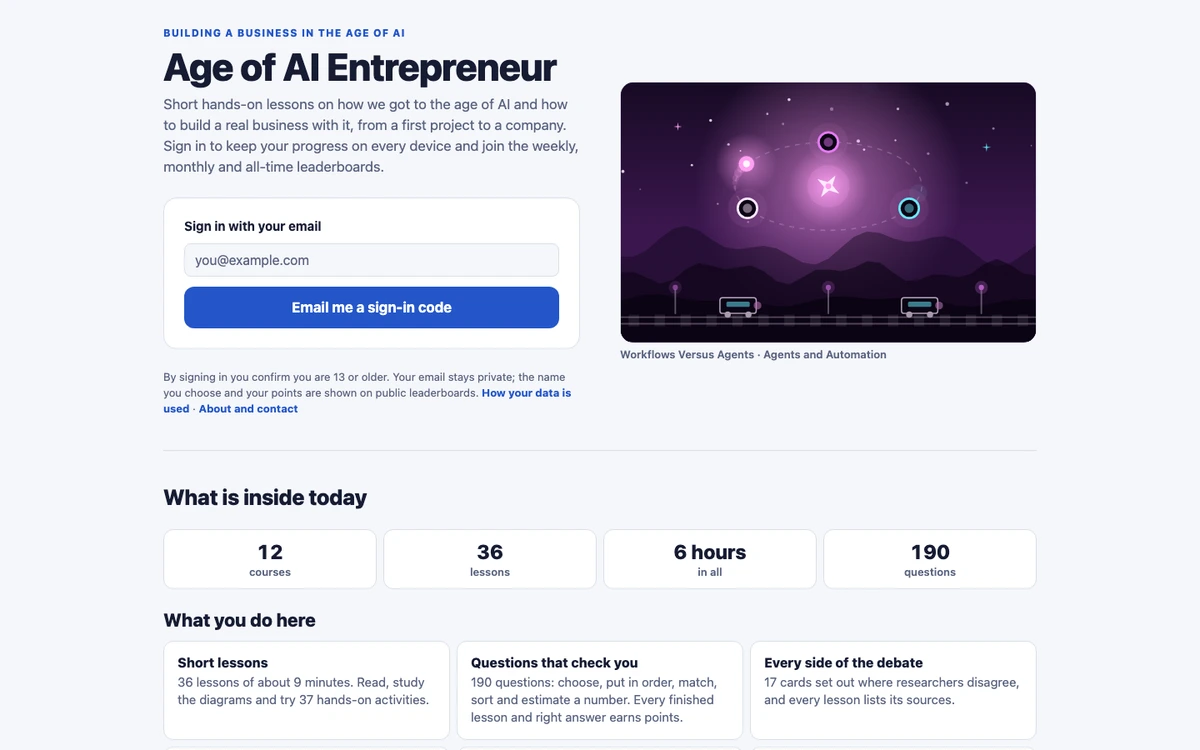
Comments
No comments yet.
Sign in or make an account to comment.