CAC Payback Period: Formula, Worked Example and Fixes
Your CAC payback period is the number of months it takes a new customer to earn back what you spent to win them. You divide customer acquisition cost by the monthly gross profit that customer brings in. If you have not worked out CAC yet, start with our post on how to calculate customer acquisition cost for a startup. It walks through what to include in the number, how to read CAC against lifetime value, and how to lower it over time. This post picks up where that one stops and turns CAC into a time measure.
If you want to learn the business side of building with AI in short hands-on lessons, Age of AI Entrepreneur covers unit economics, pricing and launch alongside how modern AI works.
What the CAC payback period tells you
CAC alone tells you a price. It does not tell you whether that price is affordable. Spending $300 to win a customer is fine if they repay it in three months. It is dangerous if they repay it in three years and you only have six months of cash.
Payback period turns the question into time. It answers: how long is my money tied up in each new customer before it starts to come back? That matters most when you are small, because every dollar you spend on acquisition is a dollar you cannot spend on anything else until it returns.
It also forces you to look at the customer's side of the ledger. A low CAC with tiny monthly profit can be worse than a high CAC with strong monthly profit.
The CAC payback period formula, step by step
The formula is short:
CAC payback (months) = CAC / (monthly revenue per customer x gross margin)
Here is how to get each input.
- Find CAC. Add up what you spent on sales and marketing in a period, then divide by the new customers you won in that same period. Include ad spend, tools, and the time you or your team spent selling, if you can estimate it.
- Find monthly revenue per customer. Use what a typical new customer pays each month. For annual plans, divide the yearly price by 12.
- Find gross margin. Take revenue, subtract the direct cost of serving the customer, and divide the result by revenue. Express it as a percentage.
- Multiply revenue by margin. That gives monthly gross profit per customer.
- Divide CAC by that gross profit. The answer is months to payback.
Keep the periods matched. If CAC covers March spend, count the customers who arrived because of March spend, even if some signed in April.
A worked example with real numbers
Say you run a small AI tool that summarizes sales calls. Last month you spent $6,000 on ads, a newsletter sponsorship and a scheduling tool. You won 20 new customers.
- CAC = $6,000 / 20 = $300
- Price = $50 a month
- Direct cost per customer (model API calls, hosting, transcription) = $15 a month
- Gross profit = $50 - $15 = $35, so gross margin is 70%
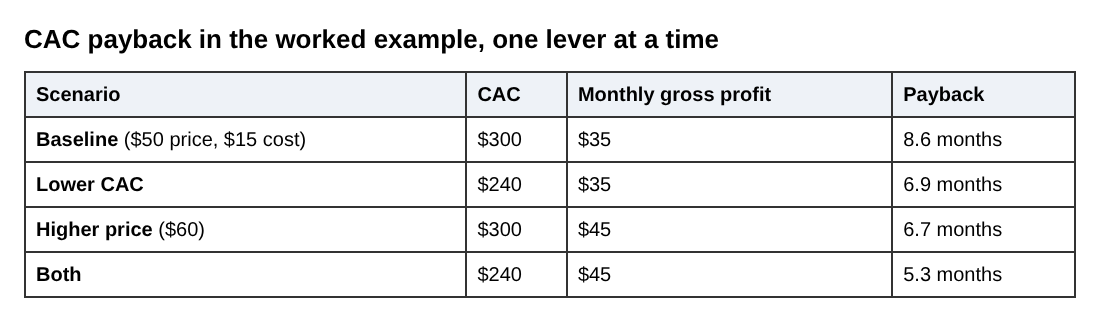
Payback = $300 / $35 = about 8.6 months.
Now see what happens if you skip margin and divide by revenue: $300 / $50 = 6 months. That looks better, but it is wrong. You do not get to keep the $15 that went to your model provider. The honest number is 8.6 months, and the gap between 6 and 8.6 is where cash problems hide.
Why gross margin matters more than revenue
Revenue is what customers pay. Gross profit is what is left to pay back your acquisition spend. Using revenue flatters the result every time.
This is especially true for AI products. Every request to a model has a cost, and that cost scales with use. A heavy user on a flat monthly plan can have a much thinner margin than a light user. If your average margin is 70% but your most active customers sit at 30%, your real payback for those customers is far longer than your average suggests.
To estimate your direct cost per customer, you need to know what a request costs. The lesson Model APIs, Tokens and What a Request Costs in the AI Product Stack course covers that. You sign in first to open a course. For the wider picture of revenue, costs and unit economics, see the Business Basics for Builders course.
What counts as a good payback period for a startup
There is no single right number, and a borrowed benchmark can mislead you. Set your own target from three things:
- Your cash. If you are self-funded with a few months of runway, you need payback measured in weeks or a few months. If you have outside capital and a long runway, you can wait longer.
- Your churn. Payback only matters if customers stay long enough to reach it. If the typical customer cancels in month 5, an 8.6 month payback means you lose money on most of them.
- Your contract type. Monthly plans give you cash slowly. Annual prepaid plans can bring payback forward sharply.
A useful check is simple. Compare your payback to how long customers actually stay. If payback is longer than the typical customer lifetime, the channel loses money no matter how good it looks on a dashboard.
Payback period vs LTV: which metric to trust early
Lifetime value, or LTV, estimates the total gross profit a customer brings over their whole time with you. It is useful, but early on it rests on guesses. You may have three months of data and be forecasting three years.
Payback period asks a smaller question and needs less guessing. You only need to know what customers pay now, what they cost to serve now, and what you spent to win them. That makes it the more trustworthy early metric.
Use both once you can, but in this order:
- Check payback first. Can you afford to wait that long?
- Check retention next. Do customers stay past the payback point?
- Look at LTV against CAC last, when you have enough history to trust it.
Before any of this, make sure the problem you solve is one people will pay for repeatedly. Our post on painkiller vs vitamin startups is a good way to test that. A problem people feel strongly is more likely to keep a customer paying, and that protects your payback.
Practical ways to shorten your payback period
There are only a few levers. Each one changes either the top or the bottom of the formula.
Lower CAC
- Stop spending on channels that bring in customers who churn fast. Track CAC by channel, not just in total.
- Lean on channels where you reach buyers directly, such as communities, partnerships and referrals.
- Tighten who you target. Fewer, better-fit leads usually cost less per paying customer.
Using our example, cutting CAC from $300 to $240 moves payback from 8.6 to about 6.9 months.
Raise gross profit per customer
- Raise your price. At $60 with the same $15 cost, gross profit is $45 and payback drops to about 6.7 months.
- Cut serving costs, for example by using a smaller model for simple requests.
- Add usage limits or tiers so heavy users pay in proportion to what they cost.
Do both together, $240 CAC and $45 gross profit, and payback is about 5.3 months. For pricing ideas, see the lesson Pricing AI Products in the Launch, Price and Get Paid course.
Collect cash sooner
- Offer an annual plan with a discount. If a customer prepays $500 for the year at 70% margin, you hold $350 of gross profit on day one. That already covers a $300 CAC.
- Get customers to their first useful result fast, so that the first month of gross profit is not wasted on people who never saw the value.
Keep customers past the payback point
Shortening payback on paper does nothing if customers leave before it arrives. Watch churn in the first three months closely. That is where most of your payback is won or lost.
Frequently asked questions
Is a shorter CAC payback period always better?
Usually, but not always. A very short payback can mean you are under-investing in growth and could safely spend more on acquisition. If you recover cash fast and retention is strong, test raising spend until payback starts to stretch.
How is CAC payback period different from CAC?
CAC is a cost: what you spend to win one customer. Payback period is a time: how many months of that customer's gross profit it takes to recover that cost.
Should I use monthly or annual payback for an AI product?
Use months, because model costs and usage change quickly and a yearly view hides problems. If you sell annual plans, calculate a second figure based on cash collected upfront.
Can I measure payback with only a few customers?
Yes, but treat the result as a rough range, not a fixed number. Use your real CAC, price and serving cost, and recalculate each month as you get more customers.
Get started
Pick one channel and work out its payback this week. Write down spend, new customers, price and direct cost, then run the formula. If you need a refresher on the CAC input, read how to calculate customer acquisition cost for a startup first.
To go deeper on unit economics, pricing and launch, Age of AI Entrepreneur offers short hands-on lessons you can work through at your own pace. You sign in with your email and an emailed code, and you need to be signed in to open a course.
Building a business in the age of AI, from a first project to a company.
Visit aientrepreneur.vlvd.net↗

Comments
No comments yet.