Painkiller vs Vitamin Startup: Which Problem Are You Solving?
A painkiller vs vitamin startup comparison comes down to one question: does your customer feel the problem today and want it gone, or is your product a nice extra they can skip? A painkiller solves a problem that hurts now. A vitamin improves something that already works well enough. For a first product, painkillers are usually the safer bet, and this post gives you a way to tell which one you have. If you want the wider test for whether a problem deserves a company at all, this post on how to tell if a problem is worth building a startup around shows how to check that a problem is painful, frequent and valuable enough before you commit. It helps founders who have an idea and no proof yet.
Age of AI Entrepreneur teaches how to build, launch and grow a business with AI through short hands-on lessons, and its Business Basics course starts with a lesson called Problems Worth Paying For. Sign in to open the course.
What the painkiller vs vitamin startup idea really means
The metaphor is simple. When you have a headache, you buy a painkiller without much thought. You know the problem, you want it gone, and you will pay to fix it today. A vitamin is different. You believe it is probably good for you, but nothing breaks if you skip it this week.
Applied to startups, the pain is not about how clever your product is. It is about how the customer feels without it. Take two hypothetical AI ideas:
- Idea A: an AI journaling coach that offers weekly reflections on your mood.
- Idea B: an AI tool that drafts appeal letters when a small clinic has an insurance claim denied.
Both use the same kind of model. But the clinic in Idea B has money stuck, a deadline and staff time going into a tedious task. The person in Idea A might enjoy the product, then forget about it in a month. Idea B is closer to a painkiller. Idea A is closer to a vitamin.
Neither label says an idea is good or bad. It tells you how hard the selling will be.
Why painkillers usually win early customers
Early on, you have no brand, no reviews and no budget for ads. You need people who will try something rough. Pain is what makes people do that.
- They search for you. A person in pain is already looking for a fix. You are not creating demand, only meeting it.
- They put up with a rough product. If the alternative is losing a day of work, a clumsy first version is fine.
- They decide faster. The cost of the problem is easy to compare to the cost of your product.
With a vitamin, every one of those gets harder. You have to convince people they have a problem, then convince them yours is the answer, then keep them using it.
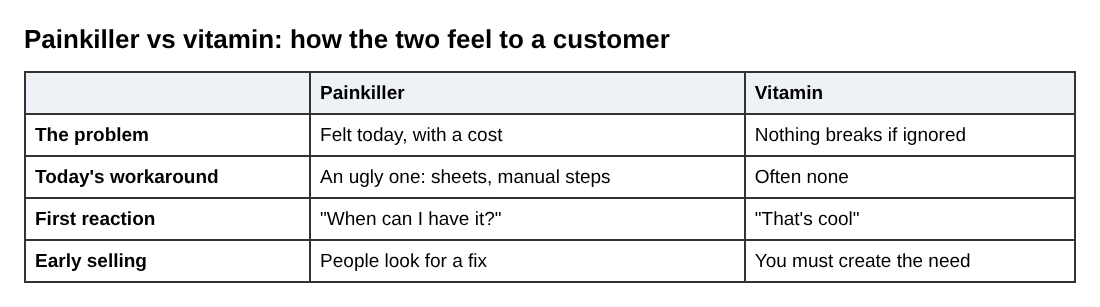
Signs your idea is a vitamin in disguise
Most vitamin ideas do not feel like vitamins to the founder. They feel exciting. Watch for these signs:
- When you describe it, people say "that's cool" or "I would probably use that." They do not say "when can I have it?"
- Your best pitch starts with "imagine if" rather than "you know how you hate when."
- Nobody currently does anything to solve the problem, not even a messy spreadsheet or a long email thread.
- You cannot name a moment in the customer's week when the problem bites.
- The product is a thin layer over a general model, and a user could get a similar result by typing a prompt themselves. The Finding AI Opportunities course has a lesson on exactly this, called Thin Wrapper or Real Product?
One sign alone is not a verdict. Several together are a warning.
Five quick tests to tell a painkiller from a vitamin
You can run these in a week of conversations, before you build anything serious. Talk to people who actually have the problem, not friends who will be polite.
- The workaround test. Ask what they do about the problem today. A real painkiller problem usually has an ugly workaround: a spreadsheet, a part-time hire, a pile of manual steps. No workaround often means no pain.
- The last-time test. Ask when it last happened and what they did. A specific recent story beats a general opinion every time.
- The cost test. Ask what it cost them in hours, money or stress. If they struggle to name a cost, the problem may be small.
- The do-nothing test. Ask what happens if they ignore it for three months. If the answer is "nothing much," you are looking at a vitamin.
- The commitment test. Ask for a small real step: joining a waitlist, booking a follow-up call, sharing a sample document. Words are cheap. Actions show pain.
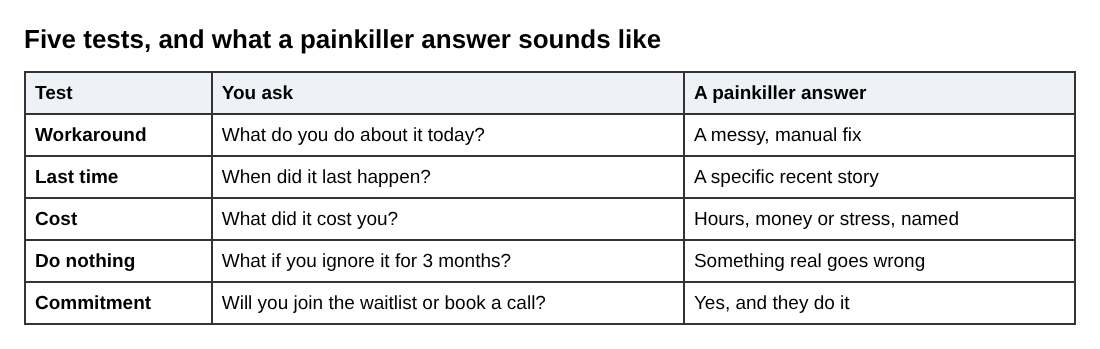
Here is a short script you can adapt for those conversations:
"Tell me about the last time a claim got denied. What did you do first? Who handled it? How long did it take? What did you try before that worked? If you could change one thing about it, what would it be?"
Notice that none of those questions mention your product. That is on purpose. If you pitch first, people tend to be kind rather than honest. The lesson Talking to Customers Without Fooling Yourself, in the Finding AI Opportunities course, is about this exact trap. You can open the Finding AI Opportunities course after you sign in.
Can a vitamin ever become a good startup?
Yes, but it is a harder route. Some products start as nice-to-have and become habits that people would miss. Others work because the market is large and even a small share is worth having. These paths tend to need more patience, more distribution effort and often more money before the business is steady.
If you still want to build a vitamin, be honest about it. Plan for slower sales and a longer path to proof, and decide in advance how many weeks you will give it before you change course.
How to turn a vitamin idea into a painkiller
Sometimes the idea is fine and you are aiming at the wrong person or moment. Try these moves:
- Narrow the customer. "Anyone who journals" is a vitamin crowd. "Therapists who write session notes after hours" might have real pain. The same underlying skill can hurt more for a specific group.
- Attach it to a deadline or a cost. Pain is stronger when something is due, when money is at stake or when someone else is waiting.
- Replace a step instead of adding a feature. A tool that removes a hated task feels like relief. A tool that adds a dashboard feels like homework.
- Check the economics. If the customer saves real money or time, you can charge in proportion to it. The Pricing AI Products lesson in the Launch, Price and Get Paid course is where that connects to what you charge. Sign in to open it.
Rerun the five tests after each change. If the answers get sharper, you are heading the right way.
What to do after you find a real painkiller
Finding pain is the start, not the finish. Next, prove people will act on it with the smallest thing you can build. A landing page that states the problem plainly, with a waitlist behind it, can show whether strangers care. The First Builds course has a first project on exactly this, called A Landing Page and a Waitlist.
Then check the money side. A painkiller with weak margins can still be a hard business, so it helps to understand gross margin versus net margin before you set a price. And share what you learn as you go. Building in public is one way to find the people who feel the pain without paying for ads.
Frequently asked questions
What is the difference between a painkiller and a vitamin startup?
A painkiller solves a problem customers feel now and actively want fixed. A vitamin offers a benefit they would like to have but can easily live without.
Is a painkiller always a better idea than a vitamin?
Not always, but it is usually easier to sell early, because people in pain look for solutions and decide quickly. Vitamin products can work, though they tend to need more time and persuasion.
How do I know if customers feel real pain?
Look for a recent story, an existing workaround, a cost they can name and a willingness to take a small real step such as joining a waitlist. Compliments alone do not count.
Can an AI product be a painkiller if it uses the same model as everyone else?
Yes. The pain comes from the customer's problem, not from the model. A narrow tool aimed at a costly, specific task can be a painkiller even if the technology underneath is common.
Get started
Before you build, pick one idea and run the five tests this week. For a wider check on whether the problem deserves a company, read how to tell if a problem is worth building a startup around. If you want structured practice, Age of AI Entrepreneur offers short hands-on lessons, including Business Basics for Builders, which starts with Problems Worth Paying For. You sign in with your email and an emailed code, and every lesson is free to anyone with an account, as set out on the terms page.
Building a business in the age of AI, from a first project to a company.
Visit aientrepreneur.vlvd.net↗
Comments
No comments yet.
Sign in or make an account to comment.